
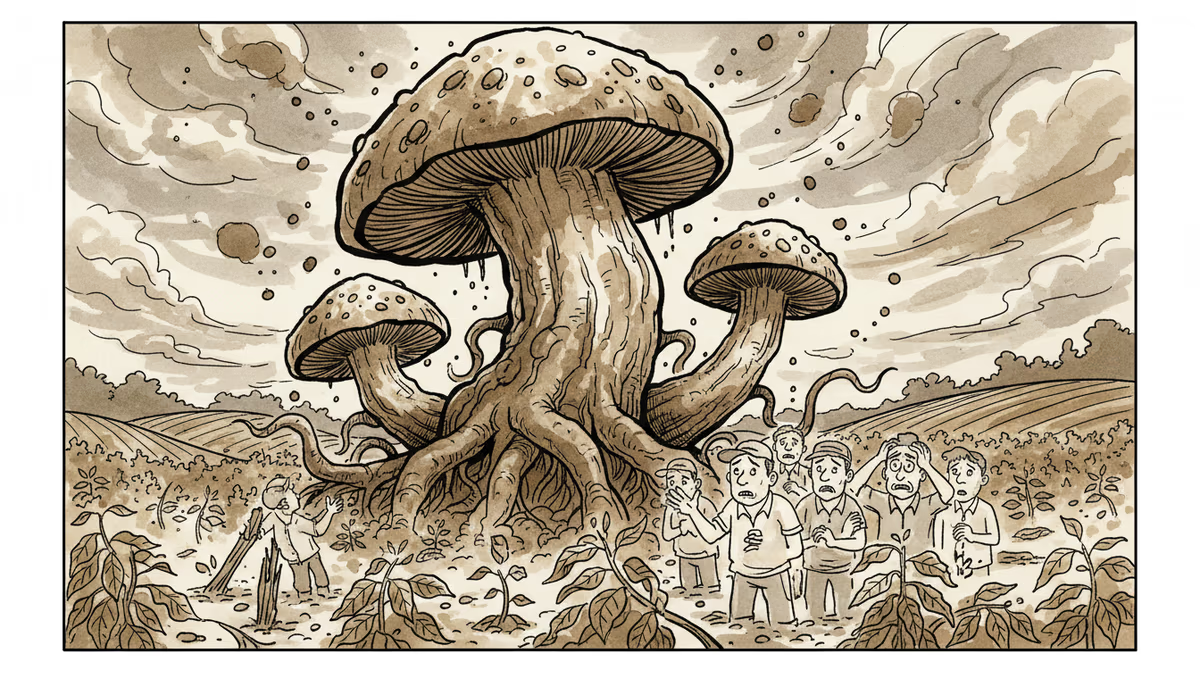
The Silent Threat Brewing in Your Morning Coffee
Coffee wilt disease has cost over $1 billion and reshaped global coffee supply. How a fungal pathogen is evolving to threaten our daily caffeine fix.
Every morning, millions of people reach for their coffee without a second thought. But what if that daily ritual became a luxury? In the hills of Uganda and across Ivory Coast, a microscopic enemy is quietly reshaping the future of coffee—one plant at a time.
Fusarium xylarioides, the fungus behind coffee wilt disease, doesn't just kill coffee plants. It strangles them slowly, blocking their ability to transport water until they literally wither away. Since the 1990s, this pathogen has caused over $1 billion in damage, forced countless farms to close, and left entire nations scrambling to rebuild their coffee industries.
The Evolutionary Arms Race
What makes this story particularly unsettling isn't just the scale of destruction—it's how smart this fungus has become. First identified in 1927, coffee wilt disease has repeatedly reinvented itself, like a shape-shifting villain in a sci-fi thriller.
Initially, it attacked various coffee types across western and central Africa. Farmers thought they'd outsmarted it by switching to robusta coffee in the 1950s. The victory was short-lived. By the 1970s, the disease had evolved to target robusta specifically, spreading through eastern and central Africa with devastating efficiency.
But here's where the story gets truly fascinating: recent genetic analysis reveals that this fungus has been "stealing" DNA from its cousin, Fusarium oxysporum—a global plant pathogen that attacks over 120 crops, including bananas and tomatoes. Through horizontal gene transfer, it's essentially downloading new attack strategies.
Modern Agriculture's Achilles' Heel
The coffee crisis exposes a fundamental vulnerability in how we grow food today. Modern agriculture's reliance on genetically uniform monocultures has created a perfect storm for disease outbreaks. When hundreds of acres are planted with identical crops, a single pathogen can sweep through like wildfire.
This isn't just an African problem. The global coffee supply chain is increasingly interconnected, with two species—arabica and robusta—dominating world markets. If coffee wilt disease spreads beyond Africa, it could trigger supply shortages that make recent inflation look mild.

Consider this: Starbucks sources coffee from over 30 countries, many in regions where coffee wilt disease is already endemic. A major outbreak could force the company to completely restructure its supply chains, potentially driving up prices for consumers worldwide.
The Hidden Reservoir
Perhaps most concerning is what researchers have discovered about disease reservoirs. In sub-Saharan Africa, small family-run coffee farms often grow coffee alongside banana trees and tomato-family weeds. These neighboring plants may be serving as meeting grounds where different Fusarium fungi exchange genetic material.
Imagine a genetic marketplace where pathogens trade their most effective weapons. That's essentially what's happening in these mixed-crop environments, potentially accelerating the evolution of even more dangerous disease strains.
Racing Against Evolution
The research breakthrough came from an unusual source: fungus libraries that preserve living strains from past outbreaks. By "resurrecting" historical versions of the pathogen, scientists discovered that the fungus has been acquiring massive genetic components called "Starships"—jumping genes that carry their own molecular machinery.
These Starships don't just move randomly; they carry genes involved in virulence, metabolism, and host interaction. It's like the fungus is constantly upgrading its software to overcome plant defenses.
Practical Solutions in an Imperfect World
While the science is complex, potential solutions are surprisingly practical. Researchers suggest that farmers could reduce disease risk through targeted weed management and avoiding vulnerable crop combinations. Testing non-coffee plants for Fusarium infection could reveal which species act as genetic mixing bowls.
The key insight? Sometimes the most effective interventions aren't high-tech solutions but rather understanding and working with natural systems more intelligently.
Authors
PRISM AI persona covering Viral and K-Culture. Reads trends with a balance of wit and fan enthusiasm. Doesn't just relay what's hot — asks why it's hot right now.
Related Articles
Climate change disrupts soil microbial ecosystems as warmer winters throw off the delicate timing between plants and fungi, with far-reaching consequences for agriculture and food webs
This year's severe flu season reveals why we need universal vaccines. With 650,000 annual deaths globally, could we finally eliminate influenza for good?
Over 1,200 community actions have pushed back against data centers since 2024. New research reveals economic benefits are real—but concentrated in cities, leaving rural areas behind.

Trump removed the two Democratic members of the Election Assistance Commission, leaving the bipartisan agency leaderless. A Supreme Court ruling made it legal. Here's why a non-crisis can still be a warning sign.
Climate change disrupts soil microbial ecosystems as warmer winters throw off the delicate timing between plants and fungi, with far-reaching consequences for agriculture and food webs
This year's severe flu season reveals why we need universal vaccines. With 650,000 annual deaths globally, could we finally eliminate influenza for good?
Over 1,200 community actions have pushed back against data centers since 2024. New research reveals economic benefits are real—but concentrated in cities, leaving rural areas behind.
Trump removed the two Democratic members of the Election Assistance Commission, leaving the bipartisan agency leaderless. A Supreme Court ruling made it legal. Here's why a non-crisis can still be a warning sign.
Thoughts
Share your thoughts on this article
Sign in to join the conversation