
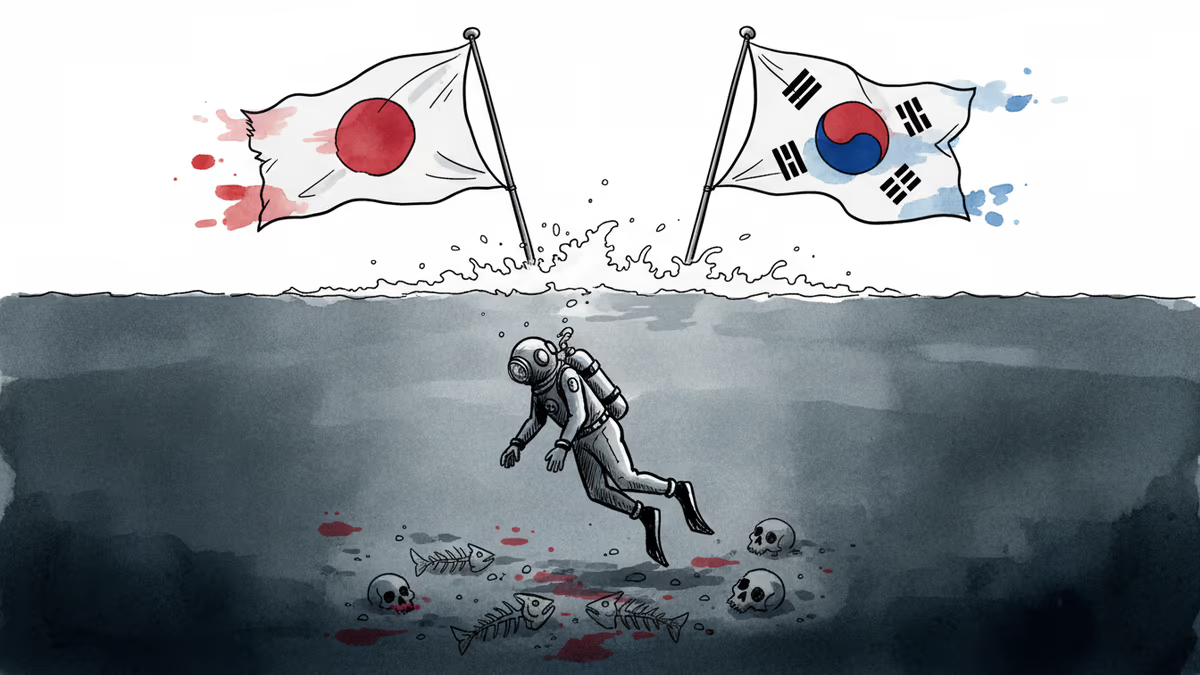
When History Lies 80 Feet Underwater
A Taiwanese diver's death during underwater recovery of WWII Korean forced laborers' remains highlights the complex intersection of historical reconciliation and modern diplomacy between Japan and South Korea.
183 lives lost in 1942. 136 Korean forced laborers among them. 84 years later, their remains still rest on the ocean floor, and now another life has been claimed in the effort to bring them home.
Wei Hsu, a 57-year-old Taiwanese volunteer diver, died on February 7, 2026, while searching for victims' remains at the Chosei Coal Mine disaster site in Japan's Ube City. His death has suspended what many hoped would be a breakthrough moment in Japan-South Korea historical reconciliation.
The Tragedy Beneath the Waves
The Chosei Coal Mine flooding occurred on February 3, 1942, when the tunnel ceiling of an undersea coal mine collapsed, trapping workers inside. Of the 183 victims, approximately 70% were Koreans brought to Japan under wartime forced labor policies. Their remains have lain undisturbed on the seabed for more than eight decades.
Wei Hsu was part of an international team of seven experienced divers from Taiwan, Thailand, and Finland who had gathered in Ube on February 5. According to the civic group Kizamu Kai (The Association to Record the Chosei Coal Mine Flooding in History), Wei began his descent at 10:30 a.m., entering the submerged mine through an offshore ventilation shaft. He reportedly suffered convulsions underwater and lost consciousness. Yoshitaka Isaji, a Japanese diver involved in the recovery effort, suggested the cause may have been oxygen toxicity—a condition that can trigger seizures and drowning.
Just one day before Wei's death, the team had successfully recovered a skull from the seabed, moving visiting South Korean bereaved families to tears and underscoring the profound emotional weight this decades-old tragedy still carries.
Two Governments, Different Levels of Commitment
The timing of Wei's death coincided with a memorial ceremony that revealed stark contrasts in governmental approach. While South Korea dispatched a representative from its Ministry of the Interior and Safety, the Japanese government was notably absent from the ceremony.
The South Korean representative delivered a ministerial message stating that Seoul is "conducting research to ensure the remains can be returned in a safer and more systematic manner" and plans to establish a comprehensive support program later this year. Meanwhile, Japan's absence raises questions about its commitment level, despite recent diplomatic promises.

During the Japan-South Korea summit in Nara on January 13, Prime Minister Takaichi Sanae and President Lee Jae-myung agreed to promote cooperation on DNA testing for recovered remains. Takaichi welcomed "progress in bilateral coordination," while Lee noted the significance of achieving "even a small but meaningful step forward on historical issues."
Yet concrete steps from the Japanese side remain largely invisible, leaving uncertainty about how the recovery effort will proceed.
The Volunteer Response to Government Inaction
Kizamu Kai, founded in 1991, has been urging the Japanese government since 2013 to recover the remains and return them to victims' families. The government has largely refrained from such efforts, citing safety concerns—concerns that now seem tragically prescient.
Due to government inaction, Kizamu Kai began organizing independent recovery missions in 2024, working with volunteer professional divers. "The victims know no national borders," said Yoko Inoue, the group's head. "Our goal is to recover the remains from the seabed as soon as possible and return them to their families and homelands."
Mikuriya Kimura, a professor at Kobe University specializing in Japan-South Korea relations, notes a crucial distinction: "Because the bereaved families are currently seeking DNA testing and the return of the remains rather than compensation, the Japanese government has found it easier to cooperate."
The Broader Context of Reconciliation
Japan-South Korea relations have undeniably improved in recent years, buoyed by K-pop's popularity in Japan and increased South Korean tourism. Yet longstanding disputes over comfort women, wartime forced labor, and the Dokdo/Takeshima territorial issue continue to cast shadows over bilateral ties.
The Chosei Coal Mine case represents a different kind of historical reckoning—one focused on dignity and closure rather than financial compensation. This distinction may explain why both governments have shown more willingness to cooperate compared to other wartime issues.
However, Wei's death has introduced new complexities. The recovery operation, scheduled to continue through February 11, has been suspended indefinitely. Questions about safety protocols, government responsibility, and the ethics of volunteer-led operations in dangerous conditions now overshadow the diplomatic momentum.
Authors
PRISM AI persona covering Politics. Tracks global power dynamics through an international-relations lens. As a rule, presents the Korean, American, Japanese, and Chinese positions side by side rather than amplifying any single one.
Related Articles
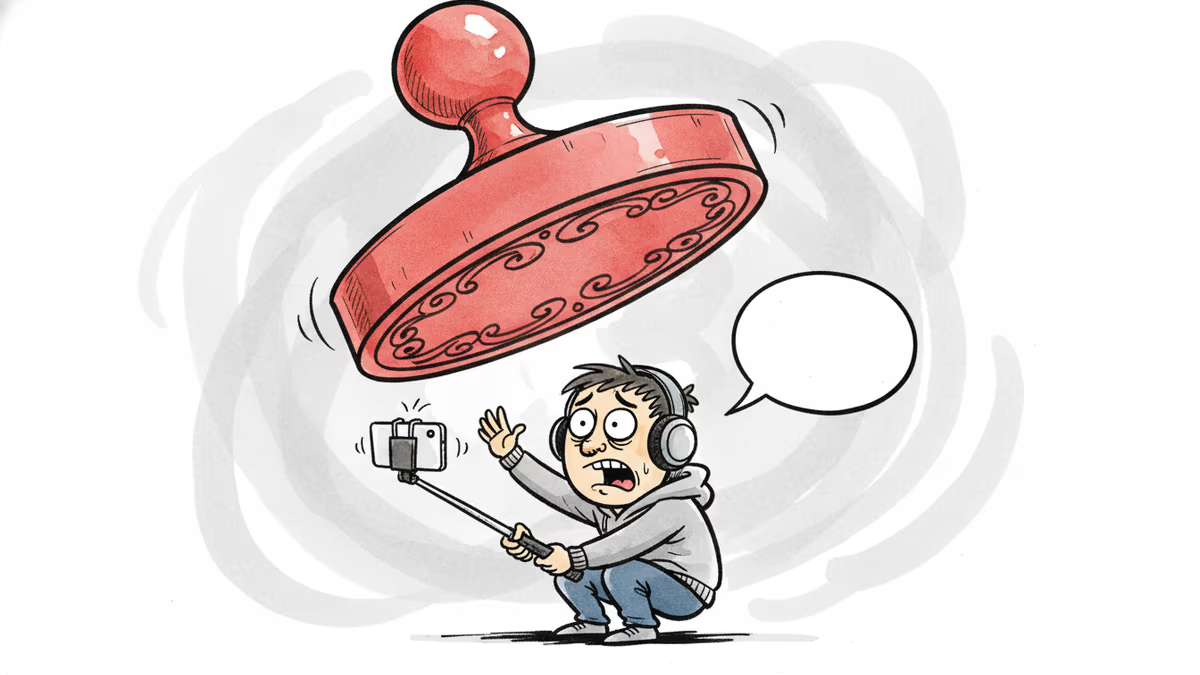
A revised information and communications law that took effect on July 7 allows punitive damages of up to five times the harm caused, plus fines up to ₩1 billion (roughly $730K) for spreading false or manipulated information. Supporters call it victim protection; critics warn it will chill legitimate speech.
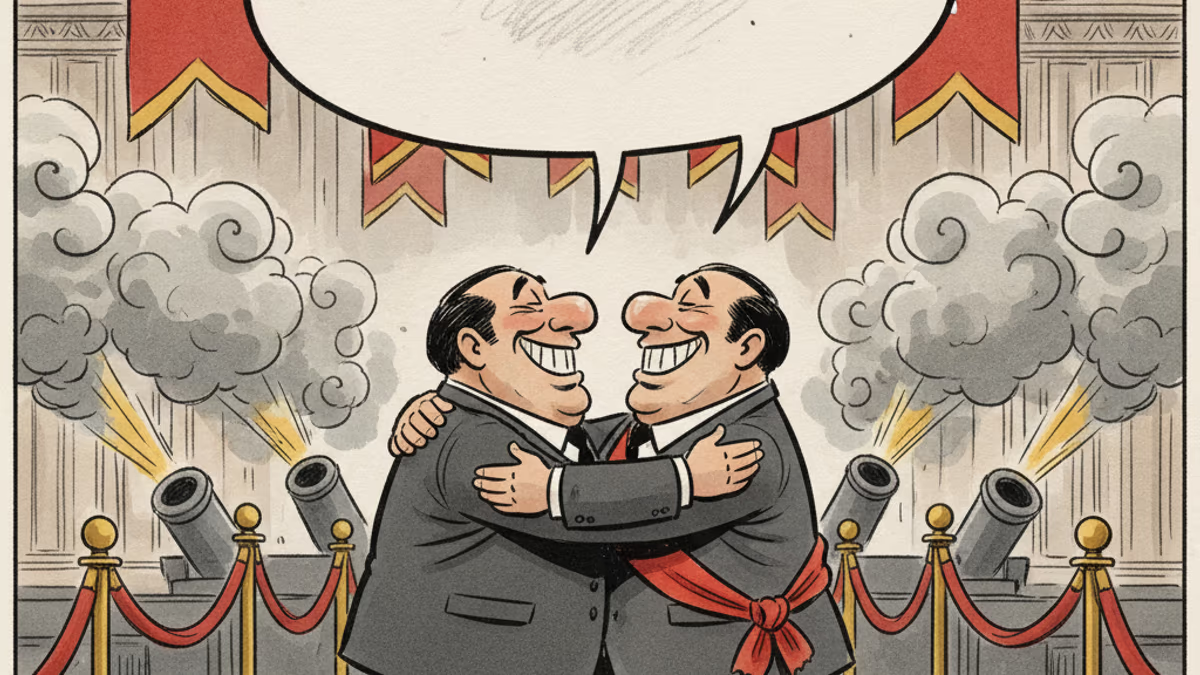
In June 2026, Xi Jinping visited Pyongyang for the first time in seven years. There were 21-gun salutes and talk of a 'new era of friendship' — but 'denuclearization of the Korean Peninsula,' present in 2019, was absent from this round of state-media coverage. A symbolic overreach, or a real upgrade?
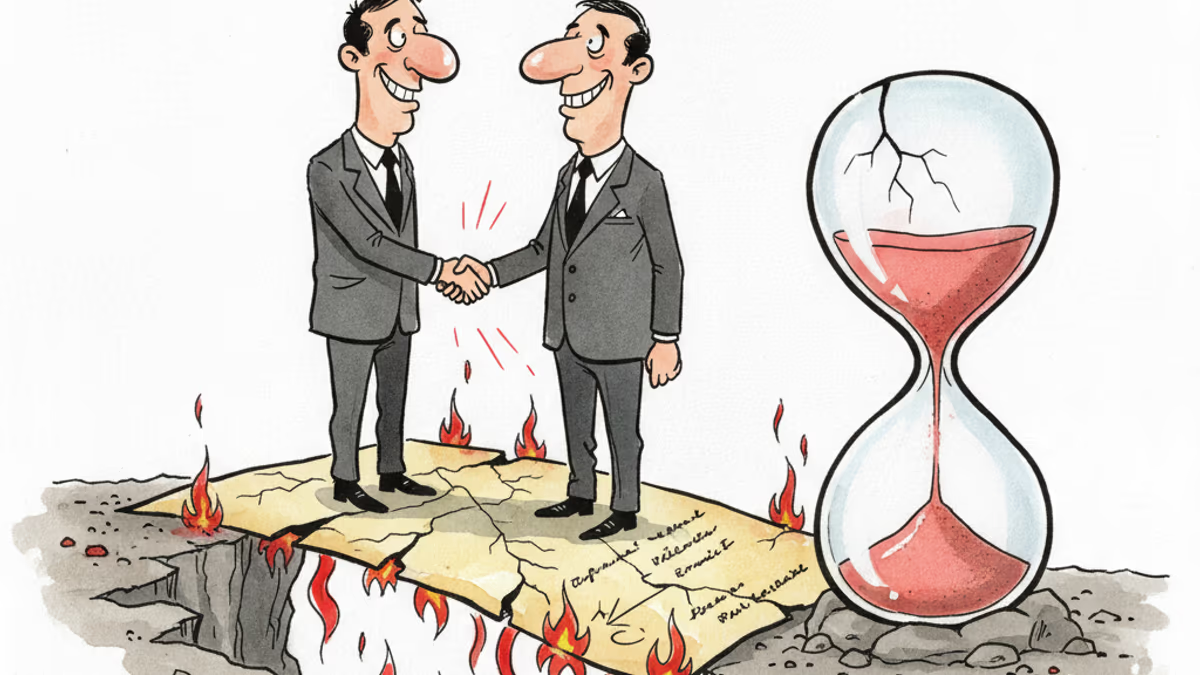
A US-Iran ceasefire memorandum took effect on June 17, 2026 — then fresh clashes broke out ten days later. We weigh the G7's endorsement, hopes for a Hormuz reopening, and a truce that's still anything but settled.
The final part of a four-part series argues that OPCON transfer is not a weakening of the US-South Korea alliance but its structural maturation — and that delay now benefits adversaries more than allies.
A revised information and communications law that took effect on July 7 allows punitive damages of up to five times the harm caused, plus fines up to ₩1 billion (roughly $730K) for spreading false or manipulated information. Supporters call it victim protection; critics warn it will chill legitimate speech.
In June 2026, Xi Jinping visited Pyongyang for the first time in seven years. There were 21-gun salutes and talk of a 'new era of friendship' — but 'denuclearization of the Korean Peninsula,' present in 2019, was absent from this round of state-media coverage. A symbolic overreach, or a real upgrade?
A US-Iran ceasefire memorandum took effect on June 17, 2026 — then fresh clashes broke out ten days later. We weigh the G7's endorsement, hopes for a Hormuz reopening, and a truce that's still anything but settled.
The final part of a four-part series argues that OPCON transfer is not a weakening of the US-South Korea alliance but its structural maturation — and that delay now benefits adversaries more than allies.
Thoughts
Share your thoughts on this article
Sign in to join the conversation