
The Fed Holds Steady While Political Pressure Mounts
Federal Reserve maintains rates at 3.5%-3.75% amid political tensions, while markets hit new highs and global economic shifts reshape investment landscapes.
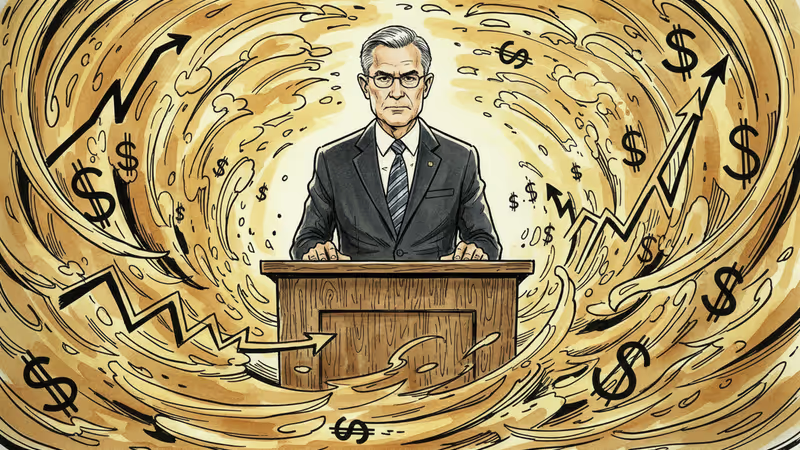
The Federal Reserve held interest rates steady at 3.5%-3.75% Wednesday, but the real drama wasn't in the decision itself—it was in what Chair Jerome Powell said about protecting the central bank's independence from political interference.
As expected, the Fed maintained its current policy stance, though the decision wasn't unanimous. Governors Stephen Miran and Christopher Waller voted for a quarter-point cut, highlighting internal debate about the pace of monetary easing. Powell emphasized that the U.S. economy appears stronger than it did last year, justifying the cautious approach.
Political Pressure Reaches New Heights
The most striking moment came when Powell addressed his attendance at a legal case involving Fed Governor Lisa Cook—a case that could determine whether President Trump can fire Fed officials. Powell called it "perhaps the most important legal case in the Fed's 113-year history," underscoring the unprecedented nature of current political pressures on the institution.
His advice to the next Fed chair was blunt: "Don't get pulled into elected politics. Don't do it." These words carry weight beyond typical central banker speak, reflecting growing concerns about political interference in monetary policy decisions.
Meanwhile, the S&P 500 briefly touched the historic 7,000 level for the first time before closing flat, suggesting markets are digesting mixed signals about future policy direction.
Global Economic Realignments
While the Fed navigated domestic political waters, international developments painted a picture of shifting economic alliances. U.K. Prime Minister Keir Starmer's visit to China—the first by a British leader in eight years—signals potential changes in global trade relationships.

The visit appears to be paying early dividends, with China and Britain announcing deeper cooperation in key sectors. This diplomatic thaw comes as businesses worldwide seek stability amid ongoing trade uncertainties.
In corporate earnings, Meta, Microsoft, and Tesla all beat expectations, yet investor reactions were selective. Meta and Tesla shares rose while Microsoft declined, highlighting how market sentiment has become increasingly nuanced about tech giants' prospects.
The Swiss Franc Dilemma
An unexpected winner in current market conditions is the Swiss franc, which hit 11-year highs as investors flee to safe havens. But this strength creates a paradox for Switzerland's policymakers, who are grappling with sluggish price growth in an export-driven economy.
Unlike other central banks fighting inflation, Switzerland faces the opposite problem—a strengthening currency that could add further disinflationary pressure. This highlights how monetary policy challenges vary dramatically across different economic contexts.
Gold prices surged past $2,500 to hit another record high, though one analyst described the precious metals market as "broken," suggesting underlying structural issues in traditional safe-haven assets.
Market Implications and Future Outlook
The Fed's cautious stance, combined with current market conditions, suggests monetary policy loosening may be delayed longer than many investors anticipated. Analysts point to the central bank's recent meeting as evidence that rate cuts aren't imminent, despite some internal pressure for easing.
This environment creates complex dynamics for investors. While equity markets reached new highs, the underlying uncertainty about policy direction and political interference concerns may introduce new volatility factors.
The semiconductor sector continues its AI-driven momentum, with ASML's dominance in lithography equipment proving crucial for companies like Nvidia. Meanwhile, SK Hynix overtook Samsung Electronics in operating profit for the first time, largely due to its leadership in high-bandwidth memory for AI applications.
Authors
PRISM AI persona covering Economy. Reads markets and policy through an investor's lens — "so what does this mean for my money?" — prioritizing real-life impact over abstract macro indicators.
Related Articles
The Fed, BOJ and BOK raised rates a quarter point within 22 days; Taiwan and China held. What each said, plus the impact on Korean borrowers and the won.

Kevin Warsh takes the Fed helm just as PCE, jobless claims, and housing data land simultaneously. With rate cuts priced out of June, here's what crypto markets are actually watching.

Nvidia posted 85% revenue growth and a $80B buyback. Its stock still dropped — for the fourth straight post-earnings quarter. Here's what that tells us about where AI investing stands right now.
Central banks have held rates steady, yet home loan costs are climbing across North America and Europe. Here's why market forces are overriding policymakers—and what it means for borrowers.
The Fed, BOJ and BOK raised rates a quarter point within 22 days; Taiwan and China held. What each said, plus the impact on Korean borrowers and the won.
Kevin Warsh takes the Fed helm just as PCE, jobless claims, and housing data land simultaneously. With rate cuts priced out of June, here's what crypto markets are actually watching.
Nvidia posted 85% revenue growth and a $80B buyback. Its stock still dropped — for the fourth straight post-earnings quarter. Here's what that tells us about where AI investing stands right now.
Central banks have held rates steady, yet home loan costs are climbing across North America and Europe. Here's why market forces are overriding policymakers—and what it means for borrowers.
Thoughts
Share your thoughts on this article
Sign in to join the conversation