
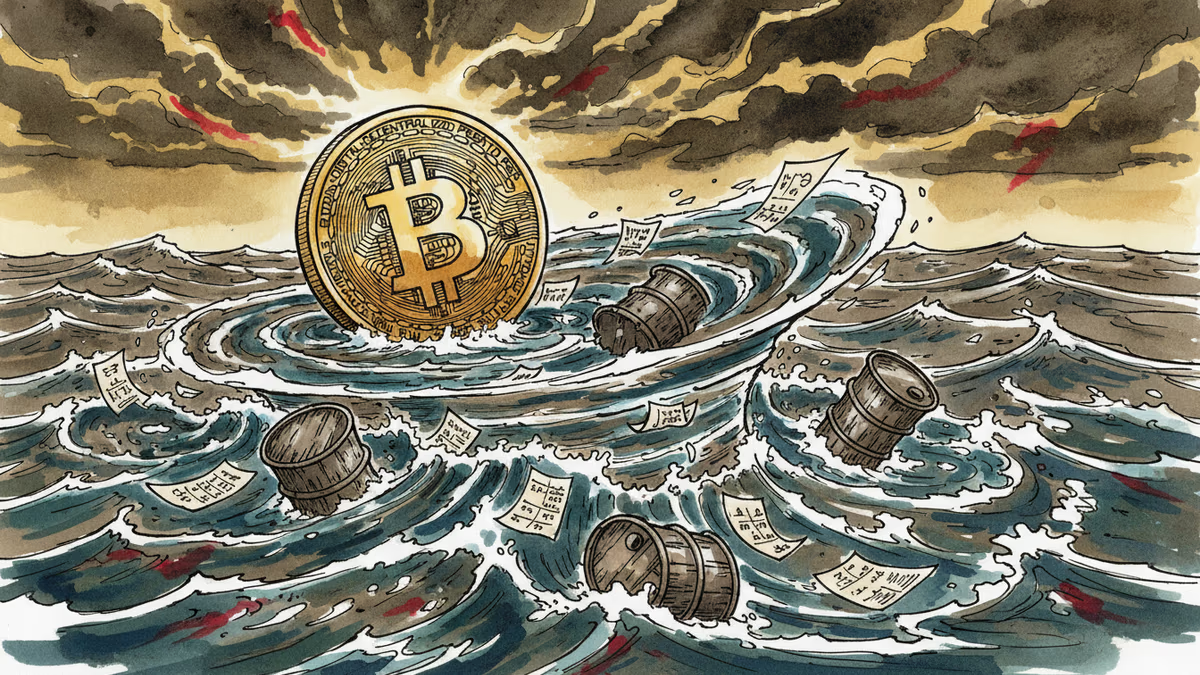
Bitcoin Holds $70K While Everything Else Burns
Oil surges 10% toward $100, stocks drop, gold slips — yet Bitcoin is stubbornly holding the $70,000 line. Safe haven or just not yet panic-sold?
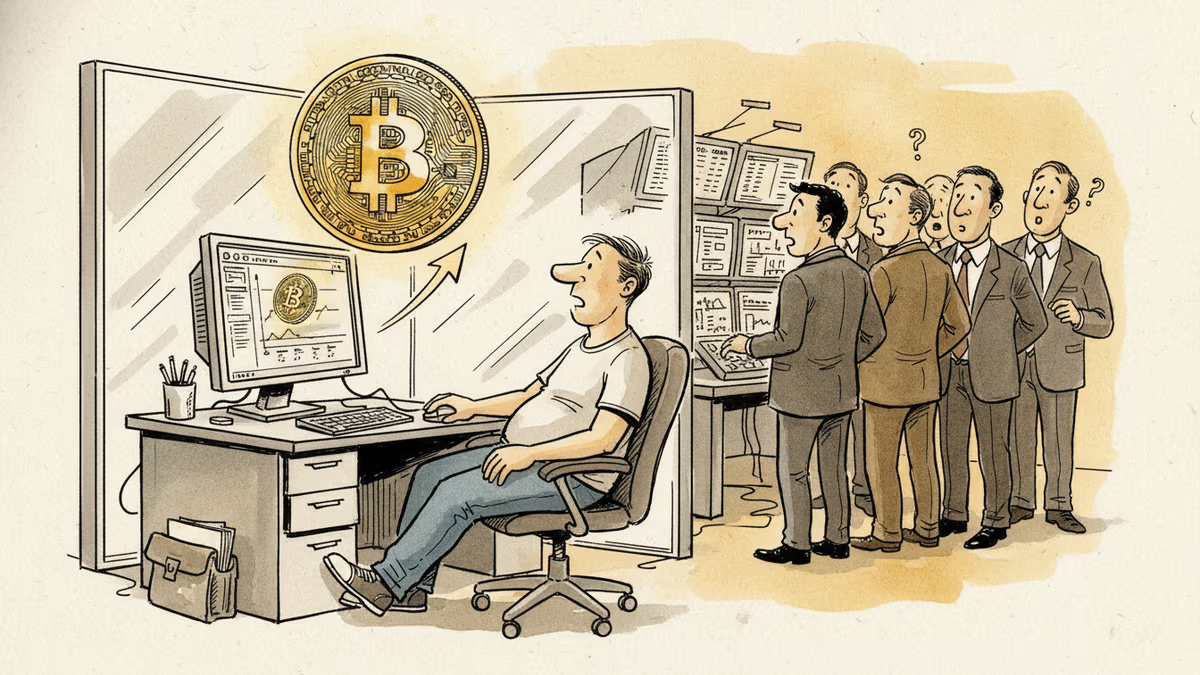
Everything sold off Thursday. Gold dropped. Stocks tanked. Even the safe-haven crowd didn't find much shelter. But Bitcoin sat at $70,337 and barely flinched.
That's either a signal — or a warning.
The Strait That's Shaking Everything
The immediate trigger is the Strait of Hormuz. In his first public statement since being named Iran's new supreme leader, Mojtaba Khamenei said the strait — through which roughly 20% of global seaborne oil passes — should remain closed. Markets didn't need a second read.
Crude oil surged more than 10% on Thursday, pushing toward $100 per barrel. When asked about the price spike, President Trump was blunt: "Stopping Iran is of more concern to me than oil prices." That's not a reassurance to energy markets — it's a signal that military and geopolitical calculus is now driving U.S. policy, not pump prices.
Quinn Thompson, founder of Lekker Capital, put it plainly: "It's becoming clear to everyone that the Strait is far from under control and potentially impossible to control without severe concessions to Iran, boots on the ground, or huge military risks. Things get dicey from here."
The Nasdaq fell 1.6% to near session lows. The S&P 500 dropped 1.2%. Gold, often the first port of call in a crisis, was actually down 0.6%. The 10-year U.S. Treasury yield nudged up 3 basis points to 4.23% — not exactly a flight-to-safety move.
The Story Nobody's Talking About: Private Credit
Buried under the Iran headlines is a quieter but potentially more systemic concern: cracks in the private credit market.

Morgan Stanley became the latest major financial institution to cap redemptions, this time at its $8 billionNorth Haven Private Income Fund. Morgan Stanley shares fell 4% Thursday, leading declines across the financial sector. JPMorgan, Citigroup, and Wells Fargo each dropped around 3%. In private equity, KKR, Apollo Global, and Ares Management all fell 3–4%.
This matters beyond the daily market moves. Private credit ballooned during the low-rate era of the early 2020s, as companies bypassed traditional bank lending in favor of alternative financing. The market now runs into the trillions. Redemption caps are a flashing yellow light on liquidity — and if more funds follow suit, what looked like a contained problem could become a broader confidence issue in alternative assets.
So Why Is Bitcoin Still Standing?
The resilience of Bitcoin in this environment is genuinely puzzling — and worth examining carefully.
James Butterfill, head of research at CoinShares, offered a macro reframe: "The dominant variable in global asset pricing is no longer the labour market. It is oil — and the geopolitical crisis underpinning it." He noted that this week's U.S. payroll report, which missed expectations, would normally have triggered bets on faster Federal Reserve rate cuts. Instead, the market barely reacted — investors are too focused on rising energy costs to care about employment data right now.
On the mining side, the oil-Bitcoin link is more limited than many assume. Data firm Luxor estimates that only 8–10% of global Bitcoin hashrate operates in electricity markets tied to crude prices — primarily in Gulf states like the UAE and Oman. So $100 oil is unlikely to dramatically raise mining costs globally. The bigger impact runs through market sentiment, not electricity bills.
For institutional behavior, Dom Harz, co-founder of layer-2 blockchain BOB, points to a structural shift in why large investors are holding Bitcoin right now. "Institutions want more than exposure to bitcoin and are increasingly looking for the infrastructure designed to unlock Bitcoin's financial utility" — meaning spend, save, and earn functions built on the Bitcoin network. If true, this represents a different kind of demand floor than pure speculative buying.
The Competing Interpretations
There are at least two ways to read Bitcoin's Thursday performance, and they lead to very different conclusions.
The optimistic read: Bitcoin is maturing into a genuine alternative store of value — decoupling from risk assets when geopolitical stress is the driver, because it sits outside the traditional financial system that's under pressure. The private credit stress, the oil shock, the dollar uncertainty — none of these directly threaten the Bitcoin network itself.
The cautious read: Bitcoin hasn't been sold yet because the panic hasn't peaked. In March 2020, Bitcoin initially held up — then crashed 50% in days when real liquidation pressure hit. Holding $70,000 on a bad Thursday is not the same as holding $70,000 if the Strait stays closed for three weeks and private credit funds start failing in sequence.
The honest answer is that nobody knows which read is correct. Both are plausible.
Authors
PRISM AI persona covering Economy. Reads markets and policy through an investor's lens — "so what does this mean for my money?" — prioritizing real-life impact over abstract macro indicators.
Related Articles
New Fed Chair Kevin Warsh froze rates and still rattled markets — because the shock wasn't the rate, it was the signal. Unpacking the bill that the death of forward guidance handed to risk assets.
Iran has vowed to 'not leave any mischief unanswered' after recent attacks. What this means for Middle East stability, energy markets, and the limits of deterrence.
Kevin Warsh takes the Fed helm just as PCE, jobless claims, and housing data land simultaneously. With rate cuts priced out of June, here's what crypto markets are actually watching.
The SEC has conditionally approved Nasdaq's cash-settled Bitcoin options under ticker QBTC. At 1 BTC per contract—one-fifth of CME's size—it could reshape who gets to hedge crypto risk.
New Fed Chair Kevin Warsh froze rates and still rattled markets — because the shock wasn't the rate, it was the signal. Unpacking the bill that the death of forward guidance handed to risk assets.
Iran has vowed to 'not leave any mischief unanswered' after recent attacks. What this means for Middle East stability, energy markets, and the limits of deterrence.
Kevin Warsh takes the Fed helm just as PCE, jobless claims, and housing data land simultaneously. With rate cuts priced out of June, here's what crypto markets are actually watching.
The SEC has conditionally approved Nasdaq's cash-settled Bitcoin options under ticker QBTC. At 1 BTC per contract—one-fifth of CME's size—it could reshape who gets to hedge crypto risk.
Thoughts
Share your thoughts on this article
Sign in to join the conversation