
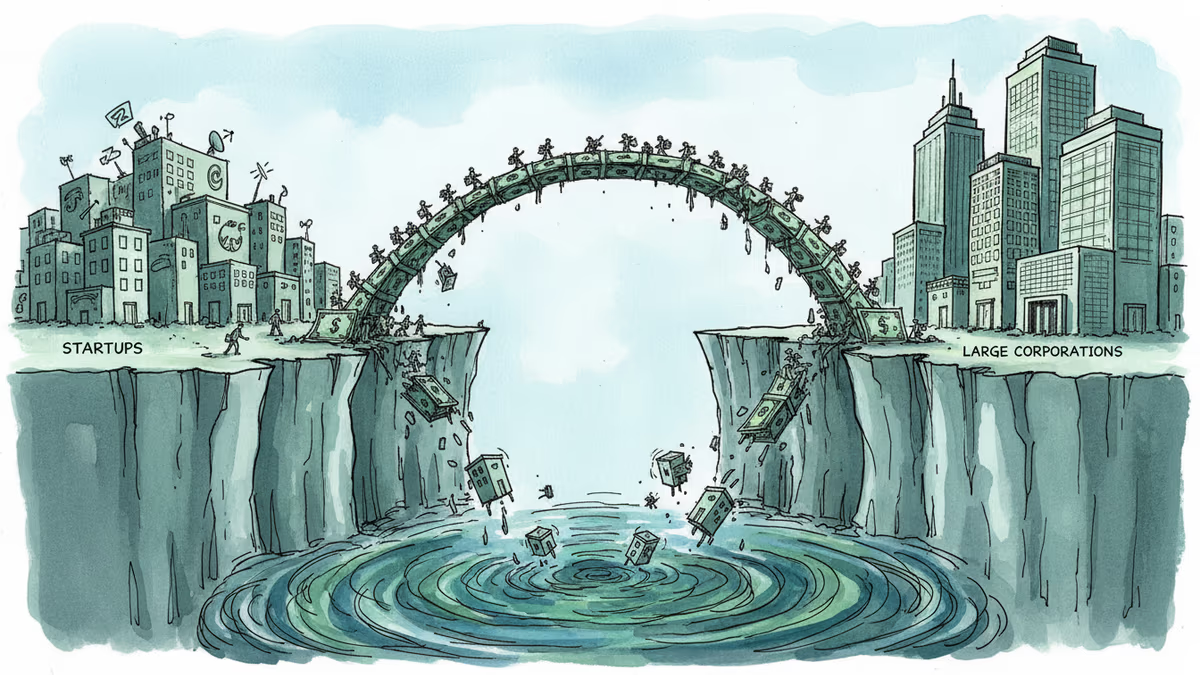
The $11M Fund Trying to Save Climate Startups from Death Valley
A new investment model aims to solve the chicken-and-egg problem killing climate tech materials startups by connecting guaranteed customers with scaling funding.
70% of Climate Startups Die Right Here
They've cracked the science. Built the prototype. Proven it works. Then they hit what venture capitalists call the "valley of death" – that brutal gap between having a product and actually selling it at scale.
Josh Felser has watched this play out dozens of times. As co-founder of climate-focused VC Climactic, he's seen promising materials startups get "chicken and egg stuck." No customers without proven scale. No scale without guaranteed customers.
"Software companies sell at negative margins all the time," Felser told TechCrunch. "Uber, Lyft – lots of examples. But materials companies aren't allowed to do that. I kept asking: why?"
The answer led him to create something entirely new: a $11 million fund that doesn't just invest in startups – it brings them customers.
Ralph Lauren's Strategic Bet
Material Scale isn't your typical investment vehicle. Instead of writing checks and hoping for the best, it orchestrates three-way deals between materials startups, corporate buyers, and itself.
Here's how it works: A company like Ralph Lauren (the platform's first buyer) commits to purchasing sustainable materials at market price. Material Scale covers the difference between market price and actual production costs through a hybrid debt-equity investment in the startup.

"We buy it and simultaneously sell it," Felser explained. The deals are signed essentially at the same time, eliminating the risk that traditionally kills these companies.
The focus on apparel isn't random. Fashion accounts for 10% of global carbon emissions, yet most sustainable materials remain stuck in small-batch production. The industry desperately needs alternatives but won't commit without proven scalability.
The Valley of Death Problem
Unlike software startups that can quickly add cloud capacity, materials companies face massive upfront production costs. Banks won't lend without guaranteed customers. VCs want proof of market demand before Series A. Customers want proven scale before placing orders.
It's a perfect catch-22 that Felser calls "unfair." While Zoom can scale from 10 to 10 million users with minimal additional infrastructure, a bio-leather startup needs entirely new production facilities.
Structure Climate is joining Climactic as a general partner, betting that this model could reshape how physical goods startups scale. The initial $11 million SPV is just the beginning – Felser envisions expanding into alternative fuels and other sectors, eventually reaching nine figures.
Beyond Fashion's Footprint
The implications stretch far beyond sustainable fashion. If successful, Material Scale's model could accelerate commercialization across climate tech – from carbon-negative concrete to lab-grown meat alternatives.
"We have a big list of companies that are candidates," Felser said. The startups are eager; large manufacturers are interested. What's been missing is the mechanism to connect them at scale.
Felser hopes other investors will "steal" his idea. "We need more novel instruments like this to attack climate change," he said. "We can't just keep doing the same old thing."
Authors
Related Articles
Cluely CEO admits to fabricating $7M revenue figure, exposing how startup "fake it till you make it" culture has gone too far. What this means for the ecosystem.
A Canadian startup claims it can prevent wildfires by stopping lightning strikes before they happen. But should we be playing god with nature's electrical storms?
AI startups are using dual-tier valuations to manufacture unicorn status. Why are investors playing along with this new valuation game?
AI startups captured 90% of record $189B February VC funding, with OpenAI, Anthropic, and Waymo dominating 83% of all investments, reshaping venture landscape
Cluely CEO admits to fabricating $7M revenue figure, exposing how startup "fake it till you make it" culture has gone too far. What this means for the ecosystem.
A Canadian startup claims it can prevent wildfires by stopping lightning strikes before they happen. But should we be playing god with nature's electrical storms?
AI startups are using dual-tier valuations to manufacture unicorn status. Why are investors playing along with this new valuation game?
AI startups captured 90% of record $189B February VC funding, with OpenAI, Anthropic, and Waymo dominating 83% of all investments, reshaping venture landscape
Thoughts
Share your thoughts on this article
Sign in to join the conversation