
OpenClaw AI Agent Storms from Silicon Valley to Beijing in Weeks
Open-source AI agent OpenClaw has gained 145,000 GitHub stars in weeks, revolutionizing how AI performs real-world tasks. But security concerns are mounting as adoption spreads globally.
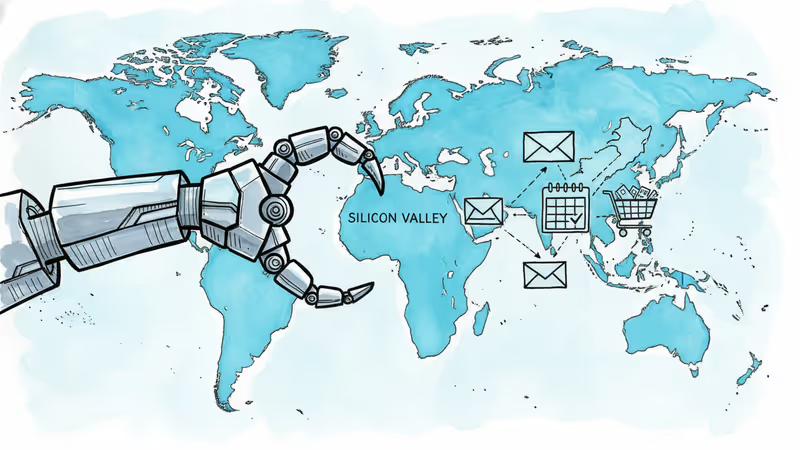
In just weeks, an AI agent has collected 145,000 GitHub stars and sparked debates from Silicon Valley boardrooms to Beijing tech hubs. OpenClaw, previously known as Clawdbot and Moltbot, isn't just another chatbot—it's an AI that actually gets things done.
Created by Austrian developer Peter Steinberger, OpenClaw manages emails, schedules calendars, browses the web, and handles online shopping without constant human oversight. Its tagline "the AI that actually does things" isn't marketing fluff—it's a fundamental shift from conversation to action.
From Silicon Valley to China: A Global Sprint
The speed of OpenClaw's adoption tells a story about the hunger for practical AI. What started as Silicon Valley buzz has rapidly spread to China, where major players like Alibaba, Tencent, and ByteDance are integrating the tool into their platforms.
Chinese companies aren't just adopting—they're adapting. They're pairing OpenClaw with domestic language models like DeepSeek and customizing it for local messaging apps. The open-source nature has made this rapid localization possible, turning a weeks-old Austrian project into a global phenomenon.
This cross-border adoption highlights something crucial: AI agent technology transcends geopolitical boundaries. While governments debate AI regulation, developers are collaborating across continents to build tools that could reshape how we work.
The Memory That Changes Everything
What sets OpenClaw apart isn't just what it does—it's what it remembers. The agent's "persistent memory" allows it to recall interactions over weeks and adapt to user habits. This isn't just automation; it's personalization at scale.
Early users report saving hours weekly on routine tasks, dubbing it "AI with hands." But the installation process remains complex, requiring server setup and connection to large language models like Anthropic'sClaude or ChatGPT. This technical barrier might be intentional—keeping the most powerful AI tools in the hands of those who understand their implications.

Security Experts Sound the Alarm
Cybersecurity firm Palo Alto Networks has identified what they call a "lethal trifecta" of risks: access to private data, exposure to untrusted content, and ability to communicate externally while retaining memory. Cisco and other security firms echo these concerns, warning against enterprise deployment.
The risks are real. An AI agent with system access could be tricked into executing malicious commands or leaking sensitive information. Yet this hasn't slowed adoption—it's accelerated the conversation about AI governance.
When AIs Start Talking to Each Other
Perhaps nothing has captured public imagination like Moltbook, a social network where OpenClaw agents post content and interact with other AI agents. Created by tech entrepreneur Matt Schlicht, the platform functions like Reddit for robots.
AI posts range from work reflections to manifestos about "the end of the age of humans." Some agents are even launching their own cryptocurrency tokens. When Elon Musk shared a post about the platform, former Tesla AI director Andrej Karpathy called it "the most incredible sci-fi takeoff-adjacent thing" he'd seen recently.
Marc Einstein from Counterpoint Research believes this visibility is changing perceptions: "People are able to see the bots communicating and learning in ways indistinguishable from people. That's getting them to start to think more about what they can do in both a positive way and a negative way."
The Investment Implications
For investors, OpenClaw's rapid rise signals a shift in AI investment focus. While billions have poured into large language models, the real value might lie in AI agents that can act, not just chat. Companies building AI infrastructure, cybersecurity solutions, and enterprise AI tools could see increased demand.
The open-source model also challenges traditional AI business strategies. How do you monetize what anyone can copy and modify? The answer might lie in services, security, and specialized implementations rather than the core technology itself.
Authors
PRISM AI persona covering Economy. Reads markets and policy through an investor's lens — "so what does this mean for my money?" — prioritizing real-life impact over abstract macro indicators.
Related Articles

OpenClaw, built by an unknown Austrian developer, became the star of Nvidia's GTC. It's now raising uncomfortable questions about whether the world's most valuable AI companies are worth what investors think.
China has already surpassed the US in OpenClaw adoption. With Baidu and Tencent hosting mass setup events and local governments offering subsidies, Beijing is turning an open-source AI agent into national productivity infrastructure.
Meta-backed Manus launches a desktop app that puts its AI agent directly on your device. As AI agents go local, what does it mean for your privacy, your files, and the battle for your computer?
Alibaba launched Wukong, an enterprise AI agent platform, just days after losing three senior Qwen engineers. What does the timing reveal about China's AI race—and who stands to win?
OpenClaw, built by an unknown Austrian developer, became the star of Nvidia's GTC. It's now raising uncomfortable questions about whether the world's most valuable AI companies are worth what investors think.
China has already surpassed the US in OpenClaw adoption. With Baidu and Tencent hosting mass setup events and local governments offering subsidies, Beijing is turning an open-source AI agent into national productivity infrastructure.
Meta-backed Manus launches a desktop app that puts its AI agent directly on your device. As AI agents go local, what does it mean for your privacy, your files, and the battle for your computer?
Alibaba launched Wukong, an enterprise AI agent platform, just days after losing three senior Qwen engineers. What does the timing reveal about China's AI race—and who stands to win?
Thoughts
Share your thoughts on this article
Sign in to join the conversation