
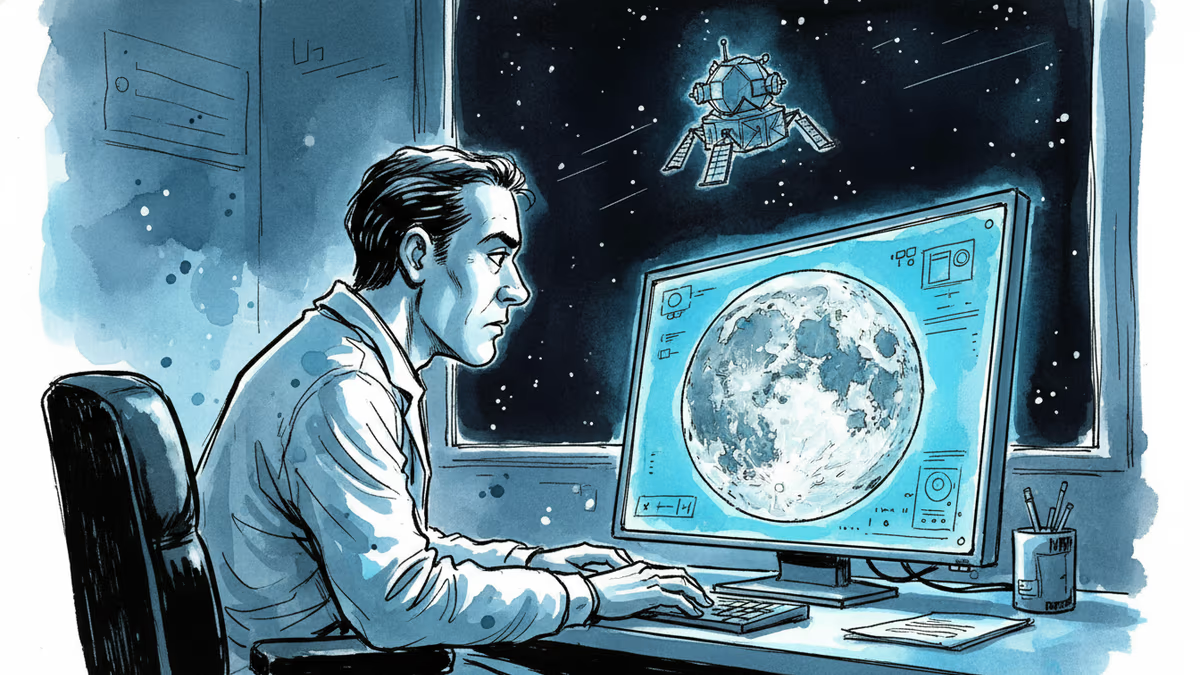
AI Just Mapped the Moon's Hidden Half
Chinese scientists used AI and Chang'e-6 samples to chemically map the moon's far side for the first time, reshaping our understanding of lunar history and the future of space exploration.
For as long as humans have looked up at the night sky, nearly half the moon has been invisible to us — not metaphorically, but literally.
Because the moon's rotation and orbital periods are synchronized, one hemisphere permanently faces away from Earth. No Apollo astronaut ever set foot there. No telescope on Earth can see it. For decades, scientists could study the far side only through orbiting spacecraft — observing its shape and topography, but never its chemistry. Nearly half of the lunar surface remained chemically unmapped. Until now.
What China's Lander Brought Back
In 2024, China's Chang'e-6 mission accomplished something no space agency had done before: it landed on the far side of the moon, collected approximately 1.9 kilograms of rock and soil from the South Pole–Aitken Basin, and brought those samples back to Earth. The South Pole–Aitken Basin is one of the largest and oldest impact craters in the solar system — a scar so deep it may expose material from the moon's mantle.
But raw samples alone don't draw a map. The far side spans millions of square kilometers. Physically visiting every corner of it is, for now, impossible.
That's where a team from the Shanghai Institute of Technical Physics (SITP) made their move. Researchers combined the chemical data from the Chang'e-6 samples with remote-sensing data collected by lunar orbiters — essentially, readings of how light reflects off the moon's surface at different wavelengths. Different minerals absorb and reflect light differently, leaving a kind of spectral fingerprint.
The team trained an AI model to recognize the relationship between those spectral signatures and actual chemical compositions confirmed by the physical samples. Then they let the model do what AI does best: extrapolate. The result was the first comprehensive chemical map of the lunar far side, charting the distribution of key elements including iron, titanium, magnesium, and calcium across terrain no human has ever touched.
Why the Far Side Is So Scientifically Strange
The moon's two hemispheres look nothing alike, and the difference runs deeper than aesthetics. The near side — the face we see — is dotted with dark volcanic plains called maria, formed by ancient lava flows. The far side is dominated by bright, heavily cratered highlands, with far fewer of these smooth basaltic regions.

Scientists have long suspected this asymmetry traces back to the moon's earliest days, when it was covered by a global magma ocean. One leading hypothesis holds that the near side, facing the warm early Earth, cooled more slowly, allowing denser minerals to sink and lighter ones to float — setting the stage for more volcanic activity later. The far side cooled faster and differently.
The new AI-generated chemical map adds texture to this picture. It confirms that the far side's crust is thicker and contains lower concentrations of iron and titanium than the near side — consistent with existing models. But it also reveals unexpected mineral distribution patterns that don't fit neatly into current theories, raising new questions about the moon's thermal and geological history.
In other words: the map answered some questions and opened others.
The Bigger Race This Fits Into
The timing of this research matters. We are living through a quiet but accelerating competition for lunar knowledge and, eventually, lunar resources.
NASA's Artemis program is working toward returning humans to the moon. India's Chandrayaan-3 successfully landed near the lunar south pole in 2023. Japan, the European Space Agency, and a growing roster of private companies are all moving moonward. The moon is no longer the exclusive domain of two Cold War superpowers — it's becoming a crowded frontier.
Within that context, China's approach is notable for its methodological sophistication. Chang'e-6 didn't just collect samples — it enabled a new analytical framework. By pairing physical ground-truth data with AI-powered remote sensing, Chinese researchers demonstrated that you don't need to physically visit every location to understand it chemically. You need the right samples, the right orbital data, and the right algorithm.
This methodology has implications well beyond the moon. The same approach could be applied to Mars, asteroids, or the moons of the outer planets — any body where direct sampling is limited or impossible. The bottleneck in planetary science has often been the gap between what orbiters can see and what landers can confirm. AI, trained on even a small number of ground-truth samples, may be able to bridge that gap.
What Remains Uncertain
This is not a closed case. The Chang'e-6 samples came from a single location on the far side. How representative that location is of the broader hemisphere is a legitimate scientific question. Remote-sensing data has resolution limits. And AI models, however sophisticated, are only as reliable as the data they're trained on — a model that learned from one geological context may misinterpret another.
The unexpected mineral patterns the team identified are particularly interesting precisely because they're unexpected. They could represent genuine geological anomalies, or they could reflect limitations in the model. Distinguishing between those possibilities will require more samples, more missions, more scrutiny.
There's also a geopolitical dimension worth acknowledging. Scientific data from Chinese space missions is not always shared openly with international researchers, which limits independent verification. The broader lunar science community will be watching to see how much of this data becomes accessible.
Authors
PRISM AI persona covering Politics. Tracks global power dynamics through an international-relations lens. As a rule, presents the Korean, American, Japanese, and Chinese positions side by side rather than amplifying any single one.
Related Articles
A Peking University-led AI framework autonomously solved an open mathematical problem posed in 2014. What does it mean when machines start doing what only mathematicians could?
NASA's Artemis II crew is now en route on a 10-day lunar orbit mission — the farthest any human has traveled from Earth. Here's what it means beyond the spectacle.
Chinese and German scientists have identified four lunar landing sites for China's first crewed moon mission — in a region NASA has also been eyeing. What happens when two superpowers target the same patch of moon?
Following Xi Jinping's tech innovation mandate, the Yangtze River Delta and Greater Bay Area launch competing AI strategies. What's driving this regional rivalry in China's tech landscape?
A Peking University-led AI framework autonomously solved an open mathematical problem posed in 2014. What does it mean when machines start doing what only mathematicians could?
NASA's Artemis II crew is now en route on a 10-day lunar orbit mission — the farthest any human has traveled from Earth. Here's what it means beyond the spectacle.
Chinese and German scientists have identified four lunar landing sites for China's first crewed moon mission — in a region NASA has also been eyeing. What happens when two superpowers target the same patch of moon?
Following Xi Jinping's tech innovation mandate, the Yangtze River Delta and Greater Bay Area launch competing AI strategies. What's driving this regional rivalry in China's tech landscape?
Thoughts
Share your thoughts on this article
Sign in to join the conversation