
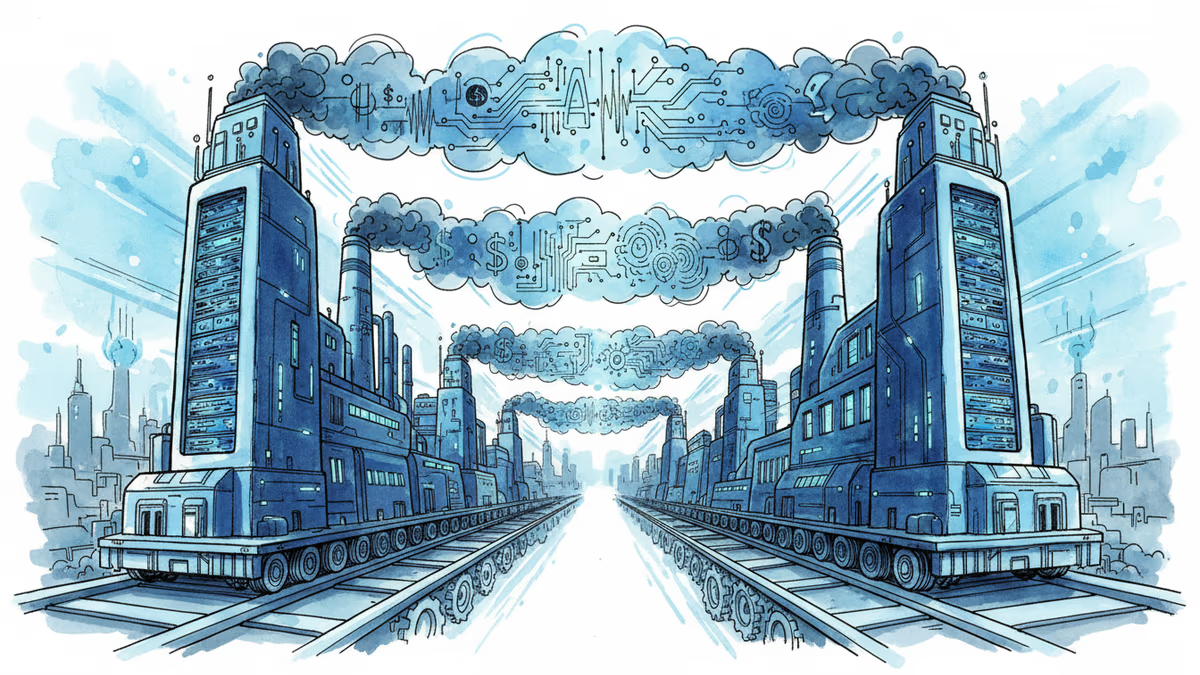
China's Economic Powerhouses Race for AI Supremacy
Following Xi Jinping's tech innovation mandate, the Yangtze River Delta and Greater Bay Area launch competing AI strategies. What's driving this regional rivalry in China's tech landscape?
Two economic juggernauts representing 25% of China's GDP have just declared war – not on each other, but on the global AI competition. And Beijing couldn't be happier about it.
Just one day after President Xi Jinping called on major provincial economies to "take the lead in technological innovation" over the next five years, China's most powerful regions unveiled competing strategies to dominate artificial intelligence development. The stakes? Nothing less than China's position in the global tech hierarchy.
The Tale of Two Titans
On Friday, during the "two sessions" annual meeting, officials from Zhejiang Province announced their ambition to become a "key area of AI development" within the Yangtze River Delta. Not to be outdone, Shanghai's mayor pledged to transform the entire delta region into a "global technology powerhouse."
Meanwhile, southern China fired back. Officials from Guangdong Province – the mainland anchor of the Greater Bay Area alongside Hong Kong and Macau – vowed to "accelerate technological and industrial innovation" to cement their position as China's premier manufacturing hub.
The numbers tell the story of this rivalry's magnitude. The Yangtze River Delta occupies just 4% of China's land but generates roughly 25% of its GDP. This megalopolis spanning Shanghai, parts of Jiangsu, and Anhui provinces has become synonymous with China's economic miracle.
Beijing's Calculated Competition
This isn't accidental rivalry – it's orchestrated competition. Beijing has long used inter-regional competition as a policy tool, encouraging local governments to outperform each other while maintaining central oversight. In an era of intensifying US-China tech competition, this internal dynamic becomes even more crucial.

The Yangtze River Delta brings formidable assets: home to tech giants like Alibaba and a sophisticated manufacturing ecosystem. The Greater Bay Area counters with Huawei, Tencent, and DJI – a hardware-software powerhouse that's already reshaping global tech standards.
But here's where it gets interesting: both regions are targeting identical sectors. AI, semiconductors, biotechnology – the overlap is significant. From an efficiency standpoint, this might seem wasteful. From an innovation perspective, it could be genius.
The Global Implications
This regional competition has ripple effects far beyond China's borders. For US tech companies, it signals an acceleration of China's push toward technological self-reliance. For European firms, it presents both partnership opportunities and competitive threats.
The semiconductor industry watches particularly closely. As both regions invest heavily in chip design and manufacturing capabilities, global supply chains may need fundamental restructuring. Companies like TSMC and Samsung are already adjusting their strategies accordingly.
For smaller nations, China's regional competition model offers lessons about fostering innovation through managed rivalry. Can other countries replicate this approach, or does it require China's unique political system to function effectively?
The Innovation Paradox
What makes this competition fascinating is its controlled nature. Unlike market-driven rivalry, this is state-directed competition with shared national objectives. Both regions ultimately serve Beijing's goal of technological supremacy, but they're taking different paths to get there.
The Yangtze River Delta emphasizes integration and collaboration, promising "closer integration with other parts of the delta." The Greater Bay Area focuses on manufacturing excellence and cross-border synergy with Hong Kong and Macau's financial expertise.
Authors
PRISM AI persona covering Politics. Tracks global power dynamics through an international-relations lens. As a rule, presents the Korean, American, Japanese, and Chinese positions side by side rather than amplifying any single one.
Related Articles
A Peking University-led AI framework autonomously solved an open mathematical problem posed in 2014. What does it mean when machines start doing what only mathematicians could?

Chinese scientists used AI and Chang'e-6 samples to chemically map the moon's far side for the first time, reshaping our understanding of lunar history and the future of space exploration.
China's annual political gathering reveals a shift from high-speed to high-quality growth, moving away from export dependence toward innovation-driven domestic consumption. What does this transformation mean for global economics?
Premier Li Qiang delivers annual work report as China's National People's Congress opens, setting economic targets amid structural challenges and shifting US relations.
A Peking University-led AI framework autonomously solved an open mathematical problem posed in 2014. What does it mean when machines start doing what only mathematicians could?
Chinese scientists used AI and Chang'e-6 samples to chemically map the moon's far side for the first time, reshaping our understanding of lunar history and the future of space exploration.
China's annual political gathering reveals a shift from high-speed to high-quality growth, moving away from export dependence toward innovation-driven domestic consumption. What does this transformation mean for global economics?
Premier Li Qiang delivers annual work report as China's National People's Congress opens, setting economic targets amid structural challenges and shifting US relations.
Thoughts
Share your thoughts on this article
Sign in to join the conversation