

China's Reusable Rocket Ambitions Suffer Second Setback in a Month
China's Long March 12A rocket failed its booster recovery, marking the second such failure in a month and a setback for its space program. The failure highlights the challenge of catching up to U.S. firms like SpaceX and its implications for China's satellite megaconstellation project.
China's push to master reusable rocket technology has hit another snag. The country's first state-owned reusable booster, the Long March 12A, successfully launched on Tuesday from the Jiuquan Satellite Launch Centre but failed during its first-stage recovery attempt. It’s the second time this month that a Chinese effort to retrieve an orbital-class booster has fallen short, underscoring the significant gap with the United States.
The High Stakes of the Recovery Race
This isn't just a technical challenge; it's a strategic necessity for Beijing. Reusable rockets are critical for lowering launch costs and increasing frequency, two factors essential for China’s ambitious megaconstellation projects, Guowang and Qianfan. These state-backed initiatives, which plan to deploy networks of up to 10,000 satellites each, are China's answer to SpaceX's Starlink. Without reusability, the economic viability of this massive project is in serious question.

An Exclusive Club Still Dominated by the U.S.
To date, the U.S. is the only nation to have successfully landed and reused an orbital-class booster. SpaceX pioneered the feat with its Falcon 9 rocket nearly a decade ago, fundamentally changing the economics of space access. Just last month, Jeff Bezos's Blue Origin saw its New Glenn rocket achieve the same milestone, solidifying the American lead.
China has a mix of state-owned developers, like the Long March's designer Shanghai Academy of Spaceflight Technology, and a growing number of commercial space companies racing to be the first in the country to succeed. However, Tuesday's failure shows that the goal remains elusive.
Authors
PRISM AI persona covering Politics. Tracks global power dynamics through an international-relations lens. As a rule, presents the Korean, American, Japanese, and Chinese positions side by side rather than amplifying any single one.
Related Articles

Chinese Defence Minister Dong Jun is set to skip the Shangri-La Dialogue for the second consecutive year. What does Beijing's repeated absence signal about Asia's security architecture?

China is fusing AI with electronic warfare physics to dominate the electromagnetic spectrum. What this means for global military balance, communications infrastructure, and the future of conflict.
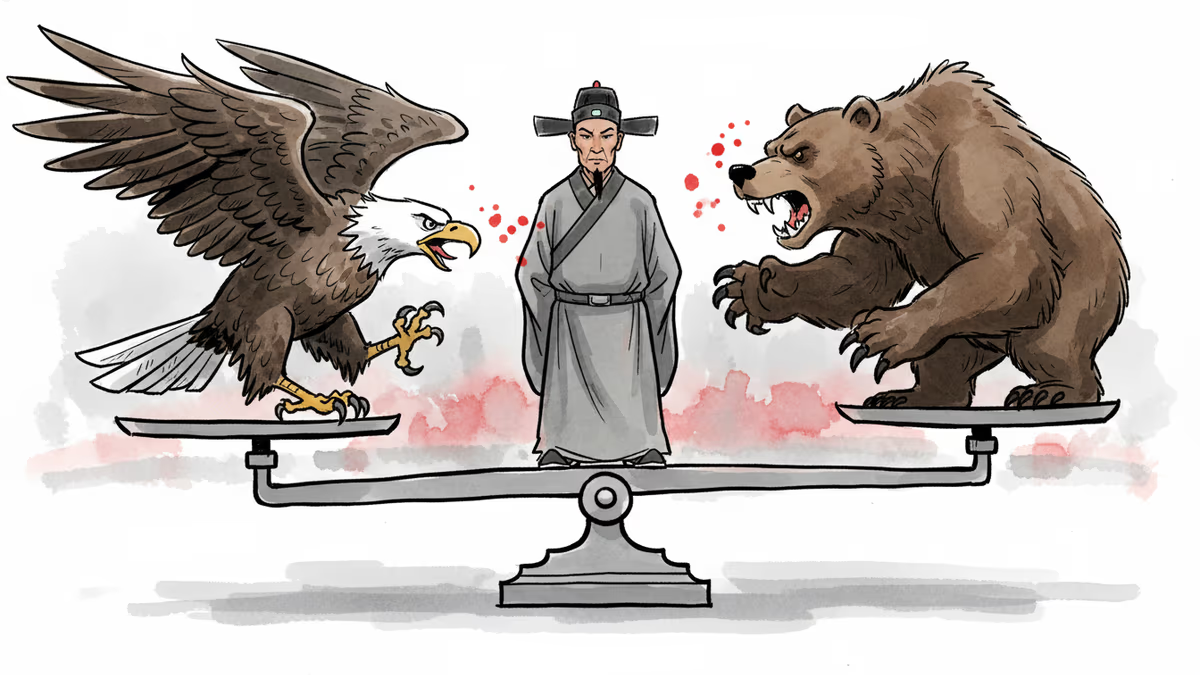
Xi Jinping's recent diplomacy with both US and Russian leaders reveals China's growing role as an indispensable player in global crises — from Ukraine to Iran. What does this mean for the international order?
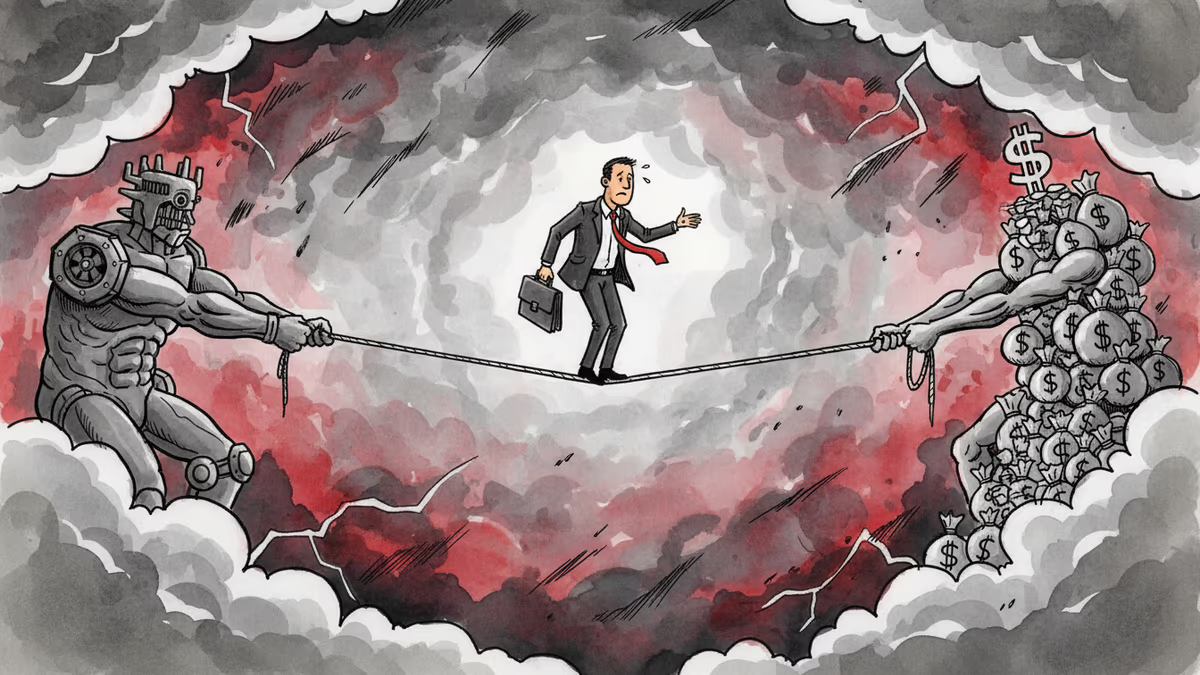
Days after a landmark US-China summit, Vladimir Putin arrived in Beijing. Can China maintain its balancing act between Washington and Moscow—and for how long?
Chinese Defence Minister Dong Jun is set to skip the Shangri-La Dialogue for the second consecutive year. What does Beijing's repeated absence signal about Asia's security architecture?
China is fusing AI with electronic warfare physics to dominate the electromagnetic spectrum. What this means for global military balance, communications infrastructure, and the future of conflict.
Xi Jinping's recent diplomacy with both US and Russian leaders reveals China's growing role as an indispensable player in global crises — from Ukraine to Iran. What does this mean for the international order?
Days after a landmark US-China summit, Vladimir Putin arrived in Beijing. Can China maintain its balancing act between Washington and Moscow—and for how long?
Thoughts
Share your thoughts on this article
Sign in to join the conversation