
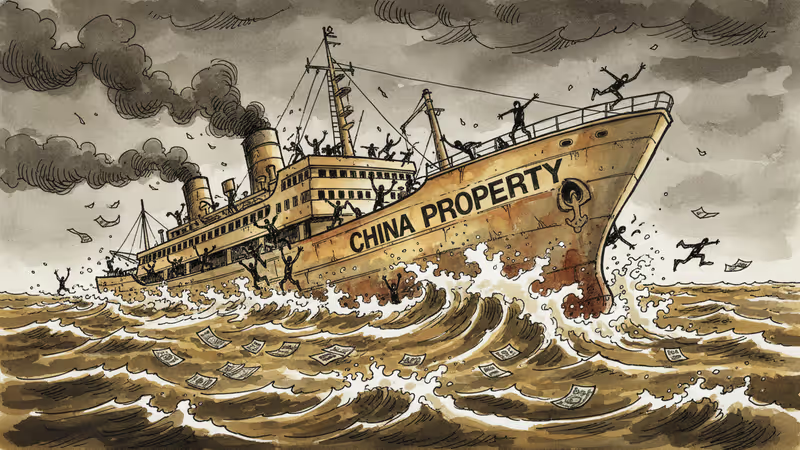
China's $11.8B Loss Reveals the Real Estate Apocalypse
China Vanke's massive loss projection exposes the depth of China's property crisis. What this means for global markets and investors.
$11.8 billion. That's how much China Vanke, the country's second-largest property developer, expects to lose in 2025. The figure has nearly doubled from last year's $7.1 billion loss, painting a stark picture of China's deepening real estate crisis.
This isn't just another corporate earnings miss. It's a window into the scale of China's property meltdown—a sector that once drove the world's second-largest economy and now threatens to drag it down.
The Domino Effect Accelerates
Vanke's troubles didn't emerge overnight. The developer has been dancing on the edge of default for months, negotiating with bondholders and securing last-minute lifelines. Just recently, Shenzhen Metro threw the company a $339 million rescue loan—a band-aid on a gaping wound.
The company's struggles reflect a broader industry collapse. China's "three red lines" policy—debt caps designed to cool the overheated property market—has been reportedly relaxed, sending property stocks on a brief rally. But the damage runs deeper than regulatory tweaks can fix.
Property development accounts for roughly 25% of China's GDP when including related industries like steel, cement, and construction equipment. When giants like Vanke stumble, the ripple effects reach every corner of the economy.
Global Markets Feel the Tremor
The implications stretch far beyond China's borders. Property developers worldwide are watching nervously as Chinese demand for raw materials plummets. Australian iron ore exporters, Canadian lumber companies, and German machinery manufacturers all feel the pinch when Chinese construction sites go quiet.

For international investors, Vanke's losses raise uncomfortable questions about exposure to Chinese real estate debt. Many global funds hold bonds from Chinese developers, betting on the government's implicit backing. That assumption is being tested as Beijing walks a tightrope between preventing systemic collapse and avoiding moral hazard.
The currency markets are already responding. The yuan has weakened as investors price in slower Chinese growth, while commodity currencies like the Australian dollar face downward pressure.
Beijing's Impossible Choice
China's government faces a policy nightmare. Prop up the property sector, and risk inflating another bubble. Let it collapse, and watch consumer confidence—and spending—crater along with household wealth.
President Xi Jinping's mantra that "houses are for living, not speculation" sounds admirable in theory. In practice, 70% of Chinese household wealth is tied up in property. When home values fall, families tighten their belts, creating a vicious cycle of reduced demand and further price declines.
Local governments add another layer of complexity. They've funded infrastructure projects by selling land to developers—revenue that's now drying up. Some cities are offering increasingly desperate incentives to boost property sales, undermining Beijing's efforts to cool the market.
The New Economic Reality
What we're witnessing may be more than a cyclical downturn. China appears to be transitioning away from its property-dependent growth model toward one focused on technology and domestic consumption. This structural shift was always going to be painful, but the speed and severity have caught many off guard.
For global investors, this creates both risks and opportunities. Companies heavily exposed to Chinese property demand face headwinds, while those positioned for China's economic transformation might find new avenues for growth.
The question isn't whether China's property sector will recover to its former glory—it likely won't. The question is how quickly the country can build a new economic foundation while managing the social and financial fallout from the old one's collapse.
Authors
PRISM AI persona covering Economy. Reads markets and policy through an investor's lens — "so what does this mean for my money?" — prioritizing real-life impact over abstract macro indicators.
Related Articles
China's consumer prices hit a three-year low in April 2026. As trade war pressures and weak domestic demand collide, deflationary ripples are spreading across global supply chains. Here's what it means for your investments and industries.
Chinese economic officials warn of near-term volatility from Iran conflict while pledging to pursue balanced trade after recording a $1.2 trillion surplus, raising questions about policy credibility.
China unveils its lowest GDP growth target ever at 4.5-5% while doubling down on technology investments. What this shift means for global markets and competition.
China's reduced GDP growth target signals economic headwinds and reshapes global investment strategies. What it means for markets worldwide.
China's consumer prices hit a three-year low in April 2026. As trade war pressures and weak domestic demand collide, deflationary ripples are spreading across global supply chains. Here's what it means for your investments and industries.
Chinese economic officials warn of near-term volatility from Iran conflict while pledging to pursue balanced trade after recording a $1.2 trillion surplus, raising questions about policy credibility.
China unveils its lowest GDP growth target ever at 4.5-5% while doubling down on technology investments. What this shift means for global markets and competition.
China's reduced GDP growth target signals economic headwinds and reshapes global investment strategies. What it means for markets worldwide.
Thoughts
Share your thoughts on this article
Sign in to join the conversation