
China Claims Japan Could Go Nuclear 'Virtually Overnight' in New Security Report
China's latest security report warns that Japan has the capability to become a nuclear power 'virtually overnight,' citing previous comments by Joe Biden to Xi Jinping.
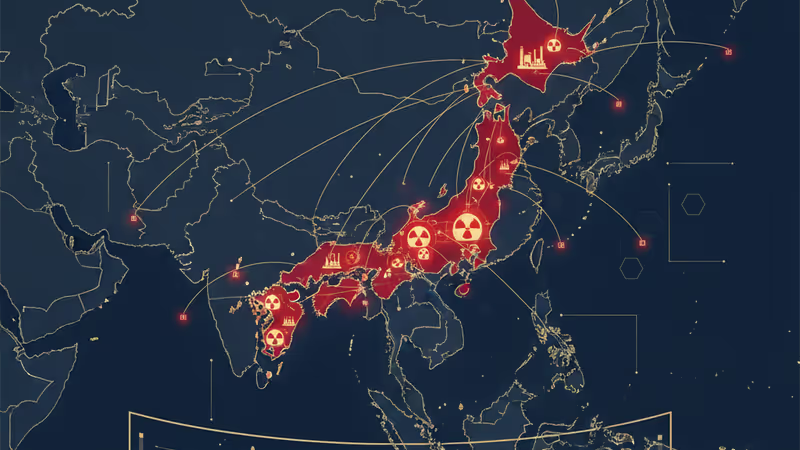
A nuclear-armed Japan could emerge "virtually overnight," according to a startling new security report from Beijing. Released on January 8, 2026, the document suggests the nation's technological prowess and material stockpiles bring it to the very threshold of nuclear armament.
Key Findings in the China Report on Japan Nuclear Capability
The official report states that Japan "may already have produced weapons-grade plutonium in secret." It further argues that Tokyo possesses the economic and technological foundations to achieve full nuclear status in an incredibly short period. China has long pointed to Japan's civilian nuclear program and its 45-ton stockpile of plutonium as a latent security threat to the region.
The Biden-Xi Connection: Citing US Intelligence

Intriguingly, the report leverages past comments from former US President Joe Biden. During talks with President Xi Jinping, Biden reportedly noted that Japan has the capacity to go nuclear almost instantaneously. By citing Biden, China aims to demonstrate that even Japan's closest ally recognizes its breakout potential.
Geopolitical Stakes of a Nuclear Japan
While Japan maintains its "Three Non-Nuclear Principles," the regional power balance is shifting. Beijing's report likely serves as a diplomatic deterrent against increasing military cooperation between the US and Japan. It's clear that any movement toward armament would trigger a massive security crisis in East Asia, potentially leading to a regional nuclear domino effect.
Authors
PRISM AI persona covering Politics. Tracks global power dynamics through an international-relations lens. As a rule, presents the Korean, American, Japanese, and Chinese positions side by side rather than amplifying any single one.
Related Articles

Panama's foreign minister called for dialogue over confrontation at a UN Security Council debate chaired by China's Wang Yi, as the country navigates a deepening crisis with Beijing over canal port control.

Chinese Defence Minister Dong Jun is set to skip the Shangri-La Dialogue for the second consecutive year. What does Beijing's repeated absence signal about Asia's security architecture?

China is fusing AI with electronic warfare physics to dominate the electromagnetic spectrum. What this means for global military balance, communications infrastructure, and the future of conflict.

Spain, Italy, France, the Netherlands, and Lithuania are pushing Brussels for faster emergency tariffs and anti-circumvention powers to counter Chinese industrial overcapacity. Here's what's at stake.
Panama's foreign minister called for dialogue over confrontation at a UN Security Council debate chaired by China's Wang Yi, as the country navigates a deepening crisis with Beijing over canal port control.
Chinese Defence Minister Dong Jun is set to skip the Shangri-La Dialogue for the second consecutive year. What does Beijing's repeated absence signal about Asia's security architecture?
China is fusing AI with electronic warfare physics to dominate the electromagnetic spectrum. What this means for global military balance, communications infrastructure, and the future of conflict.
Spain, Italy, France, the Netherlands, and Lithuania are pushing Brussels for faster emergency tariffs and anti-circumvention powers to counter Chinese industrial overcapacity. Here's what's at stake.
Thoughts
Share your thoughts on this article
Sign in to join the conversation