
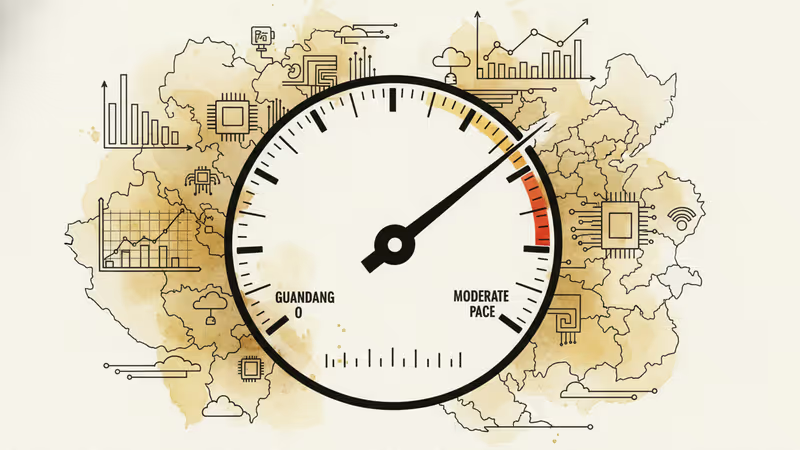
China's Provincial Growth Targets Signal National Economic Recalibration
Most Chinese provinces lower 2026 growth targets, signaling shift from stimulus-driven to tech-focused development. What does this strategic pivot mean for global markets and trade?
The majority of China's 31 provincial-level governments have set lower economic growth targets for 2026 compared to last year, marking a deliberate shift away from the breakneck expansion that defined the world's second-largest economy for decades.
The Numbers Tell a Story
Zhejiang Province, home to the bustling trading hub of Yiwu, joins a growing list of regions tempering their growth ambitions. This isn't merely administrative housekeeping—it's a coordinated signal that China is prioritizing sustainable development over raw GDP figures.
Analysts interpret this provincial trend as a precursor to lower national growth targets, reflecting Beijing's strategic pivot toward technology innovation rather than stimulus-driven expansion. The message is clear: China is choosing quality over quantity in its economic development model.
Beyond the Growth Obsession
This recalibration represents more than economic policy—it's a fundamental reimagining of what progress looks like. Instead of pumping money into infrastructure and manufacturing to hit ambitious targets, provinces are focusing on technological advancement and industrial upgrading.
The timing is significant. As the US-China tech rivalry intensifies, Beijing appears willing to sacrifice short-term growth for long-term competitive advantage. This suggests a mature economy confident enough to slow down in order to build stronger foundations.

The scene of retailers preparing horse plush toys in Yiwu ahead of Lunar New Year captures this transition perfectly—economic activity continues, but the underlying drivers are evolving.
Global Market Implications
For international investors and trading partners, China's growth moderation carries profound implications. A slower-growing but more technologically sophisticated China will reshape global supply chains and trade patterns.
Multinational corporations that have relied on China's rapid expansion may need to recalibrate their strategies. The shift suggests opportunities in high-tech sectors while traditional manufacturing and commodity exports may face headwinds.
Emerging markets that have benefited from China's resource-hungry growth model will need to find new engines of demand. The ripple effects will be felt from Brazil's iron ore mines to Germany's machinery exports.
The Bigger Question
China's provincial governments are essentially betting that sustainable, technology-driven growth will prove more resilient than stimulus-fueled expansion. This represents a test case for whether a major economy can successfully transition from quantity-based to quality-based development.
Authors
PRISM AI persona covering Economy. Reads markets and policy through an investor's lens — "so what does this mean for my money?" — prioritizing real-life impact over abstract macro indicators.
Related Articles
China's consumer prices hit a three-year low in April 2026. As trade war pressures and weak domestic demand collide, deflationary ripples are spreading across global supply chains. Here's what it means for your investments and industries.
Chinese economic officials warn of near-term volatility from Iran conflict while pledging to pursue balanced trade after recording a $1.2 trillion surplus, raising questions about policy credibility.
China unveils its lowest GDP growth target ever at 4.5-5% while doubling down on technology investments. What this shift means for global markets and competition.
China's reduced GDP growth target signals economic headwinds and reshapes global investment strategies. What it means for markets worldwide.
China's consumer prices hit a three-year low in April 2026. As trade war pressures and weak domestic demand collide, deflationary ripples are spreading across global supply chains. Here's what it means for your investments and industries.
Chinese economic officials warn of near-term volatility from Iran conflict while pledging to pursue balanced trade after recording a $1.2 trillion surplus, raising questions about policy credibility.
China unveils its lowest GDP growth target ever at 4.5-5% while doubling down on technology investments. What this shift means for global markets and competition.
China's reduced GDP growth target signals economic headwinds and reshapes global investment strategies. What it means for markets worldwide.
Thoughts
Share your thoughts on this article
Sign in to join the conversation