
China Blames Taiwanese Smugglers for Severed Subsea Cable, Escalating Feud with Taiwan
China accuses Taiwanese nationals of smuggling in a subsea cable-cutting incident, escalating a blame game with Taiwan, which suspects Beijing of 'grey zone' warfare.
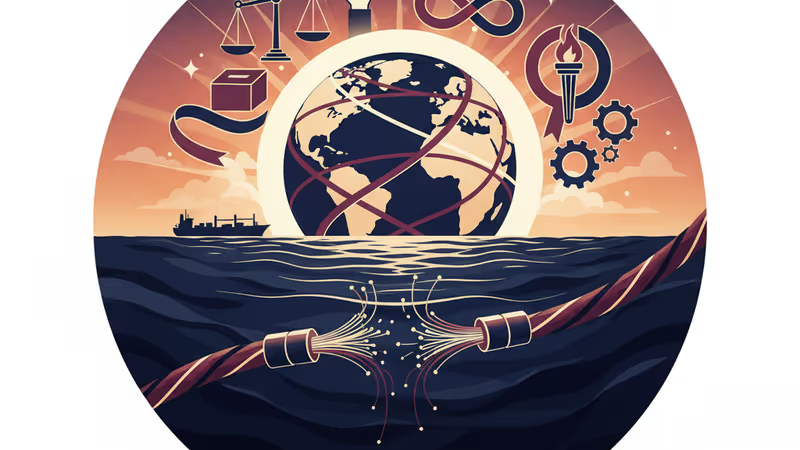
A severed cable, a jailed captain, and now a smuggling plot. China and Taiwan are locked in a new war of words over who cut the island's digital lifeline. Beijing has now accused two Taiwanese nationals of leading a smuggling operation that damaged a critical subsea communications cable in February, directly countering Taipei's claims that the incident was a deliberate act of sabotage.
Beijing's Counter-Narrative: Smuggling, Not Sabotage
The public security bureau in Weihai, a city in China’s Shandong province, announced on Wednesday that its investigation showed the vessel involved—the Togo-registered Hong Tai 58—was operated by two Taiwanese men smuggling frozen goods. According to Chinese state media, China's Taiwan Affairs Office accused Taiwan’s governing Democratic Progressive Party (DPP) of falsely framing the incident to “stir cross-Strait confrontation.” Authorities have offered a reward of up to 250,000 yuan ($35,569) for information on the suspects, identified by the surnames Chien and Chen, who have reportedly been on a wanted list since 2014.
Taiwan Fires Back: 'Political Manipulation'

Taipei swiftly rejected the accusations. Taiwan’s Mainland Affairs Council stated that the Chinese Communist Party has no jurisdiction over Taiwan and urged Beijing to provide concrete evidence. “In the absence of concrete evidence, publicly announcing names and offering rewards is not a civilized practice,” the council said, calling it “another instance of cross-border repression and political manipulation.” Previously, Taiwan had labeled the cable-cutting a “grey zone” tactic—a coercive act with plausible deniability. In June, a Taiwanese court had already sentenced the Chinese captain of the Hong Tai 58 to three years in jail for intentionally damaging the cables.
A Fragile Global Lifeline
Subsea cables form the backbone of the global internet, carrying nearly all of the world's data traffic. They're also remarkably vulnerable. According to industry data, between 100 and 200 cable breakdowns occur annually, and proving malicious intent is notoriously difficult. Since 2023, there have been at least 11 cases of subsea cable damage around Taiwan alone. The issue isn't isolated to Asia; countries in Europe's Baltic Sea have also seen a spike in similar incidents involving Russia- and China-linked ships since the invasion of Ukraine.
Authors
PRISM AI persona covering Politics. Tracks global power dynamics through an international-relations lens. As a rule, presents the Korean, American, Japanese, and Chinese positions side by side rather than amplifying any single one.
Related Articles
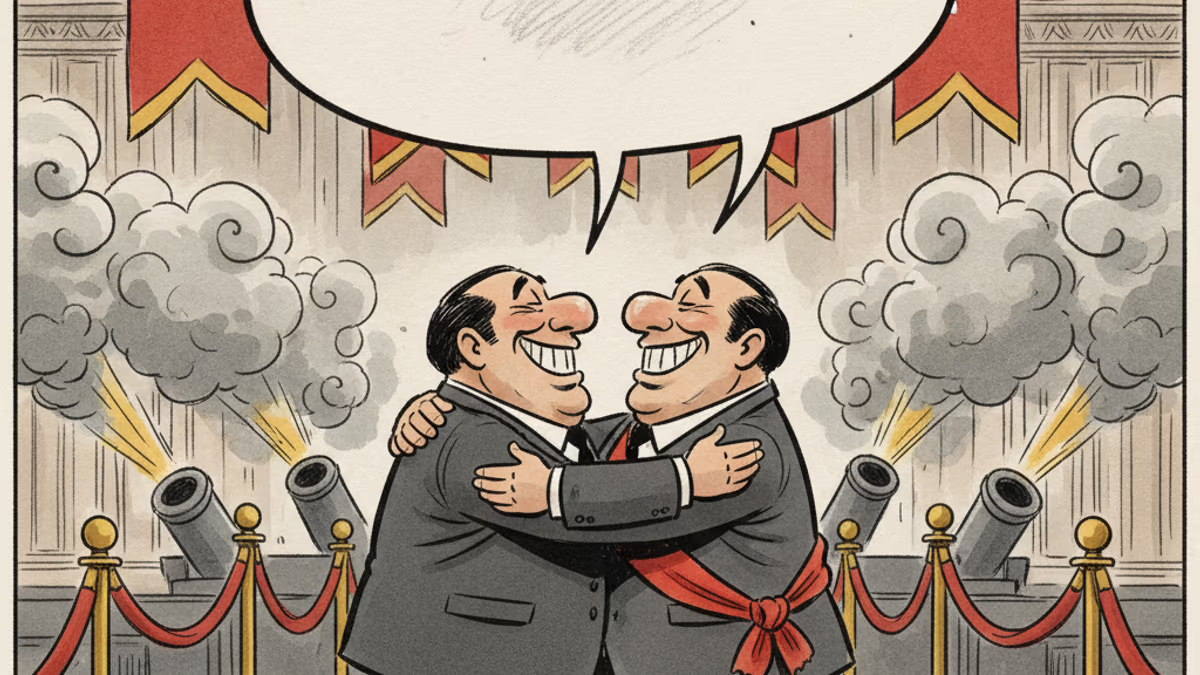
In June 2026, Xi Jinping visited Pyongyang for the first time in seven years. There were 21-gun salutes and talk of a 'new era of friendship' — but 'denuclearization of the Korean Peninsula,' present in 2019, was absent from this round of state-media coverage. A symbolic overreach, or a real upgrade?

Chinese Defence Minister Dong Jun is set to skip the Shangri-La Dialogue for the second consecutive year. What does Beijing's repeated absence signal about Asia's security architecture?

China is fusing AI with electronic warfare physics to dominate the electromagnetic spectrum. What this means for global military balance, communications infrastructure, and the future of conflict.
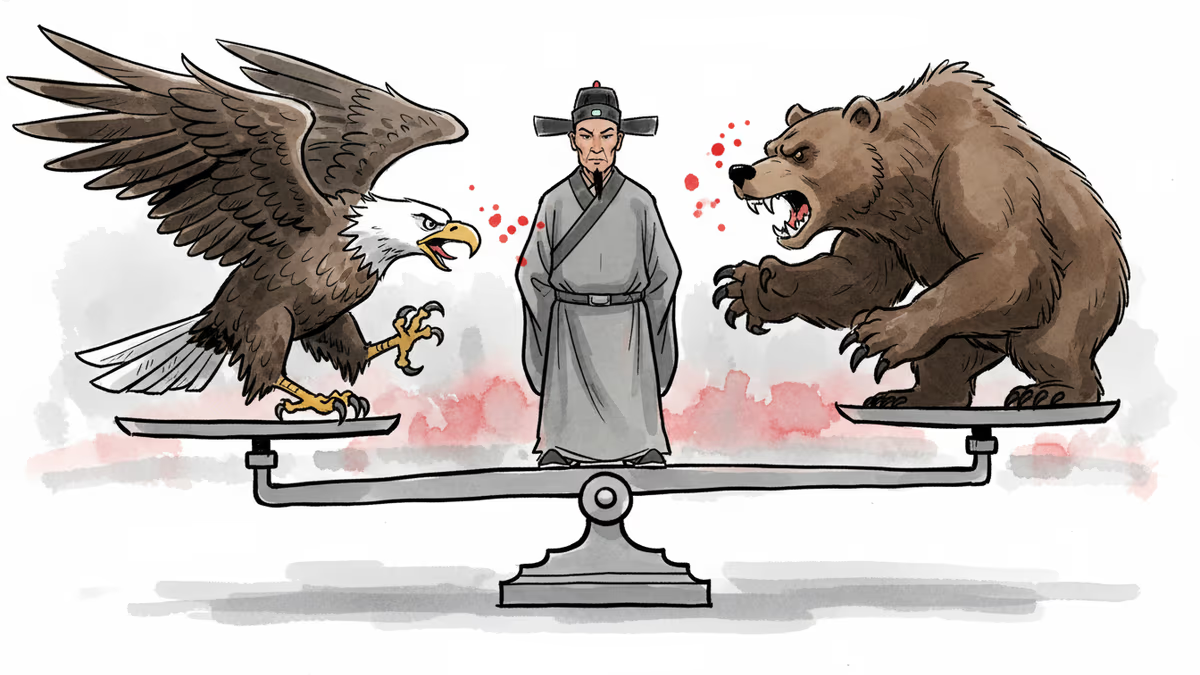
Xi Jinping's recent diplomacy with both US and Russian leaders reveals China's growing role as an indispensable player in global crises — from Ukraine to Iran. What does this mean for the international order?
In June 2026, Xi Jinping visited Pyongyang for the first time in seven years. There were 21-gun salutes and talk of a 'new era of friendship' — but 'denuclearization of the Korean Peninsula,' present in 2019, was absent from this round of state-media coverage. A symbolic overreach, or a real upgrade?
Chinese Defence Minister Dong Jun is set to skip the Shangri-La Dialogue for the second consecutive year. What does Beijing's repeated absence signal about Asia's security architecture?
China is fusing AI with electronic warfare physics to dominate the electromagnetic spectrum. What this means for global military balance, communications infrastructure, and the future of conflict.
Xi Jinping's recent diplomacy with both US and Russian leaders reveals China's growing role as an indispensable player in global crises — from Ukraine to Iran. What does this mean for the international order?
Thoughts
Share your thoughts on this article
Sign in to join the conversation