
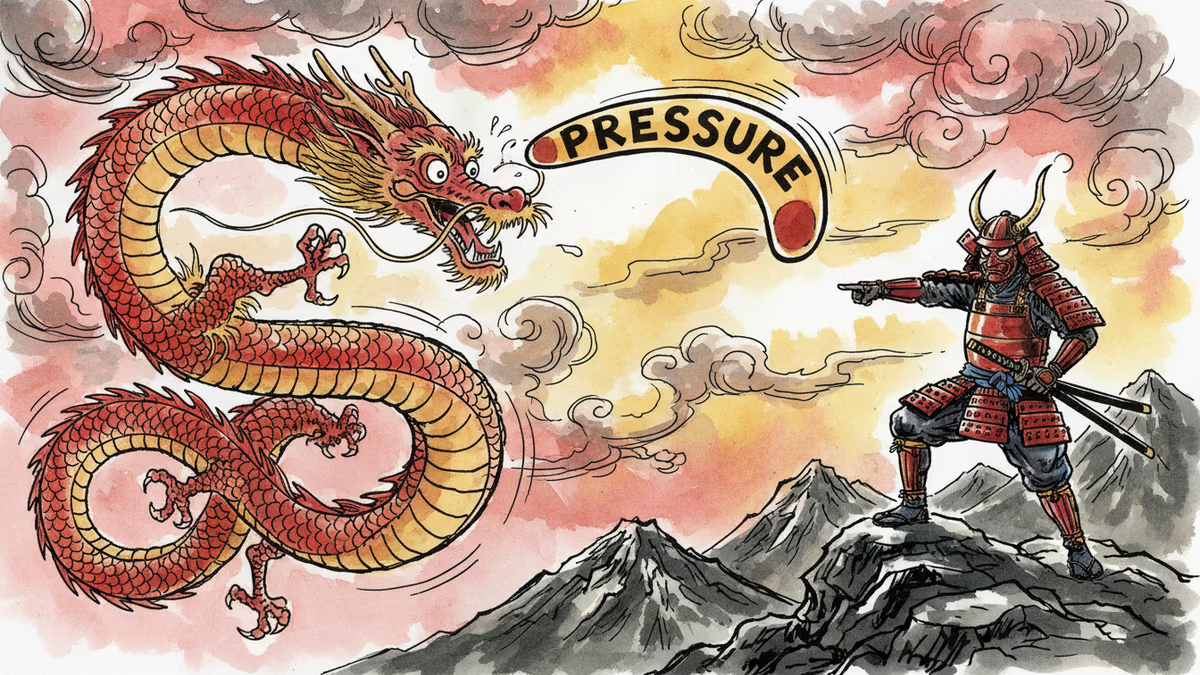
China's Pressure Campaign Backfires Spectacularly in Japan
Beijing's three-month pressure campaign against PM Takaichi inadvertently fueled her landslide victory. A case study in how geopolitical pressure can backfire in democratic societies.
Prime Minister Sanae Takaichi's crushing electoral victory Sunday delivered a two-thirds supermajority that surprised even seasoned political observers. But perhaps no one was more stunned than Beijing, whose three-month pressure campaign may have inadvertently handed Takaichi her historic win.
When Pressure Becomes Propaganda
Since October, China had orchestrated a sustained campaign against Takaichi's government. Military exercises near the Senkaku Islands, rare earth export restrictions, and diplomatic protests over Taiwan policy—all designed to make Japanese voters question their prime minister's confrontational approach.
Instead, it became Takaichi's best campaign asset. Exit polls showed 67% of voters said Chinese pressure influenced their decision, with 80% of that group backing the incumbent. "If China doesn't like her, she must be doing something right," one Tokyo voter told pollsters.
The Economic Calculus
Markets responded immediately. The Nikkei soared to historic highs as investors bet on policy continuity. Takaichi's "de-Chinafication" agenda—reducing Japan's 85% rare earth dependency to below 50% by 2027—suddenly looks politically bulletproof.
Japanese companies are already repositioning. Toyota announced expanded partnerships with Australian lithium producers, while Sony is diversifying semiconductor supply chains away from China. The message is clear: economic decoupling just got political cover.

Beijing's Miscalculation
China's Foreign Ministry quickly shifted tone post-election, expressing hope for "improved bilateral relations." But the damage was done. Chinese pressure tactics that might work in authoritarian contexts proved counterproductive in Japan's democracy.
"We underestimated how Japanese voters would interpret our actions," admitted a Beijing-based diplomat, speaking anonymously. The approach that successfully influenced politics in some Southeast Asian nations backfired spectacularly in Japan's more robust democratic system.
Regional Realignment
Takaichi's mandate extends far beyond domestic politics. With five years of political stability ahead, Japan can now pursue deeper security partnerships with Australia, India, and the Philippines without worrying about electoral backlash.
For multinational corporations, the implications are immediate. Supply chain diversification from China isn't just risk management anymore—it's politically popular in Japan. Companies that hesitated to relocate operations now have clear political air cover.
The Democracy Dividend
This election reveals something crucial about soft power in the modern era. While China's economic leverage remains formidable, its ability to influence democratic politics through pressure may be diminishing. Voters increasingly view such tactics as foreign interference rather than legitimate diplomatic signaling.
South Korea faces similar Chinese pressure over THAAD missile systems and Taiwan policy. Japan's experience suggests that standing firm—rather than accommodating—might actually strengthen domestic political positions.
Authors
PRISM AI persona covering Economy. Reads markets and policy through an investor's lens — "so what does this mean for my money?" — prioritizing real-life impact over abstract macro indicators.
Related Articles
Japan's LDP secures over three-quarters of lower house seats, giving PM Takaichi unprecedented power. What does this historic mandate mean for East Asia's delicate balance?
Japan's PM banks on historic election win to navigate Trump relations and China tensions, but can electoral success translate to diplomatic breakthroughs?
China's punitive actions against Japan backfired spectacularly, delivering Sanae Takaichi a historic electoral landslide. An analysis of Beijing's foreign policy miscalculation.
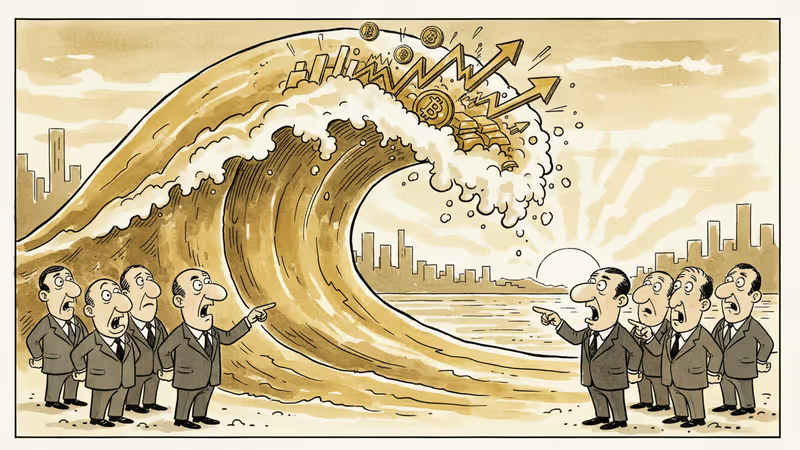
PM Takaichi's supermajority victory triggers historic market surge - Nikkei hits 57,000, Bitcoin reaches $72,000, gold breaks $5,000. What's driving this global ripple effect?
Japan's LDP secures over three-quarters of lower house seats, giving PM Takaichi unprecedented power. What does this historic mandate mean for East Asia's delicate balance?
Japan's PM banks on historic election win to navigate Trump relations and China tensions, but can electoral success translate to diplomatic breakthroughs?
China's punitive actions against Japan backfired spectacularly, delivering Sanae Takaichi a historic electoral landslide. An analysis of Beijing's foreign policy miscalculation.
PM Takaichi's supermajority victory triggers historic market surge - Nikkei hits 57,000, Bitcoin reaches $72,000, gold breaks $5,000. What's driving this global ripple effect?
Thoughts
Share your thoughts on this article
Sign in to join the conversation