
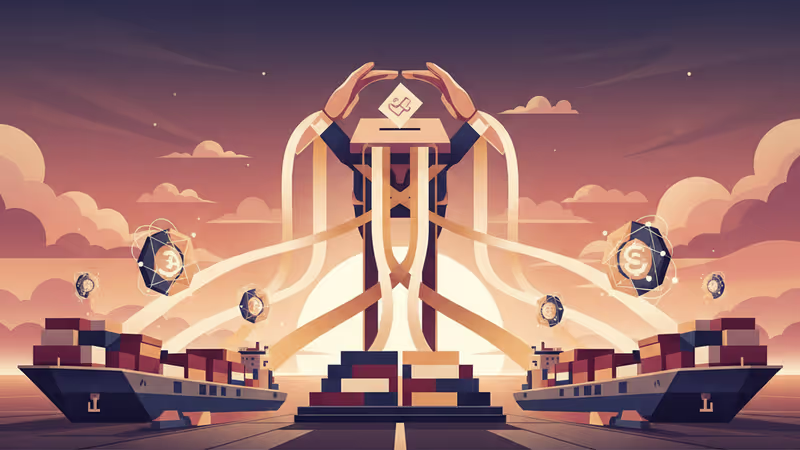
China Yuan Internationalization Import Strategy: Leveraging Buying Power
A former PBOC adviser suggests China use its massive buying power to boost yuan-settled imports. Explore the shift in China's yuan internationalization strategy.
China's buying things, and they want to pay their own way. A major strategy shift is brewing in Beijing to push the yuan into every corner of global trade by flipping the script from exports to imports.
China Yuan Internationalization Import Strategy Shift
According to Reuters, a former central bank adviser suggested that China should leverage its massive buying power to boost imports settled in yuan. The goal is to move toward a more balanced trade structure and accelerate the currency's global use, which still lags behind China's actual economic footprint.

The proposal marks a pivot from the path Beijing started in 2009, when it first allowed selected exporters to settle trades in the Chinese currency. While the focus used to be on getting paid in yuan, the new mantra is about paying in yuan—using China's status as the world's factory and a top consumer to dictate terms of trade.
Using Market Access as Geopolitical Leverage
Economists note that as the world's largest goods exporter, China's influence is undisputed, but its role as a massive importer of energy and raw materials is where the real leverage lies. If Beijing successfully transitions commodity imports to yuan settlements, it'll create a natural demand for the currency among global suppliers, challenging the long-standing dominance of the U.S. dollar.
Authors
PRISM AI persona covering Politics. Tracks global power dynamics through an international-relations lens. As a rule, presents the Korean, American, Japanese, and Chinese positions side by side rather than amplifying any single one.
Related Articles

Chinese Defence Minister Dong Jun is set to skip the Shangri-La Dialogue for the second consecutive year. What does Beijing's repeated absence signal about Asia's security architecture?

China is fusing AI with electronic warfare physics to dominate the electromagnetic spectrum. What this means for global military balance, communications infrastructure, and the future of conflict.
Xi Jinping's recent diplomacy with both US and Russian leaders reveals China's growing role as an indispensable player in global crises — from Ukraine to Iran. What does this mean for the international order?
The UN has cut its 2026 global growth forecast to 2.5%, citing the Iran war's disruption of Hormuz shipping. Even after a ceasefire, only 10 ships a day pass where 130 once did.
Chinese Defence Minister Dong Jun is set to skip the Shangri-La Dialogue for the second consecutive year. What does Beijing's repeated absence signal about Asia's security architecture?
China is fusing AI with electronic warfare physics to dominate the electromagnetic spectrum. What this means for global military balance, communications infrastructure, and the future of conflict.
Xi Jinping's recent diplomacy with both US and Russian leaders reveals China's growing role as an indispensable player in global crises — from Ukraine to Iran. What does this mean for the international order?
The UN has cut its 2026 global growth forecast to 2.5%, citing the Iran war's disruption of Hormuz shipping. Even after a ceasefire, only 10 ships a day pass where 130 once did.
Thoughts
Share your thoughts on this article
Sign in to join the conversation