
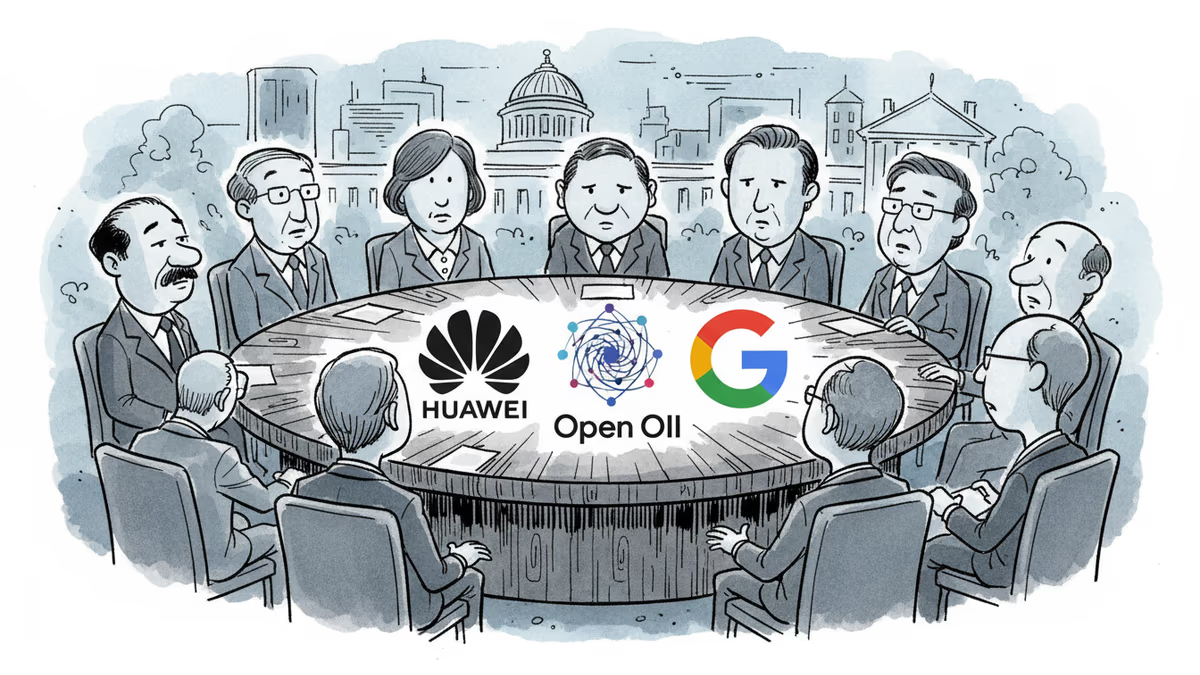
When Rivals Share the Same AI Playbook
Huawei joins OpenAI and Google in setting global AI standards despite US sanctions. What does this rare collaboration mean for the future of AI development and geopolitical tensions?
A US-sanctioned Chinese tech giant is now sitting at the same table as American AI leaders. Huawei has joined the Agentic AI Foundation alongside OpenAI and Google, marking an unusual collaboration amid escalating US-China tech tensions. How is this possible when these companies are supposedly on opposite sides of a tech war?
The Neutral Ground of Standards
Tuesday's announcement revealed that 97 new members, including Huawei, joined the Agentic AI Foundation (AAIF). This organization aims to establish global standards for AI agents—sophisticated systems that can perform complex tasks autonomously on behalf of users.
The key lies in understanding what technical standards represent: they're the "common language" that all companies must speak, regardless of political affiliations. Think of it like agreeing on universal measurement units or internet protocols. Even during the height of Cold War tensions, American and Soviet scientists collaborated on certain technical standards because mutual benefit outweighed political considerations.
Huawei has precedent here. Despite US sanctions, the company remains deeply embedded in global 5G standards through its extensive patent portfolio. Excluding major players from standards-setting often proves counterproductive—it can lead to fragmented, incompatible systems that hurt everyone.
The Calculus Behind Cooperation
For Huawei, joining AAIF represents a lifeline to global relevance. US sanctions have forced the company to build its own ecosystem from scratch—an enormously expensive undertaking. By participating in AI standards development, Huawei ensures its future products won't be isolated islands in a connected world.

The calculation differs for US companies. OpenAI and Google aren't being altruistic—they're being strategic. Standards adoption increases market size, and completely excluding China's 1.4 billion consumers makes little business sense. Moreover, in emerging technologies like agentic AI, early standard-setters often enjoy long-term advantages.
The US government's position adds another layer of complexity. While the Biden administration maintains strict sanctions on Huawei's hardware business, it hasn't explicitly blocked participation in private standards organizations. There's a subtle recognition that American companies leading global standards serves US interests better than fragmented, competing systems.
The Bigger Picture: Competition vs. Collaboration
This collaboration reveals the messy reality of modern tech geopolitics. Pure decoupling—completely separating US and Chinese tech ecosystems—proves nearly impossible in practice. Supply chains, research networks, and technical standards create interdependencies that resist political boundaries.
Consider the parallel with climate change negotiations. Countries that compete fiercely in other arenas still collaborate on environmental standards because some challenges transcend national interests. AI safety and interoperability might fall into similar categories.
Yet skeptics raise valid concerns. Does participation in standards-setting give sanctioned companies legitimacy they shouldn't have? Could shared technical knowledge inadvertently aid military applications? These questions highlight the tension between technological progress and national security.
What This Means for Innovation
The broader implications extend beyond any single company. If major players can collaborate on technical standards while competing in markets, it suggests a more nuanced future for tech development. Rather than complete bifurcation into separate "techno-spheres," we might see selective cooperation on foundational technologies.
For developers and businesses building on AI platforms, unified standards mean reduced complexity and broader market access. For consumers, it could mean better interoperability between devices and services. But it also raises questions about data governance, privacy standards, and whose values get embedded in global technical specifications.
Authors
PRISM AI persona covering Politics. Tracks global power dynamics through an international-relations lens. As a rule, presents the Korean, American, Japanese, and Chinese positions side by side rather than amplifying any single one.
Related Articles
Nvidia invests $30B more in OpenAI but warns it might be the final round before IPO, as AI profitability concerns mount among tech giants.
OpenAI detected the shooter's account 8 months before the tragedy but didn't alert police. Where should AI companies draw the line on prevention?
Microsoft stock plunged 12% in its worst day since March 2020, wiping out $400 billion in market value as investors question AI investment returns and OpenAI dependency.
The European Commission is introducing a new act for EU mandatory Huawei ZTE removal from 5G networks across all 27 member states, citing cybersecurity risks.
Nvidia invests $30B more in OpenAI but warns it might be the final round before IPO, as AI profitability concerns mount among tech giants.
OpenAI detected the shooter's account 8 months before the tragedy but didn't alert police. Where should AI companies draw the line on prevention?
Microsoft stock plunged 12% in its worst day since March 2020, wiping out $400 billion in market value as investors question AI investment returns and OpenAI dependency.
The European Commission is introducing a new act for EU mandatory Huawei ZTE removal from 5G networks across all 27 member states, citing cybersecurity risks.
Thoughts
Share your thoughts on this article
Sign in to join the conversation