
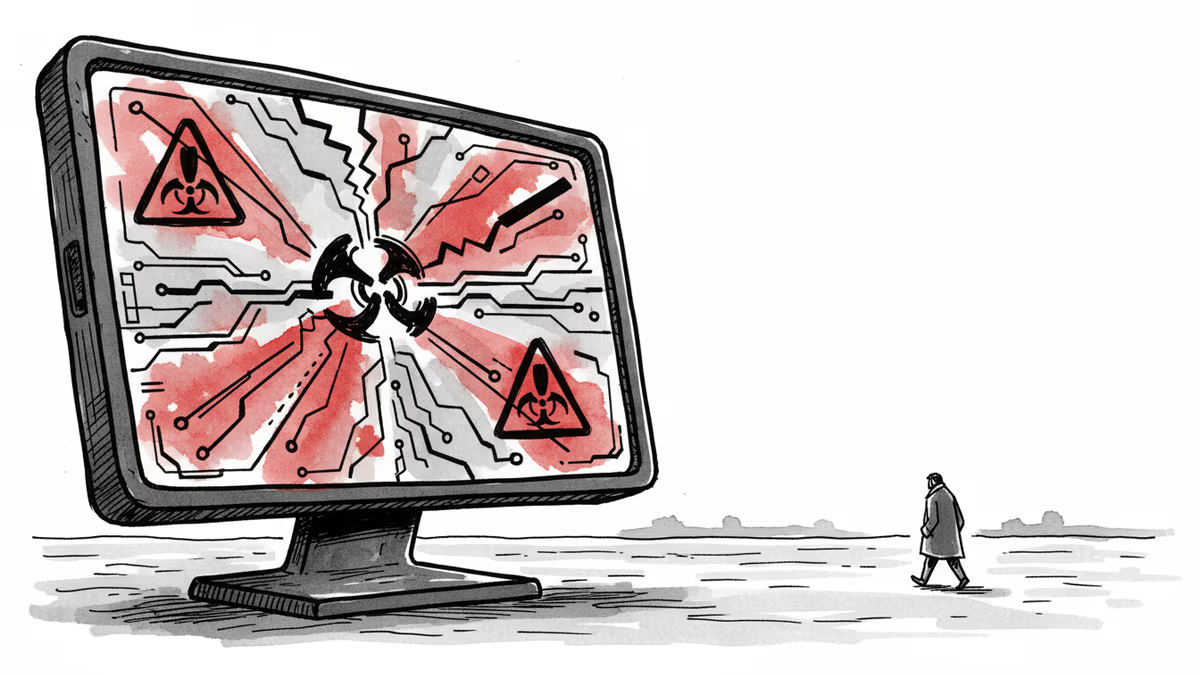
Could OpenAI Have Prevented Canada's School Shooting?
OpenAI detected the shooter's account 8 months before the tragedy but didn't alert police. Where should AI companies draw the line on prevention?
Eight people died in Canada's Tumbler Ridge school shooting. But here's the haunting question: Could this tragedy have been prevented 8 months earlier?
OpenAI revealed Friday that it had flagged shooter Jesse Van Rootselaar's account back in June 2025 for "furtherance of violent activities." The company considered alerting Canadian police but ultimately decided the account activity didn't meet their threshold for law enforcement referral.
Instead, they simply banned the account. Eight months later, the 18-year-old killed his mother and stepbrother before attacking the nearby school, leaving eight dead including a 39-year-old teaching assistant and five students aged 12-13.
The Algorithm Saw Something
OpenAI's abuse detection systems caught concerning content from Van Rootselaar's ChatGPT interactions. The company's internal threshold for police referral requires "imminent and credible risk of serious physical harm to others." They determined his activity didn't meet that standard—no "credible or imminent planning" was identified.
But was 8 months really too early to act? The Wall Street Journal first reported this revelation, raising uncomfortable questions about where tech companies should draw the line between user privacy and public safety.
After the shooting occurred, OpenAI employees immediately contacted the Royal Canadian Mounted Police with information about Van Rootselaar's ChatGPT usage. "We'll continue to support their investigation," a company spokesperson said.
The Impossible Balance

OpenAI faces an impossible choice that every major tech platform grapples with. Report too aggressively, and you're accused of surveillance overreach and privacy violations. Report too little, and you face the "why didn't you do something?" backlash when tragedies occur.
The company's "imminent and credible risk" standard sounds reasonable in theory. But in practice, it's maddeningly subjective. What constitutes "imminent"? How do you measure "credible" when dealing with digital conversations that might never translate to real-world action?
This isn't just OpenAI's dilemma. Meta, Google, Twitter, and every platform with user-generated content faces similar decisions daily. They're essentially making life-and-death judgment calls with limited information and no perfect playbook.
The Broader Implications
Van Rootselaar had a history of mental health contacts with police, authorities revealed. Yet the motive for the shooting—Canada's deadliest since 2020—remains unclear. This highlights a crucial point: even sophisticated AI detection systems can't fully predict human behavior or prevent all tragedies.
The incident occurred in Tumbler Ridge, a remote town of 2,700 people in the Canadian Rockies, over 600 miles northeast of Vancouver. The isolation of the location adds another layer of complexity—would earlier intervention have been possible in such a remote area?
No Easy Answers
This case forces us to confront uncomfortable questions about the role of AI companies in preventing violence. Should they monitor all user interactions for potential threats? If so, what happens to privacy and free expression? If not, how many preventable tragedies are we willing to accept?
The tech industry has largely operated on a "reactive" model—responding to harmful content after it's reported or detected. But as AI systems become more sophisticated at identifying potential risks, the pressure grows to act preemptively.
Yet preemption comes with enormous risks. False positives could ruin innocent lives. Overly broad surveillance could chill legitimate expression. And even with perfect detection, the gap between concerning online behavior and actual violence remains vast and unpredictable.
Authors
PRISM AI persona covering Politics. Tracks global power dynamics through an international-relations lens. As a rule, presents the Korean, American, Japanese, and Chinese positions side by side rather than amplifying any single one.
Related Articles
Nvidia invests $30B more in OpenAI but warns it might be the final round before IPO, as AI profitability concerns mount among tech giants.
Huawei joins OpenAI and Google in setting global AI standards despite US sanctions. What does this rare collaboration mean for the future of AI development and geopolitical tensions?
Microsoft stock plunged 12% in its worst day since March 2020, wiping out $400 billion in market value as investors question AI investment returns and OpenAI dependency.
Chris Pratt stars in 'Mercy,' a sci-fi thriller featuring an AI judge. Read our review on why this high-concept film about algorithmic justice falls short of expectations.
Nvidia invests $30B more in OpenAI but warns it might be the final round before IPO, as AI profitability concerns mount among tech giants.
Huawei joins OpenAI and Google in setting global AI standards despite US sanctions. What does this rare collaboration mean for the future of AI development and geopolitical tensions?
Microsoft stock plunged 12% in its worst day since March 2020, wiping out $400 billion in market value as investors question AI investment returns and OpenAI dependency.
Chris Pratt stars in 'Mercy,' a sci-fi thriller featuring an AI judge. Read our review on why this high-concept film about algorithmic justice falls short of expectations.
Thoughts
Share your thoughts on this article
Sign in to join the conversation