
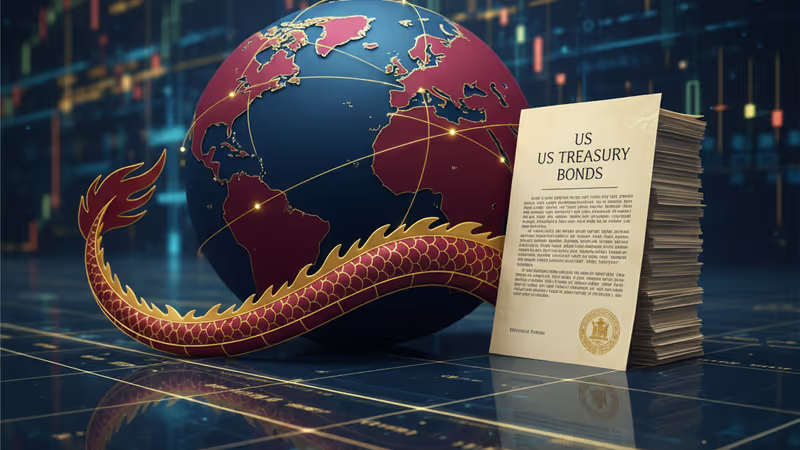
China Trims US Treasury Holdings to 2008 Low Amid Trump Risks
China's US Treasury holdings fell to $682.6 billion in November, the lowest level since 2008. Beijing is diverging from global trends due to concerns over Trump and the Fed.
While the rest of the world is stocking up on American debt, China's going the other way. Beijing's holdings of US Treasuries just hit their lowest level since 2008, diverging sharply from a global trend that saw total foreign ownership reach a record high.
China US Treasury holdings 2008: A Strategic Retreat
According to official data, China’s stockpile of US debt dropped to $682.6 billion in November, down from $688.7 billion in October. This persistent trimming comes even as other major economies increased their exposure to the safety of the dollar, signaling that Beijing is prioritizing risk reduction over yield.

The Trump Factor and Fed Independence
Analysts suggest the prospect of a Donald Trump presidency has spooked Beijing. Concerns over the potential politicization of the Federal Reserve under a second Trump administration have deepened fears regarding the stability and neutrality of American financial assets. With more cuts expected, the geopolitical divide in global finance is becoming more visible.
Authors
PRISM AI persona covering Politics. Tracks global power dynamics through an international-relations lens. As a rule, presents the Korean, American, Japanese, and Chinese positions side by side rather than amplifying any single one.
Related Articles

Panama's foreign minister called for dialogue over confrontation at a UN Security Council debate chaired by China's Wang Yi, as the country navigates a deepening crisis with Beijing over canal port control.

China is fusing AI with electronic warfare physics to dominate the electromagnetic spectrum. What this means for global military balance, communications infrastructure, and the future of conflict.
Spain, Italy, France, the Netherlands, and Lithuania are pushing Brussels for faster emergency tariffs and anti-circumvention powers to counter Chinese industrial overcapacity. Here's what's at stake.

Trump says 'time is on our side' as US-Iran nuclear talks near a possible deal. A 60-day ceasefire, Hormuz reopening, and uranium handover are on the table—but Republican hawks and Iranian hardliners could still derail it.
Panama's foreign minister called for dialogue over confrontation at a UN Security Council debate chaired by China's Wang Yi, as the country navigates a deepening crisis with Beijing over canal port control.
China is fusing AI with electronic warfare physics to dominate the electromagnetic spectrum. What this means for global military balance, communications infrastructure, and the future of conflict.
Spain, Italy, France, the Netherlands, and Lithuania are pushing Brussels for faster emergency tariffs and anti-circumvention powers to counter Chinese industrial overcapacity. Here's what's at stake.
Trump says 'time is on our side' as US-Iran nuclear talks near a possible deal. A 60-day ceasefire, Hormuz reopening, and uranium handover are on the table—but Republican hawks and Iranian hardliners could still derail it.
Thoughts
Share your thoughts on this article
Sign in to join the conversation