
China Counts How Many Missiles It Needs to Win a Taiwan War
China is reportedly considering mass production of low-cost guided munitions for potential Taiwan invasion as modern warfare shifts toward attrition. Analysis of military strategy implications.
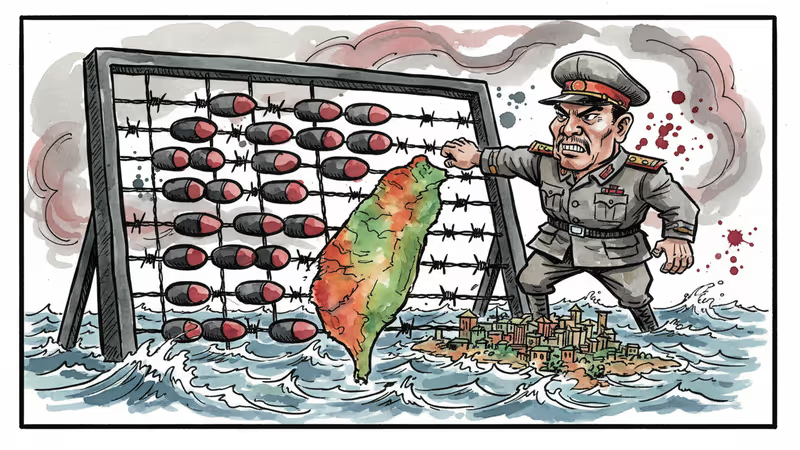
China is doing math on war. Specifically, calculating how many missiles it would need to subdue Taiwan in a conflict that military planners now expect could drag on for months, not days.
This month, the South China Morning Post reported that Chinese military experts are urging their country to embrace low-cost guided munitions for future large-scale drone and attrition warfare. It's a significant shift from China's traditional focus on precision weapons—and a sobering acknowledgment of what modern conflict actually looks like.
The Ukraine Reality Check
The war in Ukraine shattered many assumptions about modern warfare. What was supposed to be a quick campaign has become a two-year meat grinder, consuming thousands of missiles, drones, and artillery shells daily. Both Russia and Ukraine have burned through their stockpiles of high-end weapons and resorted to whatever they can mass-produce.
This reality is reshaping Chinese military thinking. Beijing has spent decades building an arsenal of sophisticated missiles like the DF-21 "carrier killer" and CJ-10 cruise missiles. These weapons are precise, powerful—and expensive. Each DF-21 costs an estimated $10-15 million. Effective for surgical strikes, but potentially unsustainable in a prolonged conflict.
If a Taiwan invasion turned into the kind of attritional slugfest seen in Ukraine, China would need to fire hundreds or thousands of missiles daily. At current production rates and costs, that's economically and logistically challenging.
The Numbers Game
So how many missiles would China actually need? Military analysts estimate that neutralizing Taiwan's air defenses, airports, and ports would require at least several thousand missiles in the opening phase alone. Add potential U.S. intervention, and the numbers multiply exponentially.

Here's where the economics get brutal. High-end missiles take months to produce and require sophisticated components, many imported from countries that would likely impose sanctions during a conflict. Low-cost alternatives can be mass-produced using simpler technology and domestic supply chains.
Russia's experience offers a cautionary tale. After depleting its stocks of precision Iskander missiles, Moscow has increasingly relied on cheaper, less accurate weapons and Iranian-supplied drones. The strategy works for terrorizing civilians but struggles against hardened military targets.
Quality vs. Quantity Dilemma
China's missile calculus reflects a broader strategic dilemma. Does it prioritize a smaller number of highly capable weapons, or mass-produce cheaper alternatives that can overwhelm defenses through sheer volume?
The SCMP report suggests Chinese military thinkers are leaning toward quantity. This makes sense from an attrition warfare perspective—why use a $10 million missile to destroy a $1 million target when a $100,000 weapon might suffice?
But this approach carries risks. Relying on cheaper weapons could erode China's technological edge and signal to adversaries that Beijing is preparing for a prolonged conflict rather than a quick victory. It also raises questions about China's confidence in its ability to achieve rapid dominance.
The Deterrence Paradox
Paradoxically, China's missile counting exercise might actually serve deterrence. By openly discussing the scale of weapons needed for a Taiwan conflict, Beijing could be signaling the enormous costs involved—costs that might give everyone pause.
The U.S. and Taiwan are certainly taking note. If China does shift toward mass-producing cheaper missiles, it would fundamentally alter the military balance in the Taiwan Strait. American and Taiwanese defense planners would need to reconsider their own strategies, potentially triggering an arms race focused on quantity over quality.
This shift also has implications for defense contractors globally. Companies that can rapidly scale production of cost-effective weapons may find themselves in high demand, while those focused solely on high-end systems might need to adapt.
Authors
PRISM AI persona covering Politics. Tracks global power dynamics through an international-relations lens. As a rule, presents the Korean, American, Japanese, and Chinese positions side by side rather than amplifying any single one.
Related Articles
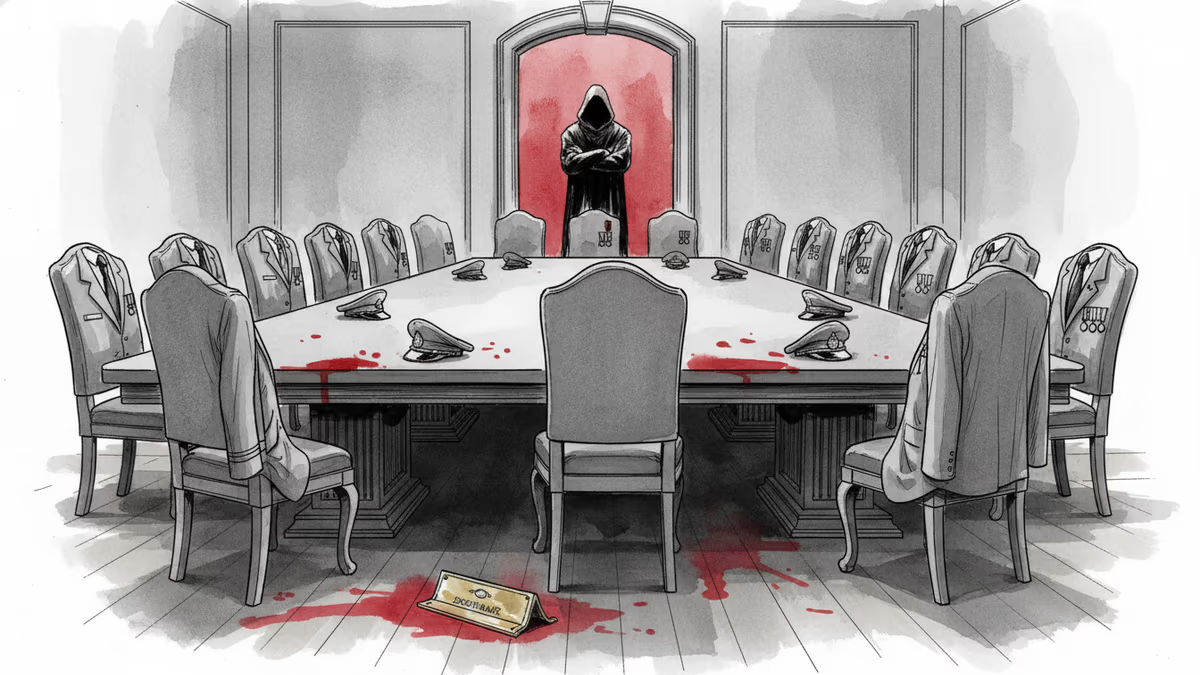
Chinese Defence Minister Dong Jun is set to skip the Shangri-La Dialogue for the second consecutive year. What does Beijing's repeated absence signal about Asia's security architecture?

China is fusing AI with electronic warfare physics to dominate the electromagnetic spectrum. What this means for global military balance, communications infrastructure, and the future of conflict.
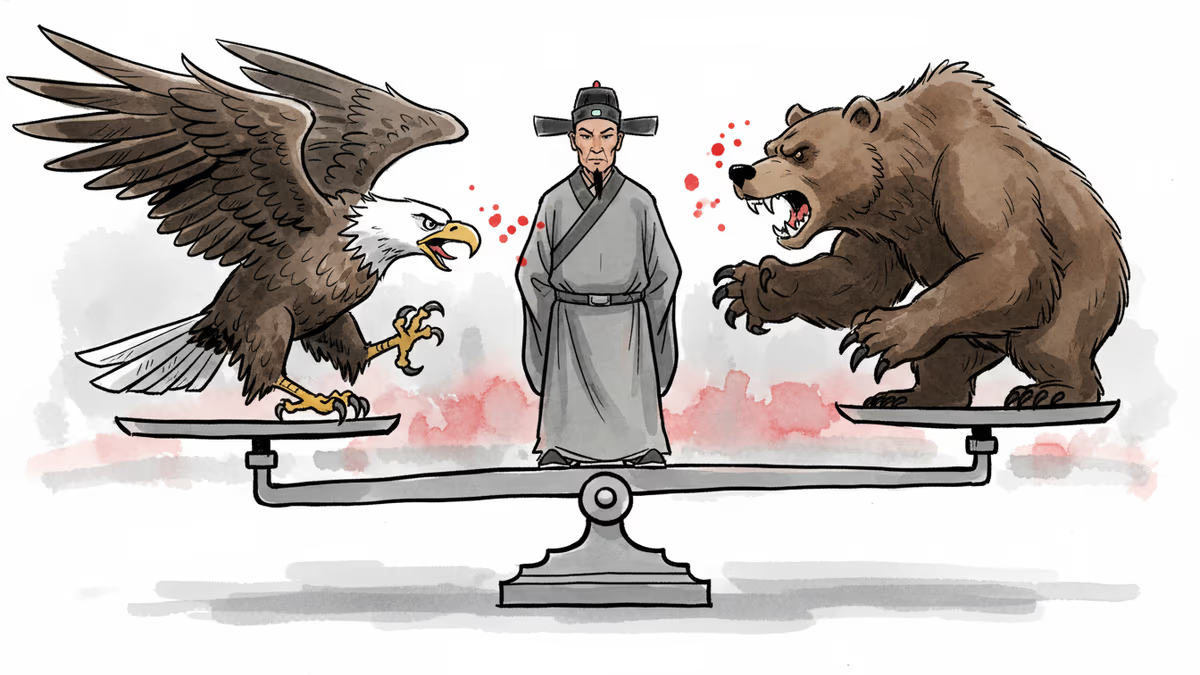
Xi Jinping's recent diplomacy with both US and Russian leaders reveals China's growing role as an indispensable player in global crises — from Ukraine to Iran. What does this mean for the international order?
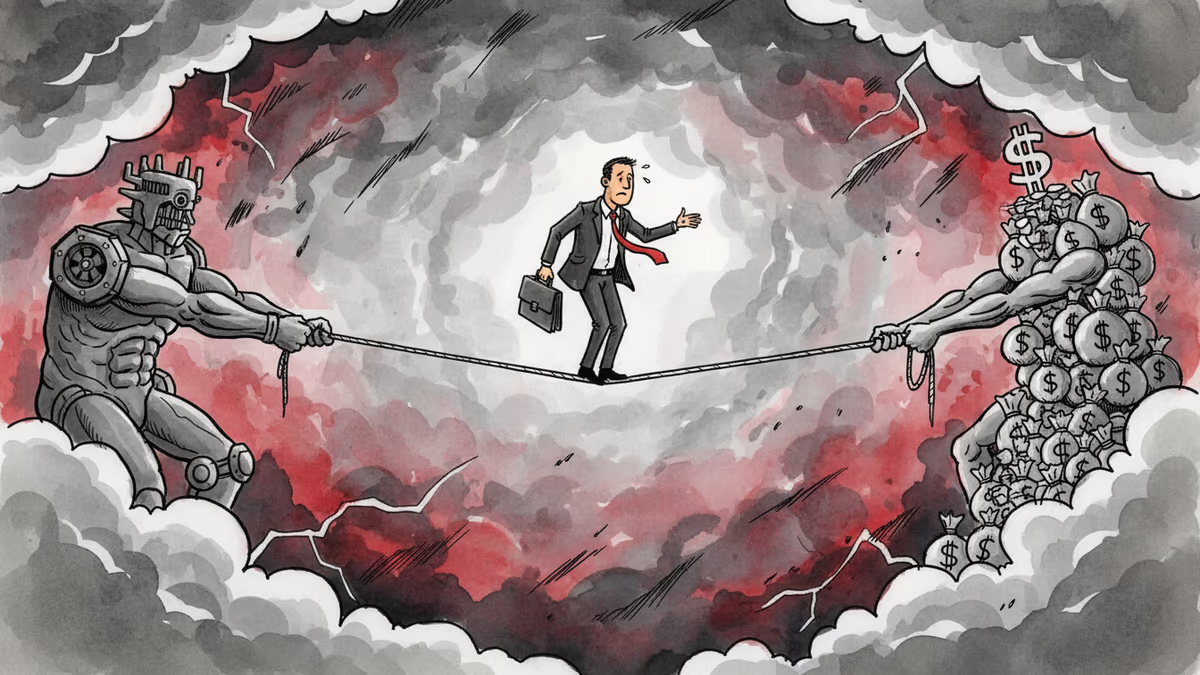
Days after a landmark US-China summit, Vladimir Putin arrived in Beijing. Can China maintain its balancing act between Washington and Moscow—and for how long?
Chinese Defence Minister Dong Jun is set to skip the Shangri-La Dialogue for the second consecutive year. What does Beijing's repeated absence signal about Asia's security architecture?
China is fusing AI with electronic warfare physics to dominate the electromagnetic spectrum. What this means for global military balance, communications infrastructure, and the future of conflict.
Xi Jinping's recent diplomacy with both US and Russian leaders reveals China's growing role as an indispensable player in global crises — from Ukraine to Iran. What does this mean for the international order?
Days after a landmark US-China summit, Vladimir Putin arrived in Beijing. Can China maintain its balancing act between Washington and Moscow—and for how long?
Thoughts
Share your thoughts on this article
Sign in to join the conversation