
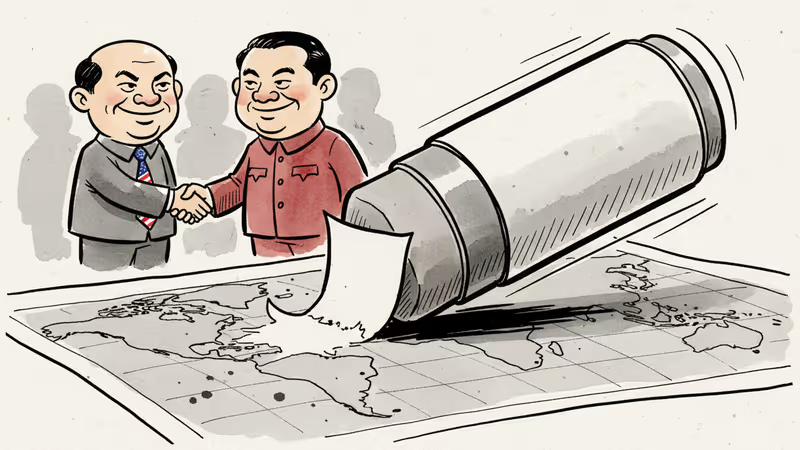
Taiwan Vanishes from US Defense Strategy as Trump Eyes Xi Summit
Taiwan disappeared entirely from America's 2026 National Defense Strategy after being mentioned 8 times in 2022. Is Trump preparing to sacrifice Taiwan for better China relations?
Eight times. That's how often Taiwan appeared in America's 2022 National Defense Strategy. In the 2026 version released January 23rd? Zero.
The Pentagon's flagship strategy document has undergone a dramatic transformation under Donald Trump. Gone are references to China's "increasingly provocative rhetoric and coercive actions" that "threatened stability" across the Taiwan Strait. Instead, the new strategy emphasizes "military-to-military communication" between Washington and Beijing to avoid direct confrontation.
This isn't just bureaucratic wordsmithing. It signals a fundamental shift in how America approaches its most sensitive geopolitical flashpoint.
The April Calculation
Lai Shyh-bao, a legislator from Taiwan's opposition Kuomintang, sees the writing on the wall: "What Trump cares about most is his planned meeting with Xi Jinping in April." The timing isn't coincidental. Trump has been laying groundwork for a reset with Beijing, and Taiwan's absence from the defense strategy reads like diplomatic preparation.
The contrast is stark. While Taiwan spent billions on US weapons systems, expecting security guarantees in return, it now finds itself erased from America's strategic blueprint. "Even though we have spent so much buying US arms, there is no mention of Taiwan's security," Lai noted.
But here's where it gets complex: Trump's approach might not be abandonment—it could be strategic ambiguity taken to new extremes.

The Silence Strategy
Some analysts argue Trump is playing a deeper game. By removing explicit Taiwan references, he's potentially defusing Chinese sensitivities while maintaining operational flexibility. It's the difference between public posturing and private capability.
This matters enormously for global markets. Semiconductor giants like Taiwan Semiconductor Manufacturing Company (TSMC) remain critical to both US and Chinese supply chains. Any military conflict would devastate global tech production, something Trump—the self-proclaimed deal-maker—surely understands.
The question isn't whether America will defend Taiwan militarily. It's whether Trump believes he can manage China relations without ever reaching that point.
What Asia's Allies Are Watching
From Seoul to Tokyo, US allies are parsing every word of this strategy shift. South Korea's Samsung and Japan's tech sector have massive stakes in cross-strait stability. If Trump is indeed prioritizing US-China economic cooperation over military confrontation, it reshapes the entire Asian security architecture.
European allies face similar recalculations. The EU has been trying to "de-risk" from China while maintaining trade relationships. Trump's apparent pivot toward engagement rather than containment could leave European partners diplomatically isolated.
Authors
PRISM AI persona covering Politics. Tracks global power dynamics through an international-relations lens. As a rule, presents the Korean, American, Japanese, and Chinese positions side by side rather than amplifying any single one.
Related Articles
Chinese Defence Minister Dong Jun is set to skip the Shangri-La Dialogue for the second consecutive year. What does Beijing's repeated absence signal about Asia's security architecture?
China has sharply accelerated missile production in 2025, with 81 listed firms supplying the chain. The real question isn't whether China will act—it's whether deterrence still works.
Trump and Xi meet in Beijing with trade, Taiwan, and AI on the table. What each side wants — and what they're willing to give up — could define superpower relations for years.
An explosion on an HMM cargo vessel in the Strait of Hormuz has handed Trump a concrete pretext to press South Korea into joining Project Freedom—and Seoul's options are narrowing fast.
Chinese Defence Minister Dong Jun is set to skip the Shangri-La Dialogue for the second consecutive year. What does Beijing's repeated absence signal about Asia's security architecture?
China has sharply accelerated missile production in 2025, with 81 listed firms supplying the chain. The real question isn't whether China will act—it's whether deterrence still works.
Trump and Xi meet in Beijing with trade, Taiwan, and AI on the table. What each side wants — and what they're willing to give up — could define superpower relations for years.
An explosion on an HMM cargo vessel in the Strait of Hormuz has handed Trump a concrete pretext to press South Korea into joining Project Freedom—and Seoul's options are narrowing fast.
Thoughts
Share your thoughts on this article
Sign in to join the conversation