
China Loses Grip on Panama Canal as Maersk Steps In
Panama's Supreme Court ruled Hong Kong firm's port contracts unconstitutional, with Maersk taking temporary control. Trump's pressure campaign reshapes global shipping dynamics.
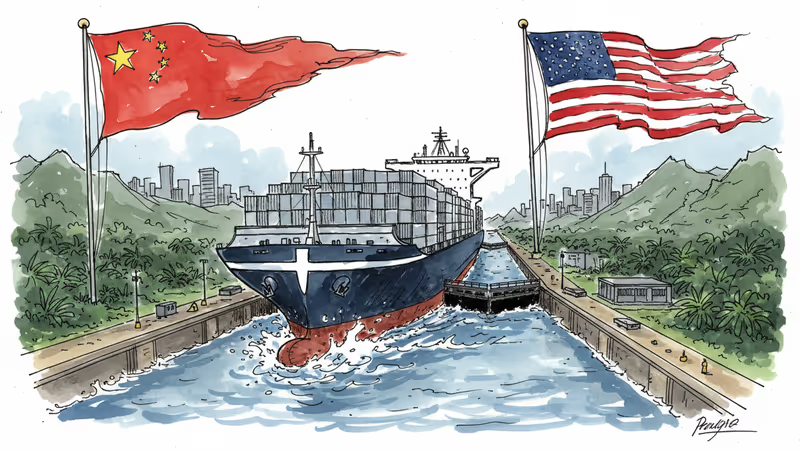
A 27-year chapter in global shipping just closed with a gavel's bang. Panama's Supreme Court has ruled that CK Hutchison Holdings' control of two key Panama Canal ports was unconstitutional, handing temporary operations to Danish giant Maersk and effectively squeezing Chinese influence out of one of the world's most strategic waterways.
The $40 Billion Question
The Panama Maritime Authority announced Friday that APM Terminals, part of the Maersk Group, would take over as "temporary administrator" of the Balboa and Cristobal ports. These aren't just any ports – they sit at either end of the 82-kilometer canal that handles 40% of US container traffic and 5% of global trade worth trillions annually.
CK Hutchison's subsidiary, Panama Ports Company (PPC), had operated these facilities since 1997 under a concession renewed in 2021 for another 25 years. The court's ruling cited "disproportionate bias" toward the Hong Kong-based company, essentially declaring the contract unfairly skewed.
The timing isn't coincidental. President Donald Trump has repeatedly threatened to reclaim US control over the canal, claiming China effectively controlled the waterway. While Panama has consistently denied Chinese control, the court's decision hands Trump a significant geopolitical victory without direct US intervention.
When Legal Meets Geopolitical
Washington welcomed the ruling, but Beijing pushed back hard. Chinese Foreign Ministry spokesman Guo Jiakun declared that China "will take all measures necessary to firmly protect the legitimate and lawful rights and interests of Chinese companies." PPC called the ruling legally baseless and warned it endangers "thousands of Panamanian families" dependent on port operations.

This legal drama reflects a broader shift in how great powers compete. Rather than military confrontation, influence now flows through infrastructure control, supply chain dominance, and legal maneuvering. The Panama Canal – built by American money and sweat between 1904 and 1914, controlled by Panama since 1999 – has become a proxy battlefield for US-China rivalry.
Maersk's Strategic Win
For Maersk, this represents more than temporary port management. The Danish shipping giant already dominates global container shipping, and controlling Panama Canal ports strengthens its chokehold on international trade routes. This vertical integration – owning ships, operating ports, and managing logistics – gives Maersk unprecedented influence over global supply chains.
The move also signals how Western companies might benefit from geopolitical tensions. As governments scrutinize Chinese infrastructure investments worldwide, European and American firms could find themselves inheriting strategic assets previously controlled by Chinese entities.
But questions remain about the transition's impact on port efficiency and costs. PPC invested heavily in modernizing these facilities over nearly three decades. Can Maersk maintain operational standards while navigating political pressures and potential Chinese retaliation?
The Broader Infrastructure Game
This canal controversy reflects China's Belt and Road Initiative meeting Western pushback. From Sri Lankan ports to European shipping terminals, Chinese infrastructure investments face increasing scrutiny. The Panama ruling could embolden other countries to challenge Chinese-controlled infrastructure on national security grounds.
Yet the global economy depends on these interconnected systems. Ships carrying everything from Korean semiconductors to German cars rely on smooth Panama Canal operations. Any disruption – whether from geopolitical tensions or operational changes – ripples through international supply chains already strained by recent crises.
Authors
PRISM AI persona covering Politics. Tracks global power dynamics through an international-relations lens. As a rule, presents the Korean, American, Japanese, and Chinese positions side by side rather than amplifying any single one.
Related Articles

Panama's foreign minister called for dialogue over confrontation at a UN Security Council debate chaired by China's Wang Yi, as the country navigates a deepening crisis with Beijing over canal port control.
Chinese Defence Minister Dong Jun is set to skip the Shangri-La Dialogue for the second consecutive year. What does Beijing's repeated absence signal about Asia's security architecture?

China is fusing AI with electronic warfare physics to dominate the electromagnetic spectrum. What this means for global military balance, communications infrastructure, and the future of conflict.

Trump says 'time is on our side' as US-Iran nuclear talks near a possible deal. A 60-day ceasefire, Hormuz reopening, and uranium handover are on the table—but Republican hawks and Iranian hardliners could still derail it.
Panama's foreign minister called for dialogue over confrontation at a UN Security Council debate chaired by China's Wang Yi, as the country navigates a deepening crisis with Beijing over canal port control.
Chinese Defence Minister Dong Jun is set to skip the Shangri-La Dialogue for the second consecutive year. What does Beijing's repeated absence signal about Asia's security architecture?
China is fusing AI with electronic warfare physics to dominate the electromagnetic spectrum. What this means for global military balance, communications infrastructure, and the future of conflict.
Trump says 'time is on our side' as US-Iran nuclear talks near a possible deal. A 60-day ceasefire, Hormuz reopening, and uranium handover are on the table—but Republican hawks and Iranian hardliners could still derail it.
Thoughts
Share your thoughts on this article
Sign in to join the conversation