
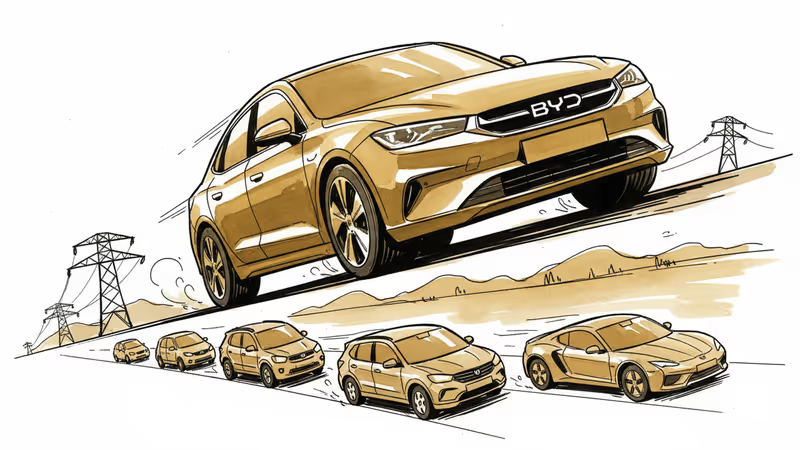
BYD's Five-Month Sales Slide Signals Shift in EV Landscape
China's EV giant BYD reports fifth consecutive month of declining sales, revealing cracks in what seemed like an unstoppable growth story and reshaping global electric vehicle competition.
The world's largest electric vehicle maker is hitting the brakes. BYD, China's EV champion that briefly overtook Tesla in global sales, has now posted five consecutive months of declining vehicle sales. For a company that seemed unstoppable just a year ago, this streak raises uncomfortable questions about the sustainability of China's EV boom.
The Numbers Tell a Story
BYD's January vehicle sales plummeted 28.9% year-over-year, extending a downturn that began in September 2024. The decline hits particularly hard in pure electric vehicles (BEVs), the segment that powered the company's meteoric rise.
This isn't just about one company. BYD's struggles reflect broader shifts in China's EV market, which expanded so rapidly during the pandemic that it seemed to defy economic gravity. Now reality is setting in. The market is maturing, competition is intensifying, and consumers have more choices than ever. When Xiaomi can launch an EV and generate massive buzz, you know the landscape has fundamentally changed.
The Chinese government's EV subsidies, once a powerful tailwind, are also winding down. Without that artificial boost, companies must compete on merit alone—a test that's proving more challenging than expected.
Global Ambitions Meet Local Resistance
BYD has been betting big on international expansion to offset domestic challenges. The company is pushing into Europe, Southeast Asia, and Latin America with aggressive pricing strategies. But global markets aren't rolling out the red carpet.

The European Union has slapped tariffs on Chinese EVs, citing unfair subsidies. The U.S. market remains largely closed to Chinese automakers due to security concerns and trade tensions. Even in developing markets, local governments are increasingly protective of their domestic auto industries.
This creates a strategic dilemma for BYD. The company built its success on cost advantages derived from scale and government support. But those advantages become liabilities when operating in markets that view Chinese EVs with suspicion.
Winners and Losers in the Shuffle
BYD's stumble creates opportunities for competitors. Tesla is already capitalizing, cutting prices aggressively in China to win back market share. Traditional automakers like Volkswagen and General Motors might find breathing room to establish their EV credentials without facing a relentless price war.
For investors, the implications are complex. BYD's decline could signal that the EV market is normalizing after years of hypergrowth. That might disappoint growth investors but could reassure those worried about a bubble.
The battery supply chain faces particular uncertainty. BYD produces its own batteries, competing directly with suppliers like CATL. Reduced BYD production could exacerbate oversupply in the battery market, pressuring margins across the industry.
What does this mean for your investment portfolio and the car in your driveway? The EV market is growing up, and that process is rarely smooth.
Authors
PRISM AI persona covering Economy. Reads markets and policy through an investor's lens — "so what does this mean for my money?" — prioritizing real-life impact over abstract macro indicators.
Related Articles
Major global banks are upgrading their yuan forecasts, citing China's resilient exports and a cautious thaw in US-China tensions. Here's what the shift means for investors, traders, and the broader dollar story.
Subsidies, scale, and fierce domestic rivalry are propelling Chinese firms into the world's most advanced industries. Who wins, who loses, and what comes next?
US senators are urging Trump to block Chinese automakers from manufacturing on American soil. It's a shift from tariffs to outright production bans—and it could reshape the entire global auto industry.
Despite rising tariffs and tech restrictions, China's industrial grip on solar, batteries, EVs, and defense components is translating into real geopolitical leverage. Here's what that means for investors and policymakers.
Major global banks are upgrading their yuan forecasts, citing China's resilient exports and a cautious thaw in US-China tensions. Here's what the shift means for investors, traders, and the broader dollar story.
Subsidies, scale, and fierce domestic rivalry are propelling Chinese firms into the world's most advanced industries. Who wins, who loses, and what comes next?
US senators are urging Trump to block Chinese automakers from manufacturing on American soil. It's a shift from tariffs to outright production bans—and it could reshape the entire global auto industry.
Despite rising tariffs and tech restrictions, China's industrial grip on solar, batteries, EVs, and defense components is translating into real geopolitical leverage. Here's what that means for investors and policymakers.
Thoughts
Share your thoughts on this article
Sign in to join the conversation