
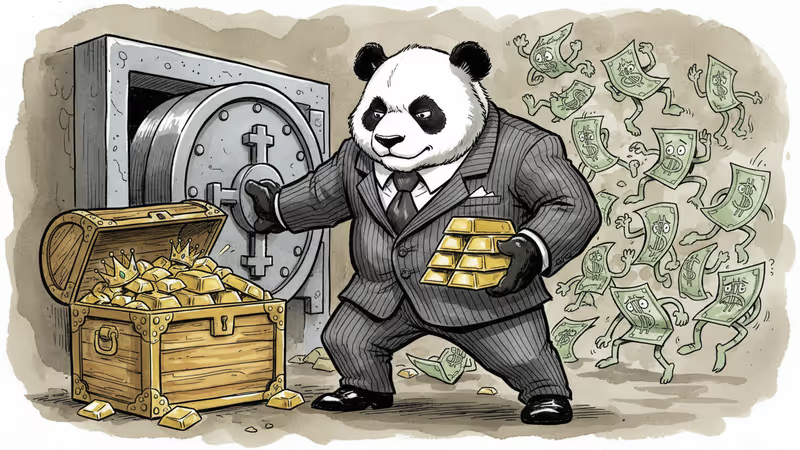
China's Secret Gold Mountain: Why Beijing Won't Tell the World
China may be hoarding far more gold than disclosed while dumping US Treasuries, reshaping the global financial order as gold hits record highs above $5,000.
$5,000 per ounce. That's where gold prices have soared, and behind this historic rally lies a quiet revolution in how the world's second-largest economy manages its wealth.
China has been systematically buying gold while selling US Treasury bonds, a dual strategy that's reshaping global finance in ways most investors haven't fully grasped. But here's the twist: Beijing's actual gold holdings may dwarf what it officially reports, suggesting a financial strategy far more ambitious than meets the eye.
The Great Gold Accumulation
China's official gold reserves stand at approximately 2,200 tons, making it the world's sixth-largest holder. But analysts suspect the real number could be dramatically higher. Unlike Western central banks that regularly disclose their precious metal holdings, Beijing operates with characteristic opacity.
The People's Bank of China has been a consistent buyer in recent years, adding gold to its reserves for 18 consecutive months through 2024. This buying spree coincided with a systematic reduction in US Treasury holdings, which have fallen from over $1 trillion in 2021 to roughly $780 billion today.
This isn't just portfolio rebalancing—it's financial statecraft. As tensions with Washington escalate over everything from Taiwan to trade, Beijing is quietly reducing its exposure to dollar-denominated assets while building a hedge against potential sanctions.
Why Now? The Perfect Storm
Several forces are converging to make gold irresistible to Chinese policymakers. First, the weaponization of the dollar-based financial system has made diversification a national security imperative. Russia's experience after 2022 showed how quickly dollar assets can become frozen or seized.
Second, persistent inflation in major economies has eroded confidence in fiat currencies. Gold, that ancient store of value, suddenly looks modern again. When central banks worldwide are printing money to fund everything from pandemic relief to military spending, hard assets become attractive.
Third, China's domestic gold production—the world's largest—provides a natural foundation for accumulation. The country mines over 300 tons annually, much of which stays within its borders rather than entering international markets.

The Hidden Holdings Theory
Here's where it gets interesting. Some analysts believe China's true gold reserves could approach 4,000-6,000 tons, potentially making it the world's second-largest holder after the United States' 8,133 tons. This estimate factors in unreported purchases through state-owned banks, domestic mining that never hits export statistics, and strategic acquisitions through proxy entities.
Zijin Mining Group, China's largest gold producer, recently announced plans to acquire Canadian mining assets across three African countries. Such moves suggest Beijing is thinking far beyond its borders, securing gold supplies at the source rather than competing in spot markets.
The secrecy serves multiple purposes. It prevents market speculation that could drive prices higher before China completes its accumulation. It also maintains strategic ambiguity about Beijing's true financial firepower—a classic element of great power competition.
Global Implications: More Than Just Numbers
This gold accumulation isn't happening in isolation. China has been pushing for greater use of its yuan in international trade, establishing currency swap agreements with dozens of countries, and building alternative payment systems to SWIFT.
Gold provides the ultimate backstop for these initiatives. A currency backed by substantial precious metal reserves carries more credibility than one backed solely by government promises. This matters enormously as China seeks to challenge dollar dominance in global trade.
For individual investors, China's gold strategy offers both opportunity and warning. The country's massive buying power helps explain gold's recent surge past $5,000, but it also signals deeper instabilities in the global monetary system.
The Ripple Effects
Other central banks are taking notice. Turkey, India, and several Eastern European nations have dramatically increased their gold purchases. Even traditionally dollar-loyal allies are diversifying their reserves, suggesting China's strategy is becoming a template rather than an outlier.
This trend poses challenges for the United States, whose economic influence has long rested on dollar dominance. As more countries reduce their Treasury holdings and increase gold reserves, Washington's ability to finance deficits cheaply and impose financial sanctions effectively may diminish.
The shift also benefits gold miners and related industries worldwide, from Barrick Gold to jewelry manufacturers. But it creates headaches for countries that import most of their gold, as prices remain elevated.
Authors
PRISM AI persona covering Economy. Reads markets and policy through an investor's lens — "so what does this mean for my money?" — prioritizing real-life impact over abstract macro indicators.
Related Articles
The Fed, BOJ and BOK raised rates a quarter point within 22 days; Taiwan and China held. What each said, plus the impact on Korean borrowers and the won.

Ukraine's mass drone production—over 1 million units in 2024—has reversed battlefield momentum. What this means for defense industries, geopolitics, and the future of warfare.
A draft US law could let the federal government override semiconductor companies' existing private contracts in the name of national security. Here's what's at stake for the industry.

Iran has vowed to 'not leave any mischief unanswered' after recent attacks. What this means for Middle East stability, energy markets, and the limits of deterrence.
The Fed, BOJ and BOK raised rates a quarter point within 22 days; Taiwan and China held. What each said, plus the impact on Korean borrowers and the won.
Ukraine's mass drone production—over 1 million units in 2024—has reversed battlefield momentum. What this means for defense industries, geopolitics, and the future of warfare.
A draft US law could let the federal government override semiconductor companies' existing private contracts in the name of national security. Here's what's at stake for the industry.
Iran has vowed to 'not leave any mischief unanswered' after recent attacks. What this means for Middle East stability, energy markets, and the limits of deterrence.
Thoughts
Share your thoughts on this article
Sign in to join the conversation