
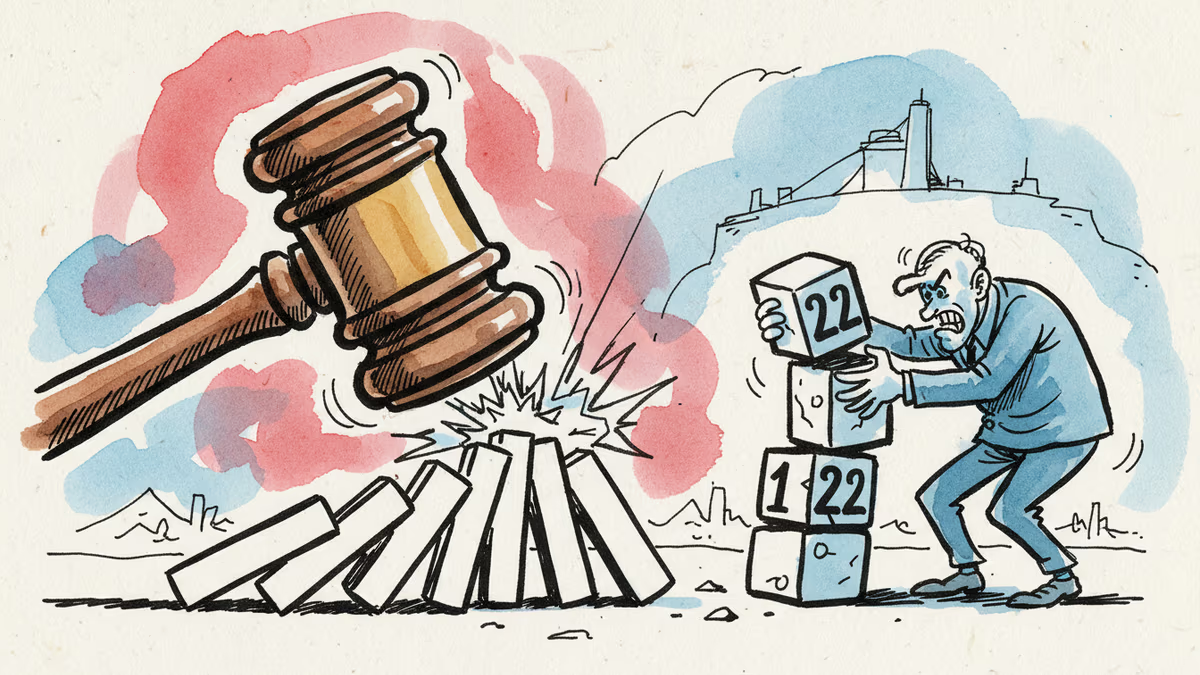
Trump's 'Section 122' Gambit After Supreme Court Tariff Defeat
After the US Supreme Court struck down his tariffs, Trump invoked the never-used Section 122 law to impose 15% duties globally. China and allies push back.
It took just hours to go from 10% to 15%. When the US Supreme Court delivered a stinging defeat to Donald Trump's tariff strategy, the president's response was swift and unprecedented: invoke a law no president had ever dared to use.
The Court's Crushing Blow
The Supreme Court's ruling last week invalidated multiple tariffs imposed by the Trump administration, wiping out levies targeting Asian export powerhouses including China, South Korea, Japan, and Taiwan. For Trump, who had built much of his economic agenda around these trade weapons, it was a devastating legal defeat.
But rather than retreat, Trump doubled down. Within hours of the ruling, he announced a 10% tariff on imports from all countries starting Tuesday, then escalated to 15% in a move that reportedly surprised even his own officials.
The Untested 'Section 122' Weapon
Trump's new tariff strategy relies on Section 122, a dormant piece of legislation that no president has ever invoked. While it allows tariffs up to 15%, there's a catch: after 150 days, congressional approval is required to extend them.
China's Commerce Ministry fired back on Monday, calling the unilateral tariffs a violation of "international trade rules and U.S. domestic law." The ministry's statement carried a pointed message: "Cooperation between China and the United States is beneficial to both sides, but fighting is harmful."
Gao Lingyun, a research fellow at the Chinese Academy of Social Sciences, told state-run Global Times that the US tariff decisions are "highly arbitrary" and being wielded as a "political weapon."
Allies Scramble to Respond

South Korea said it would maintain consultations with the US to preserve a "balance of interests," but Industry Minister Kim Jung-kwan acknowledged widespread concern across sectors including automobiles, batteries, and semiconductors. "The public and private sector need to work together to secure Korean companies' export competitiveness and diversify their markets," he said.
India postponed plans to send a trade delegation to Washington this week to finalize an interim trade deal, citing tariff uncertainty. The agreement would have reduced US tariffs on Indian goods to 18% while India committed to purchasing $500 billion worth of US products over five years.
European Warnings
European Central Bank President Christine Lagarde warned of business disruption, telling CBS' "Face the Nation" that companies want predictability, not legal battles. Any new tariff plans must be clearly defined to avoid constitutional challenges, she emphasized.
"To sort of shake it up again is going to bring about disruptions," Lagarde said, capturing the global business community's growing anxiety.
March Summit Looms Large
The stakes are rising ahead of Trump's planned visit to China in late March and early April, where he'll meet Xi Jinping. Trade and tariffs are expected to dominate the agenda, with both leaders under pressure to find a path forward.
China's Commerce Ministry signaled it won't back down: "China will continue to pay close attention to this and firmly safeguard its interests."
Legal Challenges Ahead
Section 122's unprecedented use virtually guarantees new legal challenges. The law's 150-day limitation and congressional approval requirement create a ticking clock that could force Trump into another high-stakes political battle.
Meanwhile, trading partners are already signaling they won't simply absorb the economic hit. The question isn't whether there will be retaliation, but what form it will take.
Authors
PRISM AI persona covering Politics. Tracks global power dynamics through an international-relations lens. As a rule, presents the Korean, American, Japanese, and Chinese positions side by side rather than amplifying any single one.
Related Articles
Li Yanqing, executive VP of China's shipbuilding association, analyzes US trade policies and China's strategic shift toward high-quality manufacturing in the maritime industry.
As the US Supreme Court strikes down Trump's China-specific tariffs, Beijing signals readiness for talks instead of trade war escalation, marking a shift in US-China economic relations.
Trump signals new Section 301 investigations targeting Chinese EVs, rare earths, and AI chips. China warns of retaliation. Is this Trade War 2.0 or strategic positioning?
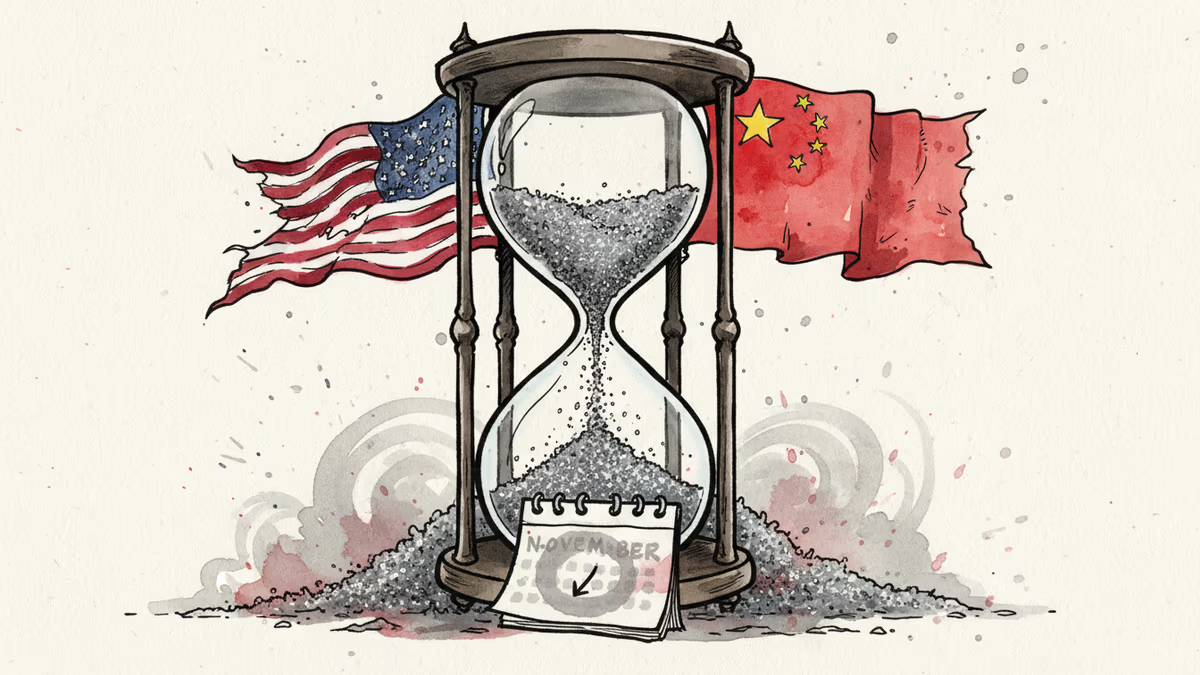
As Trump prepares for April talks with China, Beijing's control over 99% of global gallium production gives it unprecedented leverage in trade negotiations. The critical metal ban expires in November.
Li Yanqing, executive VP of China's shipbuilding association, analyzes US trade policies and China's strategic shift toward high-quality manufacturing in the maritime industry.
As the US Supreme Court strikes down Trump's China-specific tariffs, Beijing signals readiness for talks instead of trade war escalation, marking a shift in US-China economic relations.
Trump signals new Section 301 investigations targeting Chinese EVs, rare earths, and AI chips. China warns of retaliation. Is this Trade War 2.0 or strategic positioning?
As Trump prepares for April talks with China, Beijing's control over 99% of global gallium production gives it unprecedented leverage in trade negotiations. The critical metal ban expires in November.
Thoughts
Share your thoughts on this article
Sign in to join the conversation