
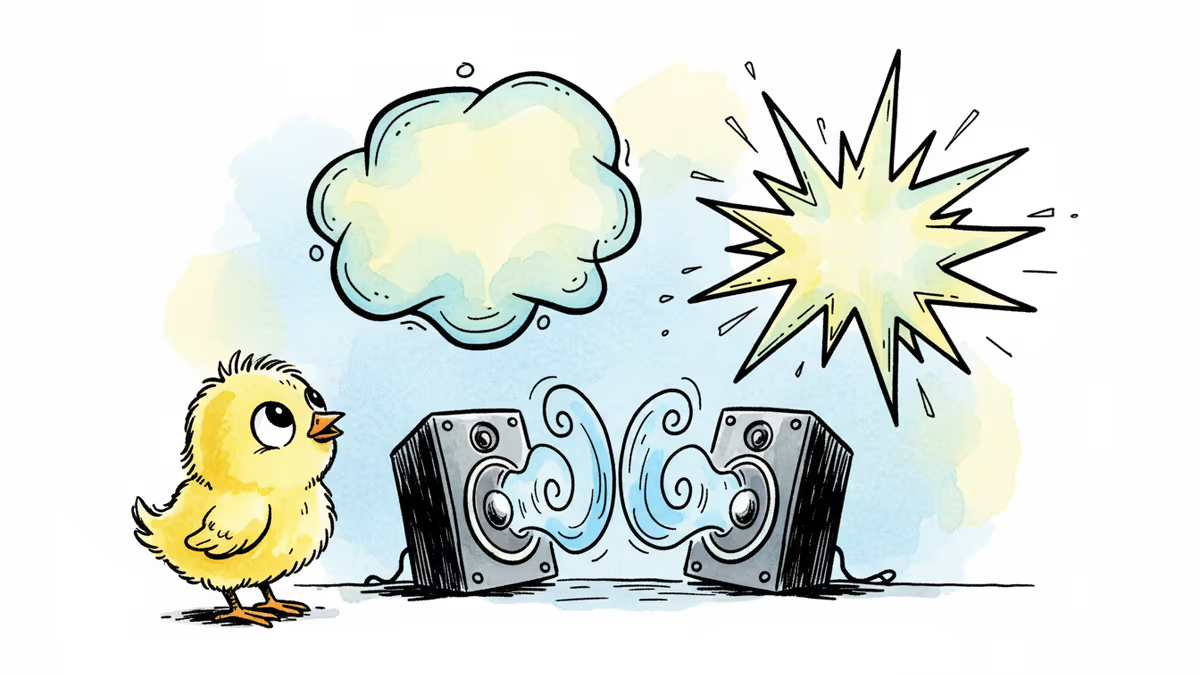
Baby Chicks Hear 'Bouba' as Round Too
A decades-old language-shape connection phenomenon shown by chicks raises new questions about the origins of human linguistic abilities and universal cognitive patterns.
What 80 Years of Research Just Got Wrong
Say "bouba" out loud. Does it sound round to you? Now try "kiki" – spiky, right? This isn't just linguistic quirk. It's a phenomenon that's puzzled scientists since 1947, when researchers first discovered that people consistently match certain sounds with specific shapes, even when the "words" are completely made up.
Now, in perhaps the strangest twist yet, newly hatched chicks – who've never heard human language – show the same pattern. The implications are staggering.
The Human Exceptionalism Theory
For decades, the bouba/kiki effect seemed like evidence of human uniqueness. Early theories suggested it came from familiarity with real words or the visual appearance of letters. But when studies expanded to include speakers of different languages and writing systems, those ideas crumbled. The effect appeared universal across human cultures.
The real shocker came when researchers tested 4-month-old infants – babies who couldn't yet speak or read. They showed the same sound-shape associations. Meanwhile, experiments with other primates came up empty. No bouba/kiki effect in our closest evolutionary relatives.
This led to a compelling hypothesis: maybe the bouba/kiki effect was evidence of a uniquely human cognitive ability that underlies our capacity for complex language. A neurological foundation that separates us from other species.

Enter the Chicks
Then came the chickens. Researchers played "bouba" and "kiki" sounds to newly hatched chicks while showing them round and spiky shapes. The results? The chicks showed the same associations humans do.
Suddenly, the "uniquely human" theory doesn't look so unique. If day-old chicks – with no language, no culture, no exposure to human concepts – can make these connections, what does that say about the nature of the effect itself?
Rethinking the Foundations
The chick study forces us to reconsider everything. Perhaps the bouba/kiki effect isn't about language at all, but about something more fundamental – how brains process sensory information and find patterns across different senses.
This could explain why the effect appears so early in human development and across cultures. It might not be a building block for language, but rather a basic feature of how nervous systems work. A kind of cross-modal processing that evolution has preserved across vastly different species.
The Bigger Questions
If chicks and humans share this ability, what other "uniquely human" traits might actually be more widespread? The research challenges our assumptions about consciousness, perception, and the origins of meaning itself.
For AI researchers, this raises intriguing questions about how artificial systems might develop similar cross-modal associations. For cognitive scientists, it suggests that the building blocks of perception might be far more ancient and universal than previously thought.
Authors
Related Articles

Archaeologists found traces of plant poison on 60,000-year-old arrowheads, proving prehistoric humans used complex chemical hunting strategies.
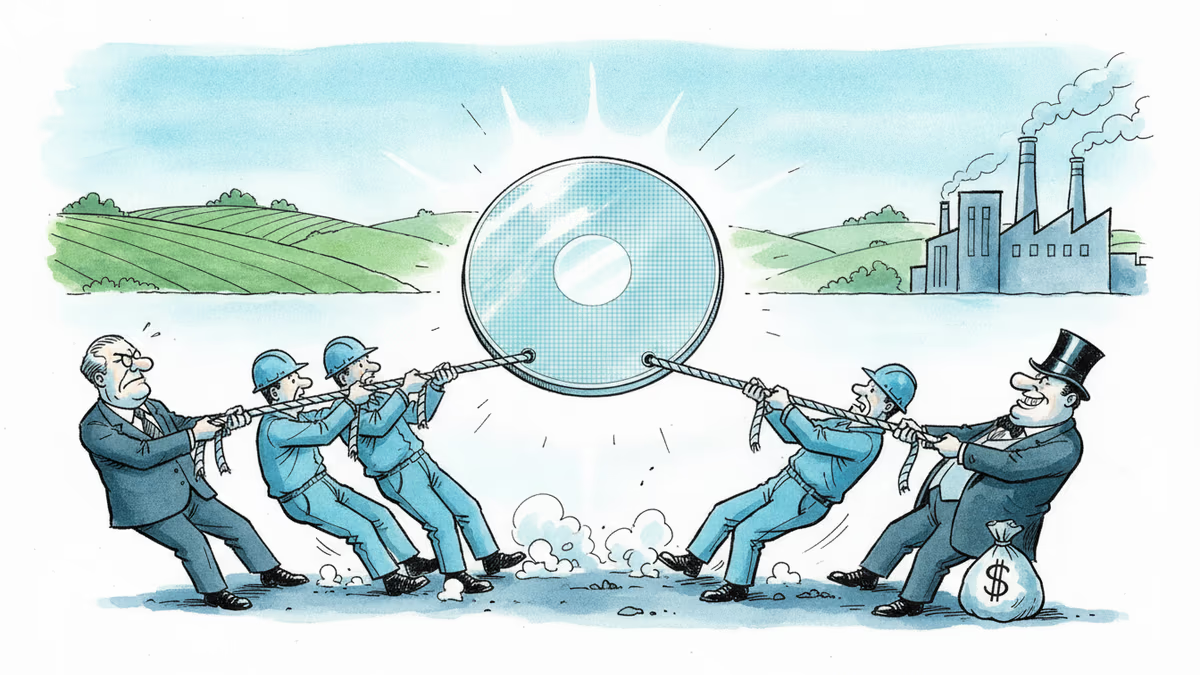
Samsung Electronics' union branch revealed that 84% of survey respondents oppose the government's roughly $290 billion (₩400 trillion) semiconductor megaproject in Gwangju. Government, management, the union and shareholders are all reading the same national project in sharply different ways.

Nvidia shipped roughly a billion RISC-V cores in 2024, then announced it would run CUDA on the open standard. We break down how royalty-free instruction sets and open software stacks are trying to route around CUDA's lock-in. Part 2 of the Semiconductor Sovereignty series.
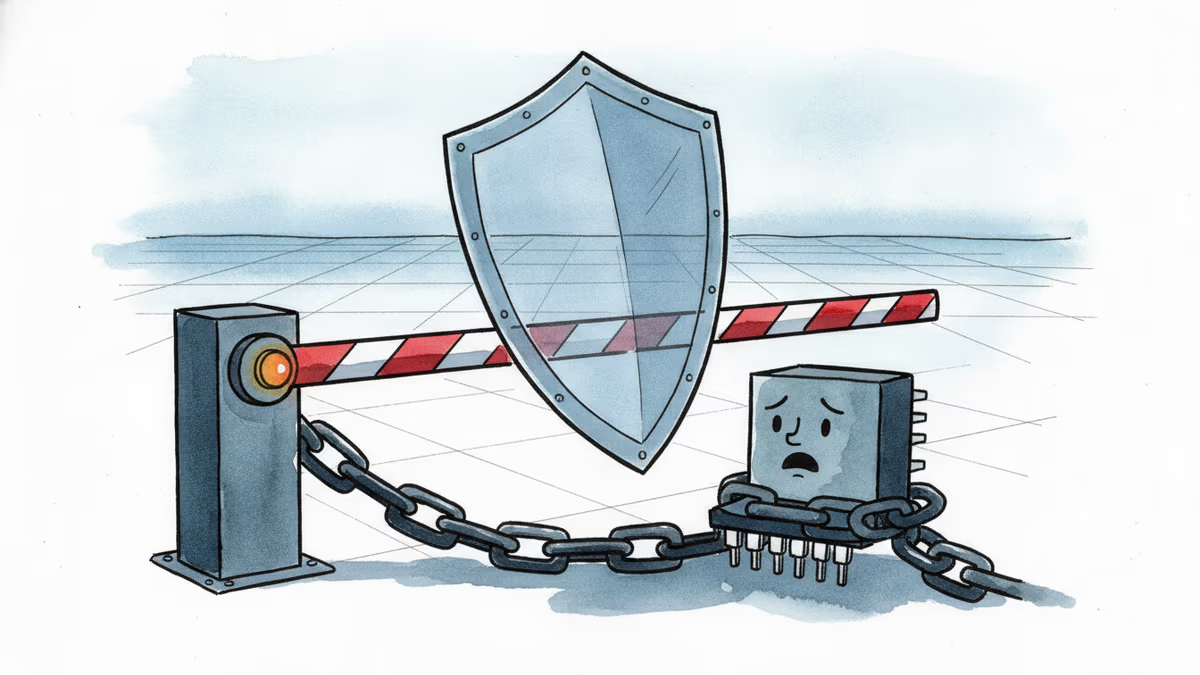
US AI-chip export controls split into three layers in the first half of 2026 — January easing, a May crackdown on circumvention, and a pending bill. Nvidia erased China from its guidance and still posted a record $81.6 billion quarter. A look at the export policy that both shields and cages it.
Archaeologists found traces of plant poison on 60,000-year-old arrowheads, proving prehistoric humans used complex chemical hunting strategies.
Samsung Electronics' union branch revealed that 84% of survey respondents oppose the government's roughly $290 billion (₩400 trillion) semiconductor megaproject in Gwangju. Government, management, the union and shareholders are all reading the same national project in sharply different ways.
Nvidia shipped roughly a billion RISC-V cores in 2024, then announced it would run CUDA on the open standard. We break down how royalty-free instruction sets and open software stacks are trying to route around CUDA's lock-in. Part 2 of the Semiconductor Sovereignty series.
US AI-chip export controls split into three layers in the first half of 2026 — January easing, a May crackdown on circumvention, and a pending bill. Nvidia erased China from its guidance and still posted a record $81.6 billion quarter. A look at the export policy that both shields and cages it.
Thoughts
Share your thoughts on this article
Sign in to join the conversation