
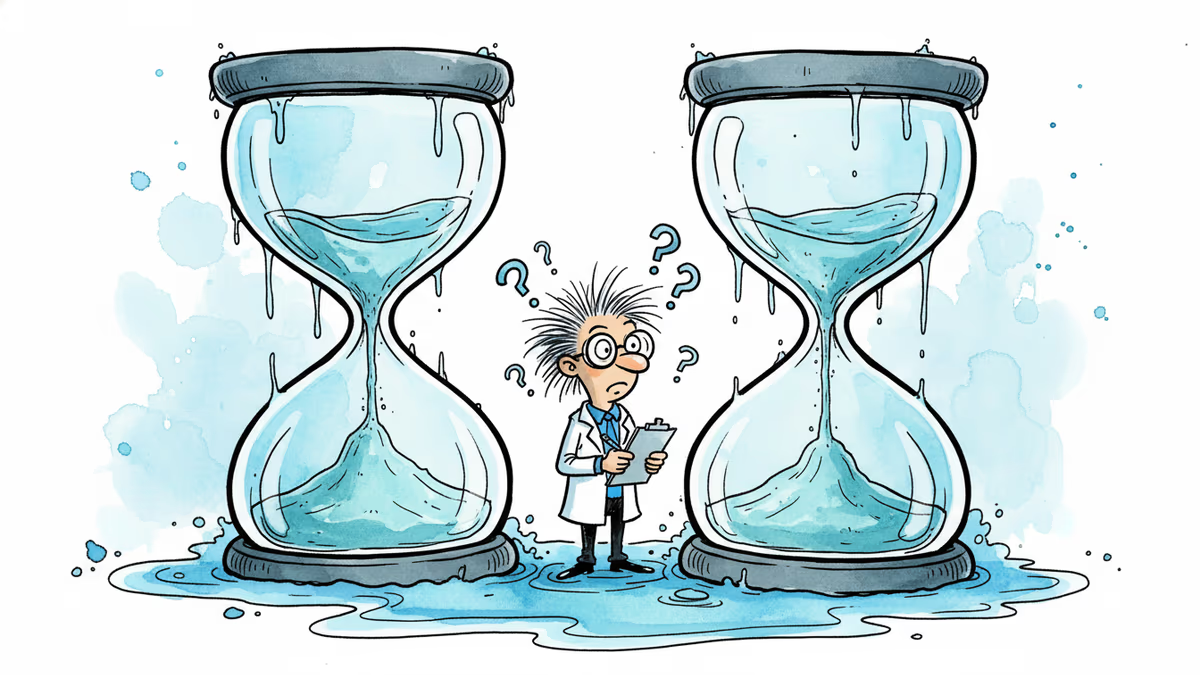
What If Cause and Effect Are Just a Suggestion?
A new quantum experiment suggests the order of events can exist in superposition—A before B and B before A simultaneously. Here's why that matters beyond the physics lab.
Everything you know about cause and effect assumes one thing: A comes before B. A new quantum experiment is quietly dismantling that assumption.
The Experiment That Asks Whether "First" Means Anything
A few weeks ago, a team of physicists published results from an experiment designed to probe one of the strangest ideas in modern physics: that the order of two events can itself exist in quantum superposition. Not just that we don't know which happened first—but that both orderings are simultaneously real until a measurement forces the question.
This isn't a thought experiment. The researchers constructed a physical setup where two distinct causal sequences—call them A→B and B→A—coexist in superposition. The concept has a name: quantum switch, a theoretical framework that has been discussed for over a decade. What's new is the experimental push to close the loopholes that have kept skeptics at bay. The team acknowledges those loopholes still exist, but argues they are, in principle, eliminable.
To understand why this matters, consider a related experiment that surfaced roughly 10 years ago. One half of an entangled photon pair was sent through a device; afterward, a measurement on the other half retroactively determined how the first had behaved the whole time—as a particle or as a wave. It looked, uncomfortably, like measurement had rewritten the past. That experiment raised questions. This new one is attempting to answer them with far greater precision.
Why Physicists Are Excited (and Cautious)
The implications split across two domains: pure physics and applied technology.

On the physics side, causality—the principle that causes precede effects—is foundational not just to classical mechanics but to general relativity itself. Quantum mechanics has long been uncomfortable with this. If causal order can be placed in superposition, it opens a new angle on the most stubborn problem in theoretical physics: reconciling general relativity with quantum mechanics. The two theories describe reality at different scales and have refused to merge cleanly for nearly a century. A universe where causal order is probabilistic at the quantum level might be the conceptual bridge that's been missing.
On the applied side, quantum computing researchers have already shown theoretically that indefinite causal order can improve the efficiency of certain computational tasks. Specifically, when information is transmitted through noisy quantum channels, maintaining the order of those channels in superposition can outperform any fixed-order strategy. That's not a marginal gain—it's a structural advantage that no classical algorithm can replicate.
IBM, Google, Microsoft, and a growing field of startups are racing to make quantum computers fault-tolerant and commercially viable. The timeline for practical quantum advantage is still measured in years, not months. But the foundational research happening now—including experiments like this one—is what determines which architectural bets pay off in 2035.
Three Ways to Read This Result
For quantum researchers, the reaction is disciplined optimism. The loopholes matter. Extraordinary claims about causality require airtight experimental design, and the team is the first to say they're not there yet. But the fact that a path to closing those loopholes exists is itself significant.
For the tech industry, this is the kind of basic science that doesn't show up in a product roadmap for years, then suddenly reorganizes an entire field. The history of computing is littered with examples: the transistor, error-correcting codes, public-key cryptography. Each was "just physics" or "just math" until it wasn't.
For philosophers and cognitive scientists, the discomfort runs deeper. Human cognition is built around linear time. Language, law, moral responsibility, narrative—all of it assumes that causes come before effects. If quantum systems operate under different rules, the question isn't just "how do we build better computers?" It's whether our conceptual frameworks are adequate tools for understanding a universe that may not share our intuitions about time.
There's also a regulatory and ethical dimension that hasn't yet entered the conversation. Quantum computing's potential to break current encryption standards is already prompting governments and standards bodies like NIST to accelerate post-quantum cryptography. If indefinite causal order becomes a practical resource—a feature, not just a curiosity—the security implications extend further than anyone has mapped.
Authors
Related Articles

The US government invested $2 billion in quantum computing startups, but Congress says the money was never authorized for that purpose. The fate of IBM-backed Anderon hangs in the balance.
IBM's quantum computer contributed to synthesizing a half-Möbius topology molecule. What this experiment reveals about quantum computing's slow march toward real-world utility.

The SandboxAQ Jack Hidary lawsuit 2026 reveals allegations of financial misconduct and misuse of funds. PRISM examines the battle within the $5.75B startup.

Chinese researchers have achieved a critical milestone in quantum computing with their Zuchongzhi 3.2 processor, reaching the fault-tolerant threshold. They are now the second team globally, after Google, to clear this hurdle, intensifying the tech race.
The US government invested $2 billion in quantum computing startups, but Congress says the money was never authorized for that purpose. The fate of IBM-backed Anderon hangs in the balance.
IBM's quantum computer contributed to synthesizing a half-Möbius topology molecule. What this experiment reveals about quantum computing's slow march toward real-world utility.
The SandboxAQ Jack Hidary lawsuit 2026 reveals allegations of financial misconduct and misuse of funds. PRISM examines the battle within the $5.75B startup.
Chinese researchers have achieved a critical milestone in quantum computing with their Zuchongzhi 3.2 processor, reaching the fault-tolerant threshold. They are now the second team globally, after Google, to clear this hurdle, intensifying the tech race.
Thoughts
Share your thoughts on this article
Sign in to join the conversation