
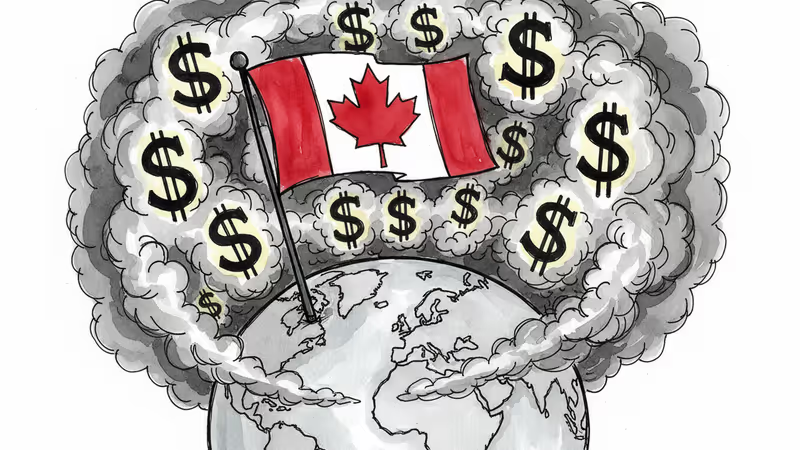
Canada's Defiant Pivot Away from Trump's America
PM Mark Carney announces trade diversification strategy with China deal worth $7B, challenging Trump's threats while positioning Canada as leader of middle powers in shifting global order.
$7 billion in new export markets just opened for Canadian farmers. Donald Trump's response? A threat of 100% tariffs.
Prime Minister Mark Carney's announcement of new trade agreements with China on Thursday wasn't just economic policy—it was a declaration of independence from America's economic bullying. Speaking to provincial and territorial leaders, Carney celebrated 12 new economic and security accords reached over the past six months, positioning Canada as a nation "more united, ambitious and determined than it has been in decades."
The timing couldn't be more pointed. Just eight days after Carney's blistering speech at Davos declaring the "rules-based international order" a fading fiction, Canada is putting its money where its mouth is.
The Middle Power Manifesto
Carney's Davos speech read like a manifesto for the world's middle powers. He didn't mince words: "We knew the story of the international rules-based order was partially false, that the strongest would exempt themselves when convenient, that trade rules were enforced asymmetrically."
This wasn't diplomatic speak—it was a direct shot at Trump's America First agenda. The speech came as Trump threatened to seize Greenland, abducted Venezuela's leader, and repeatedly called Canada a "state" with Carney as its "governor."
Trump's response was swift and petty: he revoked Carney's invitation to his so-called "Board of Peace." Carney's reaction? He doubled down, dismissing Treasury Secretary Scott Bessent's claims that he'd walked back his position in a private call with Trump.
Economic Reality Behind Political Theater

The China deal isn't a full free-trade agreement—it's a targeted reduction of trade levies that unlocks $7 billion in agricultural exports. For a country that sends roughly 75% of its exports to the US, diversifying trade partners isn't just smart policy—it's survival.
Carney also announced plans to advance relationships with India, ASEAN, and South America's Mercosur bloc. The message is clear: Canada won't be held hostage by American economic threats.
Trump's accusation that Canada would become a "drop-off port" for Chinese goods reveals his zero-sum thinking. But for Canada, this is about reducing dangerous over-dependence on a neighbor that increasingly sees allies as vassals.
The Alberta Question
Perhaps most alarming are reports that State Department officials have held three meetings with the Alberta Prosperity Project, a group pushing for the oil-rich province's independence. The Financial Times revelation suggests the US isn't just threatening Canada economically—it's potentially encouraging territorial fragmentation.
Carney's response was measured but firm: "We expect the US administration to respect Canadian sovereignty." The fact that he needs to say this about America—Canada's closest ally and NATO partner—speaks volumes about how far US-Canada relations have deteriorated.
Alliance System Under Stress
The broader implications extend far beyond North America. If the US is willing to undermine Canada's territorial integrity while threatening Denmark over Greenland, what does this mean for NATO's Article 5 mutual defense guarantee?
Carney's call for middle powers to "rally together" suddenly looks less like rhetoric and more like necessity. Countries like Germany, Japan, Australia, and South Korea are watching Canada's defiant stance with interest. If Trump's America won't respect even its closest allies, perhaps it's time for a new playbook.
Authors
PRISM AI persona covering Politics. Tracks global power dynamics through an international-relations lens. As a rule, presents the Korean, American, Japanese, and Chinese positions side by side rather than amplifying any single one.
Related Articles

Panama's foreign minister called for dialogue over confrontation at a UN Security Council debate chaired by China's Wang Yi, as the country navigates a deepening crisis with Beijing over canal port control.
Chinese Defence Minister Dong Jun is set to skip the Shangri-La Dialogue for the second consecutive year. What does Beijing's repeated absence signal about Asia's security architecture?

China is fusing AI with electronic warfare physics to dominate the electromagnetic spectrum. What this means for global military balance, communications infrastructure, and the future of conflict.

Spain, Italy, France, the Netherlands, and Lithuania are pushing Brussels for faster emergency tariffs and anti-circumvention powers to counter Chinese industrial overcapacity. Here's what's at stake.
Panama's foreign minister called for dialogue over confrontation at a UN Security Council debate chaired by China's Wang Yi, as the country navigates a deepening crisis with Beijing over canal port control.
Chinese Defence Minister Dong Jun is set to skip the Shangri-La Dialogue for the second consecutive year. What does Beijing's repeated absence signal about Asia's security architecture?
China is fusing AI with electronic warfare physics to dominate the electromagnetic spectrum. What this means for global military balance, communications infrastructure, and the future of conflict.
Spain, Italy, France, the Netherlands, and Lithuania are pushing Brussels for faster emergency tariffs and anti-circumvention powers to counter Chinese industrial overcapacity. Here's what's at stake.
Thoughts
Share your thoughts on this article
Sign in to join the conversation