
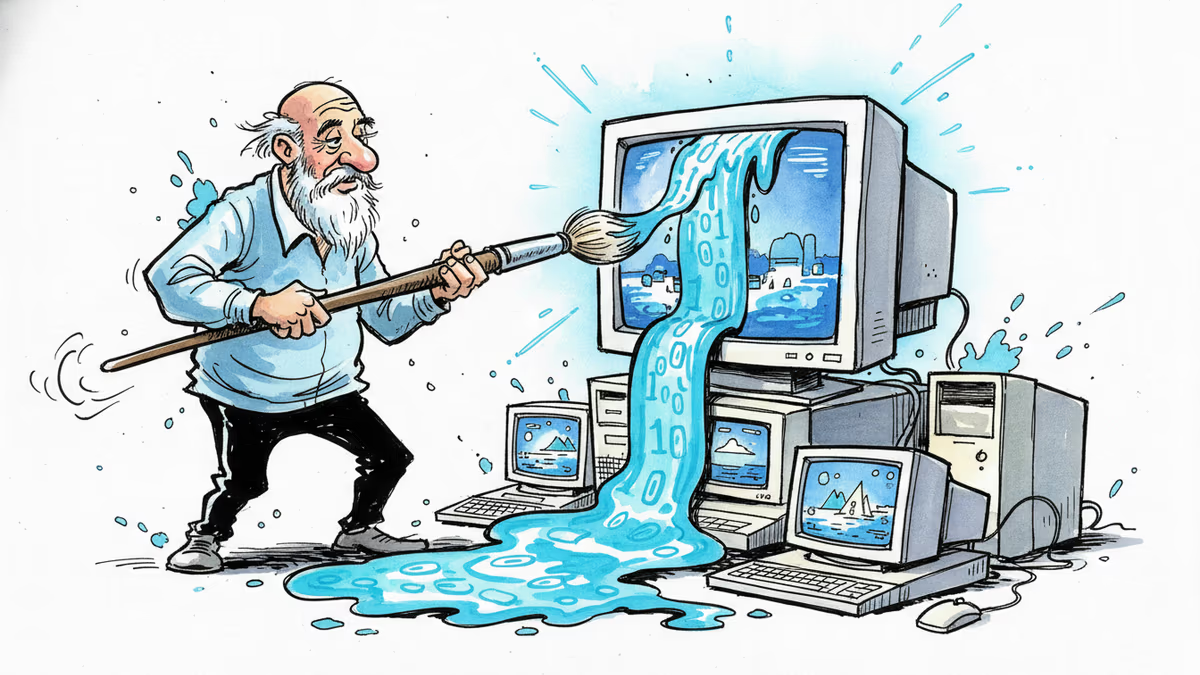
The Artist Who Gave Computing Its First Visual Language
Robert Tinney's death marks the end of an era when one illustrator's airbrush paintings shaped how a generation imagined personal computers
80 Covers That Taught the World What Computers Look Like
On February 1st, Robert Tinney died at 78 in Baker, Louisiana. You might not know his name, but you've probably seen his work. For over a decade, from 1975 to the late 1980s, Tinney painted the covers of Byte magazine—and in doing so, became the first person to give personal computing a visual identity.
This wasn't just commercial illustration. Tinney was translating an entirely abstract world into concrete images that people could understand. Artificial intelligence, networking, programming—concepts that barely existed in popular consciousness—suddenly had faces, thanks to his surrealist-influenced airbrush paintings.
When Computers Had No Face
Consider the challenge Tinney faced in 1975. Personal computers didn't really exist yet. The Apple II wouldn't launch until 1977, the IBM PC until 1981. Most people's idea of a "computer" came from science fiction: room-sized machines with blinking lights, or HAL's glowing red eye from 2001: A Space Odyssey.
Tinney worked almost exclusively in airbrushed Designers Gouache, choosing the medium for its "opaque, intense colors and smooth finish." Each cover took about a week to paint once the design was approved. He'd start with phone conversations with editors about the issue's theme, then translate abstract technical concepts into what he called "visual metaphors."
The Magritte of Microprocessors

Tinney cited René Magritte and M.C. Escher as influences, and it showed. His covers had that same sense of impossible logic—computers that grew like plants, data that flowed like water, circuits that resembled neural networks decades before anyone talked about AI that way. He wasn't just illustrating technology; he was imagining what it could become.
This visual language became incredibly influential. Throughout the 1980s, tech magazines worldwide borrowed Tinney's aesthetic. Even today, when we see floating screens, glowing interfaces, or anthropomorphized robots in tech marketing, we're seeing echoes of visual concepts Tinney pioneered.
The Feedback Loop of Imagination
Here's what's fascinating: Tinney's computers were often more elegant and futuristic than the actual machines being sold. But those idealized images created expectations. Engineers and designers saw his covers and thought, "That's what computers should look like." The visual preceded the reality.
This phenomenon continues today. Think about how AI is marketed—sleek interfaces, glowing neural networks, friendly robot assistants. These images shape public expectations and, ultimately, product development. Companies don't just build technology; they build toward an aesthetic ideal.
Beyond the Tech Bubble
Tinney's work reached far beyond Silicon Valley. Byte had a global readership, including many in countries where personal computers were still exotic. His covers served as a universal language, communicating complex ideas through imagery that transcended cultural and linguistic barriers.
For many readers in the 1980s, Tinney's covers were their first introduction to concepts we now take for granted: user interfaces, computer graphics, even the idea that humans and machines could work together creatively. His paintings didn't just document the computer revolution; they helped people envision participating in it.
Authors
Related Articles

Harvey, valued at $8 billion, has acquired Hexus to strengthen its legal AI tools for enterprise clients. Discover the strategy behind this aggressive expansion.

Discover why Japanese planners like Hobonichi and Kokuyo are gaining global popularity. We break down the key differences in paper quality, design, and customization compared to American brands.
Reviewing the Grado Signature S750 headphones. A deep dive into the $1,675 audiophile cans that offer sublime sound but suffer from a flawed, uncomfortable design.
Samsung Electronics' union branch revealed that 84% of survey respondents oppose the government's roughly $290 billion (₩400 trillion) semiconductor megaproject in Gwangju. Government, management, the union and shareholders are all reading the same national project in sharply different ways.
Harvey, valued at $8 billion, has acquired Hexus to strengthen its legal AI tools for enterprise clients. Discover the strategy behind this aggressive expansion.
Discover why Japanese planners like Hobonichi and Kokuyo are gaining global popularity. We break down the key differences in paper quality, design, and customization compared to American brands.
Reviewing the Grado Signature S750 headphones. A deep dive into the $1,675 audiophile cans that offer sublime sound but suffer from a flawed, uncomfortable design.
Samsung Electronics' union branch revealed that 84% of survey respondents oppose the government's roughly $290 billion (₩400 trillion) semiconductor megaproject in Gwangju. Government, management, the union and shareholders are all reading the same national project in sharply different ways.
Thoughts
Share your thoughts on this article
Sign in to join the conversation