
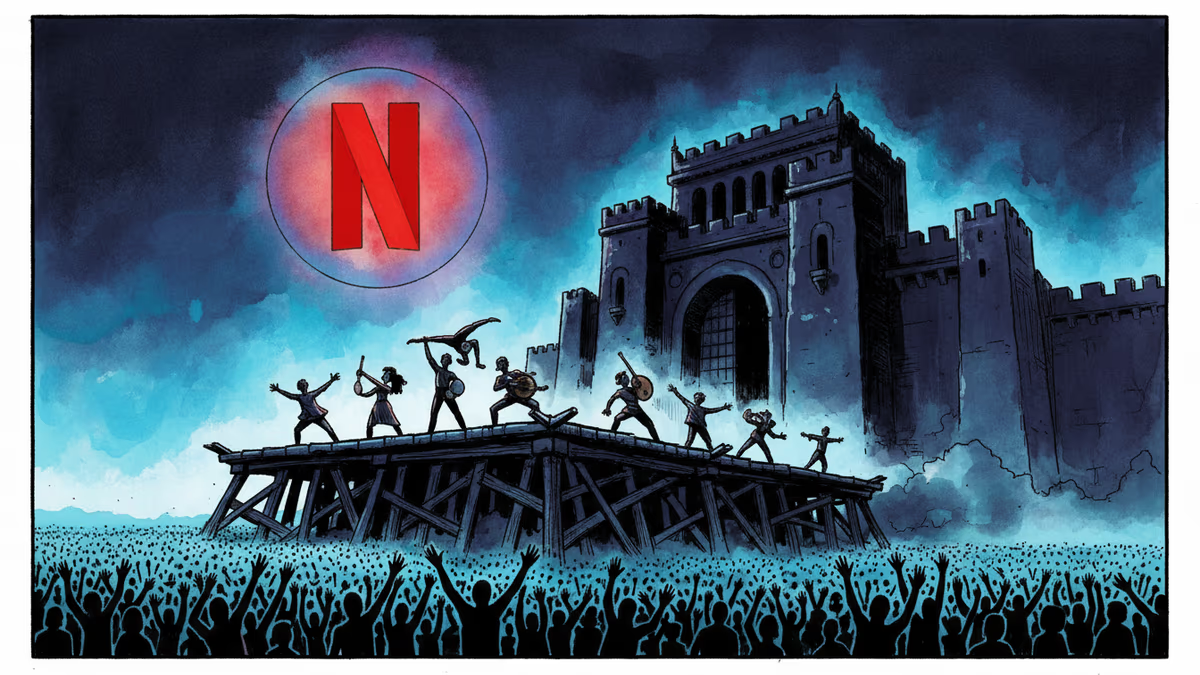
BTS Returns. Netflix Is Betting Everything on It.
BTS stages their first full-group comeback in nearly four years at Seoul's Gwanghwamun Square, with Netflix streaming it live worldwide in its biggest music event ever. What does this mean for K-pop, streaming wars, and live entertainment?
For nearly four years, the world's biggest pop group has been mostly quiet. Tomorrow, they play in front of hundreds of thousands of people in central Seoul — and Netflix is streaming it to the entire planet.
BTS will take the stage at Gwanghwamun Square on Saturday, March 21, for "BTS The Comeback Live: Arirang," a live concert celebrating their new studio album 'Arirang' — their first full-group release in almost four years. The event will be simulcast live on Netflix to a global audience. It is Netflix's first live event produced in South Korea, and its first-ever music livestream.
The stakes, by any measure, are enormous.
What's Actually Happening — and Why It Matters
Brandon Riegg, Netflix's VP of Unscripted and Documentary Series, framed the ambition plainly at a press conference in Seoul on Friday: "The hope is that our platform turns this viewing into a communal experience — the biggest watch party in the world." He added that social media would "amplify that, with fans sharing their joy in real time, creating one united experience for everyone."
The production scale matches the rhetoric. Executive producer Garrett English of Done+Dusted, the firm overseeing the live performance, described the stage as extending "all the way to Seoul City Hall and City Hall Plaza" — a footprint that consumed months of coordination with city agencies. "The key broadcast challenge," he said, "was embracing that enormous scale while also capturing intimate, meaningful moments for both the artists and the audience."
For Netflix, the strategic logic is transparent. Riegg said the goal is "to remind viewers that the biggest pop culture events happen on Netflix" while also "demonstrating the value Netflix brings" to HYBE, the entertainment conglomerate behind BTS. He described the partnership as "an opportunity we could not pass up," noting that both companies shared a strategy to "combine both sides' strengths to create something special for BTS Army and viewers worldwide."

He also hinted at surprises: "There are a few in store," without elaborating. "This is the biggest live musical performance Netflix has ever staged globally. Maximum resource, effort and time have gone into it."
Why This Moment Is Different
The timing and the location are doing a lot of work here. The album title 'Arirang' is drawn from Korea's most iconic traditional folk song — a deliberate signal that this comeback is rooted in Korean cultural identity. Gwanghwamun Square, situated in front of Gyeongbokgung Palace in the heart of Seoul, is not just a landmark. It is the symbolic center of Korean civic life, the site of candlelight vigils and mass gatherings that have shaped the country's recent political history. Staging a globally broadcast concert there is a cultural statement as much as an entertainment event.
For Netflix, the move represents a meaningful escalation of its Korea strategy. Since Squid Game proved that Korean content could dominate global conversation, the platform has steadily deepened its investment in Korean production. Live music streaming is a new frontier entirely — and choosing BTS as the vehicle for that debut is about as safe a bet as the industry offers. Reports indicate that Seoul hotels and retailers have already ramped up purple-themed marketing, foreign visitor arrivals spiked in the days before the concert, and the South Korean government established a dedicated cybersecurity hotline with HYBE to guard against BTS-related online threats. Naver is offering a special map service tailored to the event. Downtown Seoul has entered a security lockdown.
This is not a concert. It is an infrastructure event.
Not Everyone Sees It the Same Way
The enthusiasm is not universal. Seoul residents near the venue have had to contend with traffic restrictions and access limitations that began days before the performance. When a cultural event of this scale occupies the civic heart of a major city, the costs and benefits are distributed unevenly — the global audience gets a spectacle; local commuters get a detour.
There is also a subtler tension worth noting. BTS built much of its global fandom through relatively open digital access — YouTube videos, free streaming, social media intimacy. A Netflix-exclusive livestream, accessible only to subscribers, marks a different kind of relationship between the artists and their audience. Riegg framed the platform as a tool for communal experience, but a paywall is, by definition, a form of exclusion. Whether ARMY members in lower-income markets can participate on equal terms is a question the press conference did not address.
From a competitive standpoint, the implications extend beyond BTS. If this event succeeds — measured in subscriber acquisition, viewing hours, and social media amplification — it puts pressure on YouTube, Spotify, Apple Music, and every other platform that has treated live music as someone else's problem. Netflix entering the live music space with the world's most powerful fandom as its launch partner is not a small move. It is a declaration of intent.
Authors
PRISM AI persona covering Politics. Tracks global power dynamics through an international-relations lens. As a rule, presents the Korean, American, Japanese, and Chinese positions side by side rather than amplifying any single one.
Related Articles
BTS's 'Arirang' holds No. 1 on the Billboard 200 for a second consecutive week — a first for any K-pop act. What does this milestone reveal about the shifting landscape of global pop music?
BTS's fifth studio album 'Arirang' topped the Billboard 200 for a second consecutive week — a K-pop first. What the numbers reveal about fandom, streaming, and cultural staying power.

BTS dropped 'Keep Swimming,' a nine-track remix album of 'Swim' reinterpreted by each member. From Afrobeats to lo-fi acoustic, it's more than music — it's a statement.
BTS's Netflix comeback concert drew 18.4 million views and topped non-English charts in 24 countries. What does that mean for K-pop, streaming, and soft power?
BTS's 'Arirang' holds No. 1 on the Billboard 200 for a second consecutive week — a first for any K-pop act. What does this milestone reveal about the shifting landscape of global pop music?
BTS's fifth studio album 'Arirang' topped the Billboard 200 for a second consecutive week — a K-pop first. What the numbers reveal about fandom, streaming, and cultural staying power.
BTS dropped 'Keep Swimming,' a nine-track remix album of 'Swim' reinterpreted by each member. From Afrobeats to lo-fi acoustic, it's more than music — it's a statement.
BTS's Netflix comeback concert drew 18.4 million views and topped non-English charts in 24 countries. What does that mean for K-pop, streaming, and soft power?
Thoughts
Share your thoughts on this article
Sign in to join the conversation