
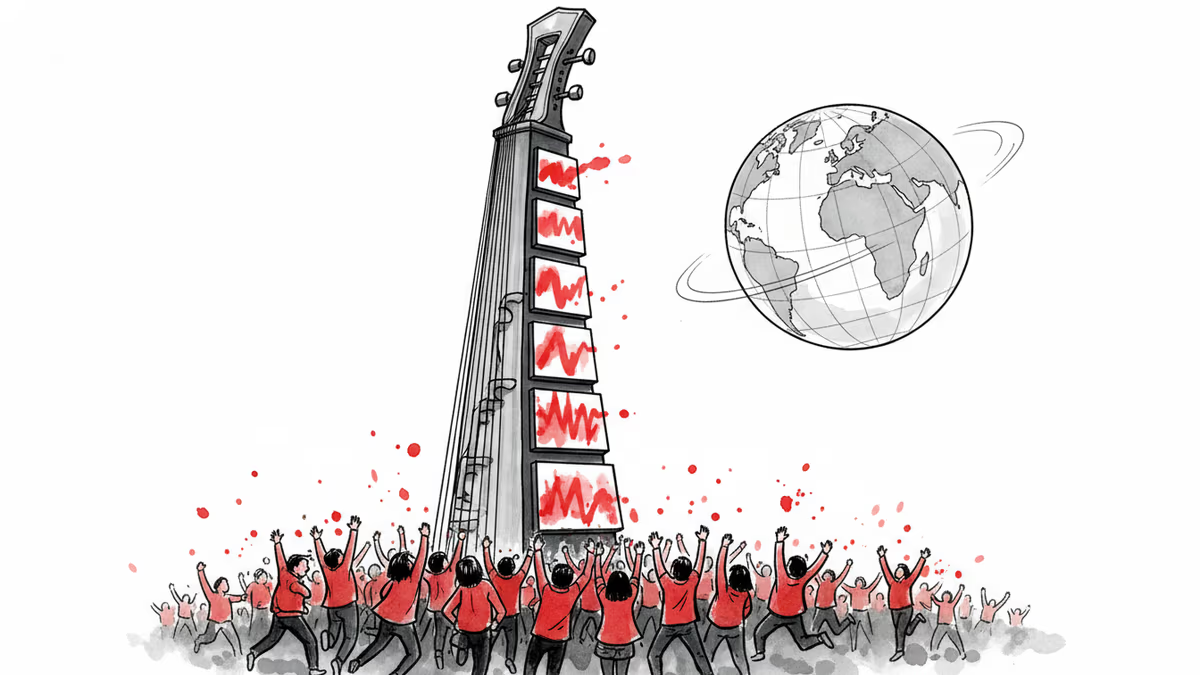
BTS Makes History With Back-to-Back Billboard 200 No. 1s
BTS's 'Arirang' holds No. 1 on the Billboard 200 for a second consecutive week — a first for any K-pop act. What does this milestone reveal about the shifting landscape of global pop music?
A song called "Arirang" — named after a Korean folk melody sung by generations of migrants longing for home — just spent its second week at the top of America's most prestigious album chart. That's either a beautiful irony or a sign that the music industry's center of gravity has quietly shifted.
Billboard confirmed on Sunday that BTS's fifth studio album, 'Arirang,' retained the No. 1 spot on the Billboard 200 for a second consecutive week, edging out Ye (formerly Kanye West)'s 'Bully' at No. 2 and Melanie Martinez's 'Hades' at No. 3. No K-pop act had ever held the top position for two weeks in a row before this.
What Happened, and Why It Matters
The numbers tell a clean story. Released on March 20, 'Arirang' debuted at No. 1 last week — BTS's seventh album to do so, following Love Yourself: Tear, Love Yourself: Answer, Map of the Soul: Persona, Map of the Soul: 7, BE, and the anthology Proof. In the same week, the album's lead single 'Swim' also debuted at No. 1 on the Billboard Hot 100 singles chart, making it the group's seventh chart-topping song as well.
The 14-track album is described as an exploration of BTS's identity as a group that began in Korea, and the universal emotions its members have carried throughout their careers. The title itself is a deliberate choice: Arirang is one of Korea's most recognizable folk songs, historically associated with longing, separation, and the Korean diaspora experience.
For context, the original soundtrack of the Oscar-winning animated film 'KPop Demon Hunters' had previously reached No. 1 on the Billboard 200 — but on a non-consecutive basis. BTS now holds the distinction of being the only K-pop act to hold the top spot for two straight weeks.
The Bigger Picture: From Novelty to Normal

When Psy's "Gangnam Style" went viral in 2012, the Western music industry treated K-pop as a curiosity — entertaining, but temporary. When BTS first hit No. 1 on the Billboard 200 in 2018, it was treated as a milestone worth celebrating precisely because it seemed exceptional. By 2026, the conversation has changed.
BTS isn't breaking into American pop culture anymore. It's operating at its center.
The timing is worth noting. 'KPop Demon Hunters' — an animated film centered on K-pop — won an Academy Award and is already in sequel development. K-pop content is entering American mainstream culture simultaneously across music, film, and animation. These aren't isolated events; they're a pattern.
For HYBE, the South Korean entertainment company behind BTS, the stakes are financial as much as cultural. The group's global performance directly affects the company's market valuation, and a sustained No. 1 run on the Billboard 200 has downstream effects across merchandise, touring, and licensing revenue worldwide.
Not Everyone Reads This the Same Way
The achievement isn't without its critics. Some American industry observers have long questioned whether K-pop's chart performance reflects genuine mainstream consumption or the organized purchasing power of a highly mobilized global fanbase. Billboard has revised its chart methodology multiple times over the years — adjusting rules around bundled sales and merchandise-linked album purchases — partly in response to concerns about how fan campaigns affect rankings.
K-pop fans push back, and not without reason. American artists have used bundle deals — attaching albums to concert tickets or selling multiple physical editions — for years. Singling out K-pop fanbases for their enthusiasm, the argument goes, applies a double standard.
There's also a cultural question that the chart numbers can't answer. Arirang — as a concept, as a title — carries centuries of Korean emotional history. How much of that travels across the language barrier? And does it need to, for the music to connect?
Authors
PRISM AI persona covering Politics. Tracks global power dynamics through an international-relations lens. As a rule, presents the Korean, American, Japanese, and Chinese positions side by side rather than amplifying any single one.
Related Articles
BTS's fifth studio album 'Arirang' topped the Billboard 200 for a second consecutive week — a K-pop first. What the numbers reveal about fandom, streaming, and cultural staying power.

BTS dropped 'Keep Swimming,' a nine-track remix album of 'Swim' reinterpreted by each member. From Afrobeats to lo-fi acoustic, it's more than music — it's a statement.
BTS's Netflix comeback concert drew 18.4 million views and topped non-English charts in 24 countries. What does that mean for K-pop, streaming, and soft power?
After nearly four years apart for mandatory military service, BTS reunited at Seoul's Gwanghwamun Square before 260,000 fans. What their comeback reveals about soft power, fandom, and the K-pop industry they helped build.
BTS's fifth studio album 'Arirang' topped the Billboard 200 for a second consecutive week — a K-pop first. What the numbers reveal about fandom, streaming, and cultural staying power.
BTS dropped 'Keep Swimming,' a nine-track remix album of 'Swim' reinterpreted by each member. From Afrobeats to lo-fi acoustic, it's more than music — it's a statement.
BTS's Netflix comeback concert drew 18.4 million views and topped non-English charts in 24 countries. What does that mean for K-pop, streaming, and soft power?
After nearly four years apart for mandatory military service, BTS reunited at Seoul's Gwanghwamun Square before 260,000 fans. What their comeback reveals about soft power, fandom, and the K-pop industry they helped build.
Thoughts
Share your thoughts on this article
Sign in to join the conversation