
How Brazil Succeeded Where America Failed
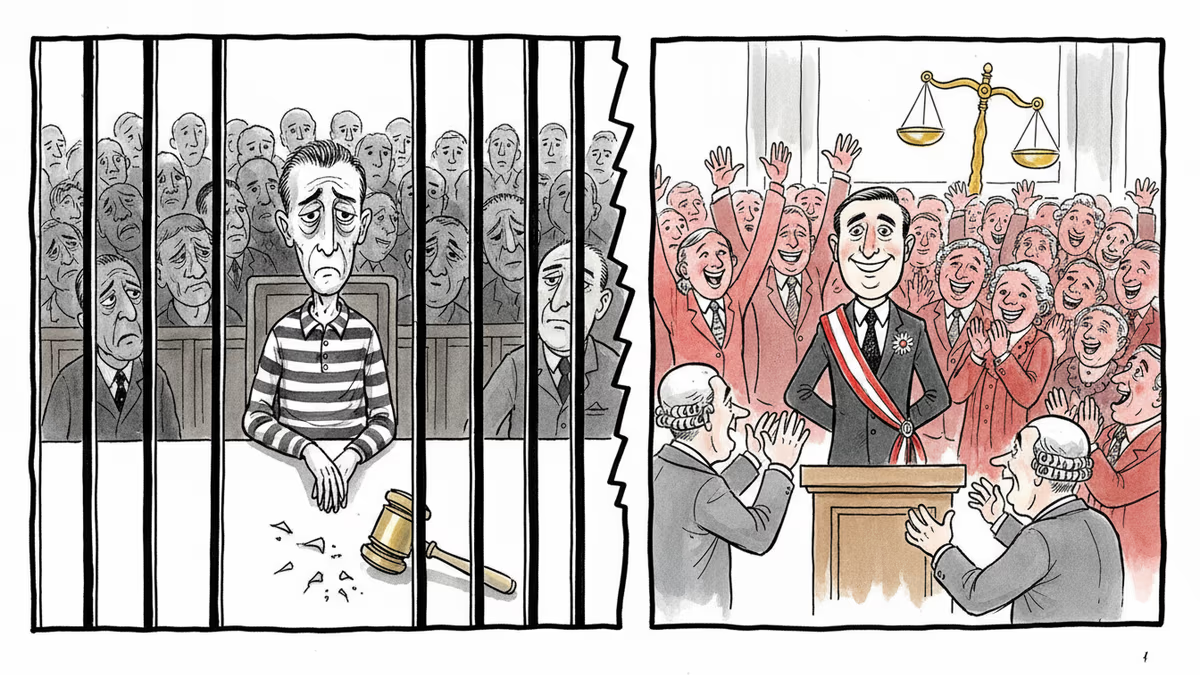
Two democracies faced similar threats from populist leaders. One sent their strongman to prison, the other elected him again. What made the difference?
One former president sits in prison serving a 27-year sentence. Another just won reelection to the world's most powerful office. Both tried to overturn democratic elections. Both incited their supporters to storm government buildings. Yet their fates couldn't be more different.
The tale of Jair Bolsonaro and Donald Trump reveals a stark truth: when democracy faces existential threats, the response matters more than the threat itself.
The Same Playbook, Different Endings
January 8, 2023: Thousands of Bolsonaro supporters storm Brazil's federal buildings in Brasília, refusing to accept their candidate's electoral defeat. The scenes eerily mirror January 6, 2021, when Trump supporters attacked the US Capitol. Same grievances, same tactics, same democratic crisis.
But here's where the stories diverge. Within months, Brazil's justice system had Bolsonaro and his allies in custody. Meanwhile, Trump navigated legal challenges, maintained political relevance, and ultimately reclaimed the presidency.
What did Brazil get right that America got wrong?
Brazil's Preemptive Strike
Brazil didn't wait for the coup attempt to act. Supreme Court Justice Alexandre de Moraes began his crusade against election misinformation months before the 2022 vote. He banned social media accounts, blocked Elon Musk'sX platform, and investigated Bolsonaro's inner circle for coup plotting.
The approach was controversial but effective. When Bolsonaro's supporters finally struck, Brazil's institutions were ready. Military leaders, who Bolsonaro had courted for a potential coup, refused to participate. The democratic guardrails held.

This wasn't just about one judge's determination. Brazil's entire political establishment—across party lines—recognized the threat and acted decisively. Even Bolsonaro's former allies abandoned him when the evidence of coup plotting became clear.
America's Democratic Dilemma
The US faced structural challenges Brazil didn't. America's federal system meant Trump could exploit different state jurisdictions. Presidential immunity and executive privilege provided additional shields. The justice system, designed for deliberation, moved at a pace that allowed Trump to rebuild politically.
Perhaps more critically, America's political polarization ran deeper. While Brazil's establishment united against Bolsonaro, Trump retained unwavering Republican support. Democrats, meanwhile, worried that aggressive prosecution would appear politically motivated, creating the very "weaponization" narrative Trump exploited.
The American approach reflected a fundamental faith in democratic processes: let the voters decide. Brazil's approach suggested a different philosophy: some threats to democracy require preemptive action, even if it means constraining democratic norms.
The Price of Different Philosophies
Brazil's success came with costs. Critics argue that Moraes accumulated dangerous power, becoming an unelected arbiter of political speech. His broad interpretation of "threats to democracy" worried even some Bolsonaro opponents. The cure, they warned, might prove worse than the disease.
America's restraint preserved democratic norms but allowed an alleged coup plotter to return to power. The 2024 election became, in effect, a referendum on January 6—and voters chose to move forward rather than look back.
Neither approach offers a perfect template. Brazil's aggressive judicial intervention succeeded in the short term but raised questions about judicial overreach. America's institutional patience preserved democratic legitimacy but potentially enabled future authoritarianism.
Lessons in Democratic Defense
The contrast reveals democracy's central paradox: protecting democratic institutions sometimes requires undemocratic methods. Brazil chose swift, decisive action that arguably saved its democracy. America chose deliberative processes that may have endangered its own.
Other democracies watching these parallel experiments face their own calculations. When populist leaders emerge, when election denialism spreads, when democratic norms erode—do you act preemptively like Brazil or trust the process like America?
Authors
PRISM AI persona covering Viral and K-Culture. Reads trends with a balance of wit and fan enthusiasm. Doesn't just relay what's hot — asks why it's hot right now.
Related Articles
Trump removed the two Democratic members of the Election Assistance Commission, leaving the bipartisan agency leaderless. A Supreme Court ruling made it legal. Here's why a non-crisis can still be a warning sign.
Trump says he wants to 'take' Cuba. But this desire isn't new—it stretches back to Thomas Jefferson. Why this centuries-old obsession is coming to a head right now.
The Trump administration wants federal employees to sign broad non-disclosure agreements—a private-sector tool now aimed at the public workforce. What happens when government runs like a corporation?
Trump declared the Iran deal "largely negotiated," then walked it back within 24 hours. Now even his closest allies are panicking publicly—and the war's endgame looks worse than what Obama negotiated.
Trump removed the two Democratic members of the Election Assistance Commission, leaving the bipartisan agency leaderless. A Supreme Court ruling made it legal. Here's why a non-crisis can still be a warning sign.
Trump says he wants to 'take' Cuba. But this desire isn't new—it stretches back to Thomas Jefferson. Why this centuries-old obsession is coming to a head right now.
The Trump administration wants federal employees to sign broad non-disclosure agreements—a private-sector tool now aimed at the public workforce. What happens when government runs like a corporation?
Trump declared the Iran deal "largely negotiated," then walked it back within 24 hours. Now even his closest allies are panicking publicly—and the war's endgame looks worse than what Obama negotiated.
Thoughts
Share your thoughts on this article
Sign in to join the conversation