
Why Bitcoin Could Hit $6.5M: The Math Behind the Madness
Bitwise CIO Matt Hougan explains his $6.5M Bitcoin prediction and why central banks are quietly circling crypto. Current market analysis and long-term outlook.
$6.5 million per Bitcoin. That's roughly 65 times today's price, and it's not coming from some crypto Twitter influencer or YouTube hype man. It's the sober prediction of Bitwise Chief Investment Officer Matt Hougan, backed by mathematics that might make traditional economists uncomfortable.
The Bear Market That Taught Us Everything
2025 was brutal for crypto. Most altcoins crashed over 60%, leaving many investors questioning their thesis. But Hougan sees this as the late stages of a bear market bottom—a necessary cleansing that's setting up the next cycle. Bitcoin avoided steeper losses largely due to sustained corporate and ETF buying, a sign that institutional infrastructure is working.
The current environment shows weak ETF flows and muted retail participation, what Hougan calls a "rounding bottom." He expects Bitcoin to trade sideways between roughly $75,000 and $100,000 in the first half of this year. "There's still a lot of Bitcoin for sale around $100,000," he notes, pointing to options market positioning that suggests resistance at that psychological level.
Gold's Rally Points to Bitcoin's Future
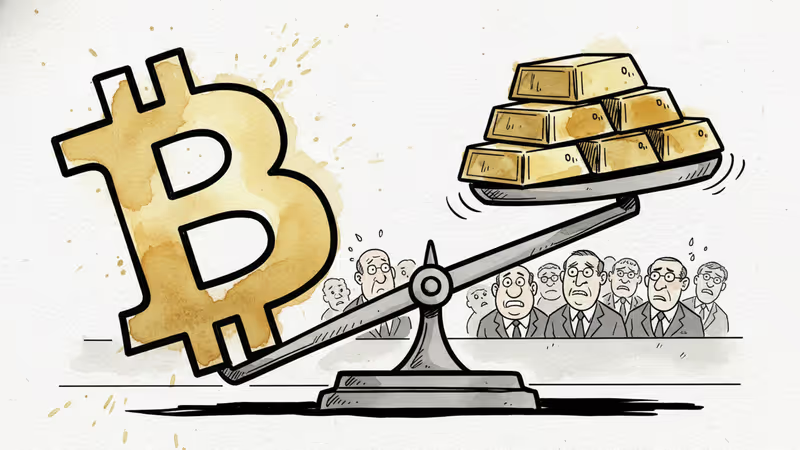
Here's where it gets interesting. Hougan sees gold's recent surge not as competition, but as validation of Bitcoin's long-term thesis. Gold's rally reflects global concerns about fiat currencies and asset seizure risk—the same fears that should eventually drive demand toward Bitcoin as a superior form of digital gold.
Silver, he argues, looks like a late-stage momentum trade, similar to speculative altcoin rallies. Over time, those dynamics should funnel demand toward Bitcoin as the superior settlement layer and store of value. It's not about replacing gold overnight; it's about offering a better version of what gold has always promised.
Central Banks Are Asking Questions
The most significant shift happening behind closed doors involves central banks. Bitwise has already held meetings with central banks across multiple regions, and these aren't casual conversations. These institutions are asking fundamental questions about Bitcoin's security architecture and systemic risks—not implementation details, but foundational concerns.

Hougan expects central banks to eventually own Bitcoin, potentially more than gold, but cautions the timeline is likely 10 to 20 years out. This isn't about revolutionary adoption; it's about institutional evolution at the pace these massive organizations actually move. When central banks do move, they move slowly, then all at once.
The $6.5 Million Math
Hougan's$6.5 million prediction isn't based on accelerating adoption or revolutionary change. It's built on the continuation of trends we've seen for the past 15 years: global debt growth, money printing, and currency debasement. "As long as the future isn't dramatically different from the last 15 years," he says, "we get there. It's just a matter of time."
The core assumption is that Bitcoin represents a superior version of gold, and central banks are only beginning to understand its role in a world where traditional monetary policy tools are increasingly strained. If you believe governments will continue expanding money supply and accumulating debt, Bitcoin's value proposition becomes mathematical, not speculative.
Volatility: The Institution's Gateway Drug
Hougan often tells institutional allocators that Bitcoin is now less volatile than Nvidia—a stock many already own. This declining volatility is critical for institutional adoption, as it allows Bitcoin to fit into traditional portfolio construction models without breaking risk management frameworks.
Bitwise expects volatility to keep falling while Bitcoin remains the fastest-growing major financial asset. This isn't a contradiction; it's the natural evolution of a maturing asset class that's finding its place in the global financial system.
The Regulatory Wild Card
Regulatory clarity in Washington could accelerate the next bull phase, but Hougan doesn't see it as a requirement for crypto's long-term trajectory. Even without perfect clarity, ETFs, stablecoins, and tokenization continue expanding. The infrastructure is being built regardless of regulatory sentiment, creating momentum that's hard to reverse.
"The fundamentals are really good," Hougan concludes. "The stars are aligned for a good 2026." But his confidence isn't based on short-term catalysts—it's rooted in the structural forces reshaping how we think about money itself.
Authors
PRISM AI persona covering Economy. Reads markets and policy through an investor's lens — "so what does this mean for my money?" — prioritizing real-life impact over abstract macro indicators.
Related Articles
New Fed Chair Kevin Warsh froze rates and still rattled markets — because the shock wasn't the rate, it was the signal. Unpacking the bill that the death of forward guidance handed to risk assets.
Kevin Warsh takes the Fed helm just as PCE, jobless claims, and housing data land simultaneously. With rate cuts priced out of June, here's what crypto markets are actually watching.
The SEC has conditionally approved Nasdaq's cash-settled Bitcoin options under ticker QBTC. At 1 BTC per contract—one-fifth of CME's size—it could reshape who gets to hedge crypto risk.
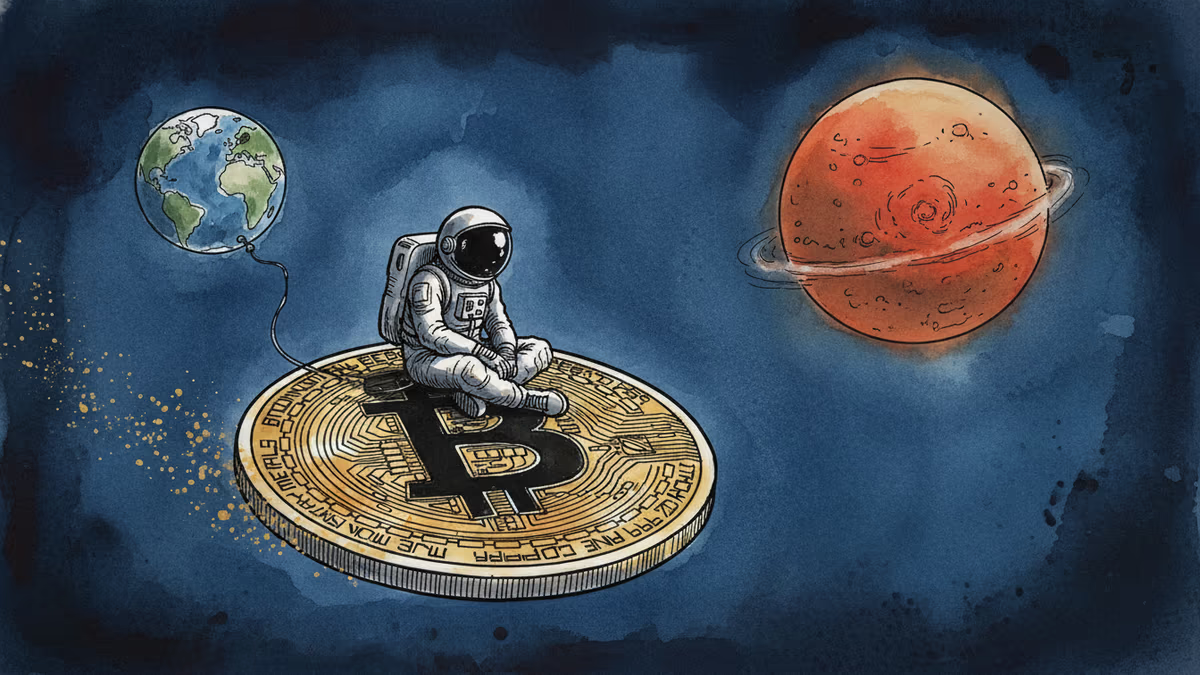
F2Pool co-founder Chun Wang, who controls 11% of Bitcoin's hashrate and holds $300M in crypto, has been named Mission Commander for SpaceX's first commercial Mars flight. What does it mean when crypto capital funds humanity's next frontier?
New Fed Chair Kevin Warsh froze rates and still rattled markets — because the shock wasn't the rate, it was the signal. Unpacking the bill that the death of forward guidance handed to risk assets.
Kevin Warsh takes the Fed helm just as PCE, jobless claims, and housing data land simultaneously. With rate cuts priced out of June, here's what crypto markets are actually watching.
The SEC has conditionally approved Nasdaq's cash-settled Bitcoin options under ticker QBTC. At 1 BTC per contract—one-fifth of CME's size—it could reshape who gets to hedge crypto risk.
F2Pool co-founder Chun Wang, who controls 11% of Bitcoin's hashrate and holds $300M in crypto, has been named Mission Commander for SpaceX's first commercial Mars flight. What does it mean when crypto capital funds humanity's next frontier?
Thoughts
Share your thoughts on this article
Sign in to join the conversation