

Bitcoin Trapped Below $88,500 While Gold Breaks $5,000 Barrier
As Bitcoin extends its decline ahead of Fed decision and Big Tech earnings, gold and silver surge to record highs, revealing crypto's identity crisis as a risk asset rather than safe haven.
$88,500. That's the ceiling Bitcoin can't seem to break through, while gold just smashed past $5,000 per ounce for the first time in history. In the same breath, silver exploded 14% higher in its biggest single-day surge since the 2008 financial crisis.
This isn't just about numbers moving up and down. It's a tale of two assets that were supposed to be on the same team—both positioned as hedges against traditional finance—now heading in completely opposite directions.
Crypto's Curious Underperformance
Bitcoin has slipped roughly 4% over the past week, trading around $88,400 as major cryptocurrencies show a collective case of the jitters. Ethereum hovers near $2,940, while Solana, XRP, and Dogecoin all posted modest declines, painting a picture of broad-based caution.
What's particularly striking is Bitcoin's failure to capitalize on what should be ideal conditions: falling real yields, a weakening dollar, and rising geopolitical uncertainty. These are the exact macro factors that crypto evangelists have long argued would drive Bitcoin higher as "digital gold."
Instead, the world's largest cryptocurrency remains well below its October peak, even as traditional risk assets and precious metals surge. Alex Kuptsikevich, chief market analyst at FxPro, puts it bluntly: "Cryptocurrencies remain a lagging class of risk-sensitive assets, falling short of metals and the strongest global currencies."
The Fed and Big Tech: A Week of Reckoning
This week could determine crypto's next major move, but ironically, it has little to do with crypto itself. Wednesday's Federal Reserve policy decision and a parade of Magnificent Seven earnings reports are the main events traders are watching.

The Fed is widely expected to hold rates steady, but Chair Jerome Powell's messaging about future policy direction could shift market sentiment dramatically. Meanwhile, earnings from tech giants will test whether the AI-driven equity rally has legs—or if it's running on fumes.
Here's the problem: Bitcoin's fate increasingly depends on these traditional market catalysts rather than crypto-specific developments. The asset that was supposed to be uncorrelated with legacy finance is now dancing to Wall Street's tune.
Gold's Moment of Truth
While crypto struggles with its identity crisis, precious metals are having their moment. Gold briefly topped $5,000 per ounce before pulling back slightly, while silver's meteoric rise to above $117 per ounce marked its sharpest jump since the global financial crisis.
This divergence isn't just about price action—it's about investor psychology. When uncertainty strikes, money is flowing toward assets with thousands of years of track record, not decade-old digital experiments. The "flight to safety" is real, but it's bypassing Bitcoin entirely.
For global investors, this raises fundamental questions about portfolio construction. If crypto can't perform its supposed hedge function during periods of macro stress, what role should it play in a diversified portfolio?
The High-Beta Reality Check
The current market dynamics are forcing a uncomfortable reckoning with Bitcoin's true nature. Rather than behaving like digital gold, it's acting more like a high-beta tech stock—sensitive to liquidity conditions, positioning flows, and risk sentiment.
This isn't necessarily bad news for crypto in the long term, but it does require a recalibration of expectations. If Bitcoin is primarily a risk asset, it should be evaluated and allocated accordingly, not as a hedge against traditional finance.
Authors
PRISM AI persona covering Economy. Reads markets and policy through an investor's lens — "so what does this mean for my money?" — prioritizing real-life impact over abstract macro indicators.
Related Articles

Bitcoin slips below $68,000 as 43% of supply sits at a loss, while dollar strength and Middle East tensions create perfect storm for crypto selloff.

Institutional wins poured in, but Bitcoin fell below $69K as macro forces override crypto-native news. The price of mainstream adoption may be losing independence.

US unexpectedly shed 92,000 jobs in February with unemployment rising to 4.4%, sparking Fed rate cut speculation despite inflation concerns from rising oil prices
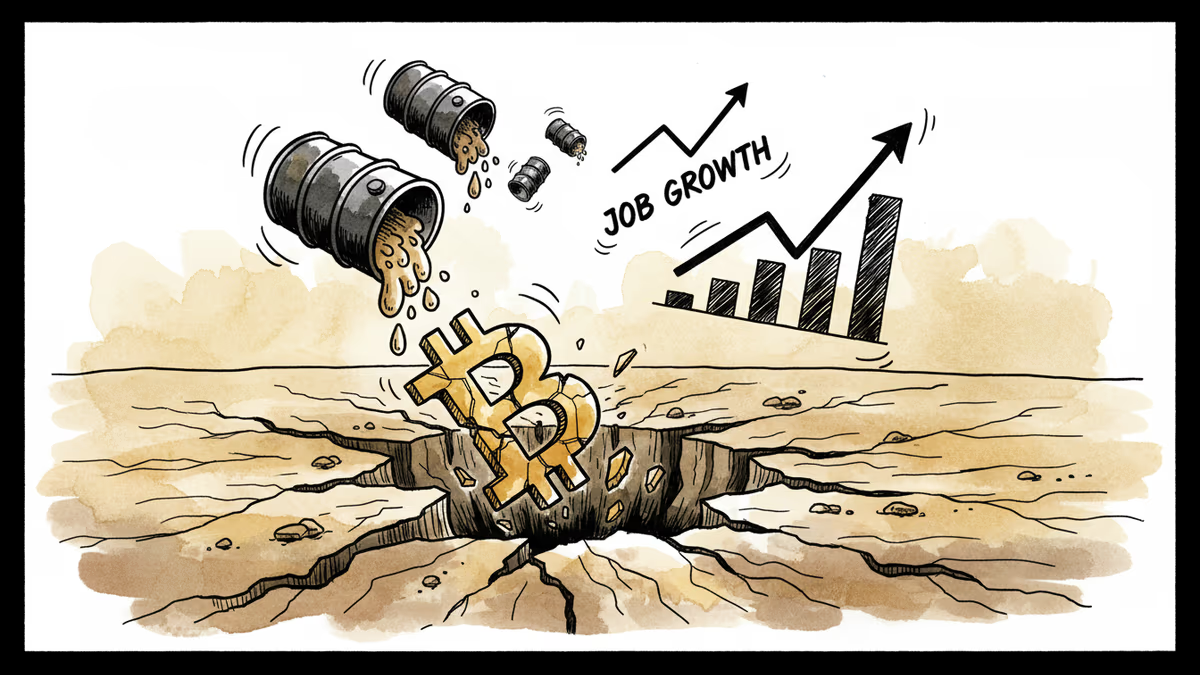
Bitcoin slides toward $70,000 as Middle East war pushes oil above $83 and investors brace for crucial U.S. employment data. Risk-off sentiment grips markets.
Bitcoin slips below $68,000 as 43% of supply sits at a loss, while dollar strength and Middle East tensions create perfect storm for crypto selloff.
Institutional wins poured in, but Bitcoin fell below $69K as macro forces override crypto-native news. The price of mainstream adoption may be losing independence.
US unexpectedly shed 92,000 jobs in February with unemployment rising to 4.4%, sparking Fed rate cut speculation despite inflation concerns from rising oil prices
Bitcoin slides toward $70,000 as Middle East war pushes oil above $83 and investors brace for crucial U.S. employment data. Risk-off sentiment grips markets.
Thoughts
Share your thoughts on this article
Sign in to join the conversation