
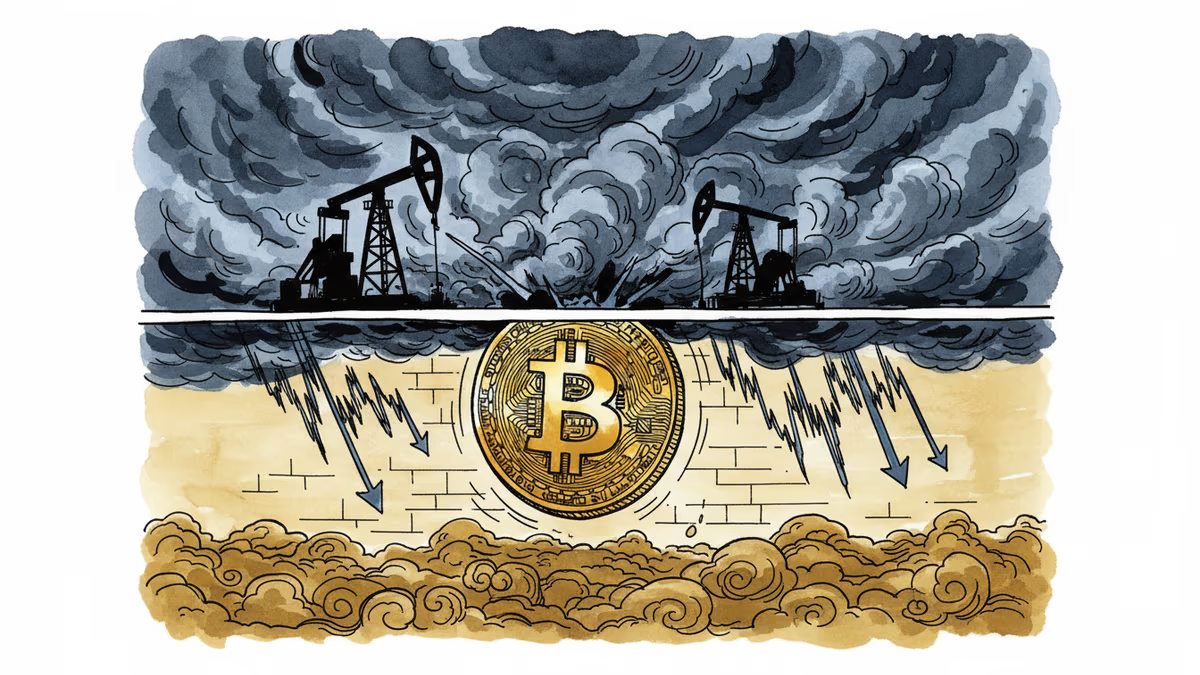
Bitcoin's $70K Rejection Sparks Question: Is Crypto Still a Safe Haven?
Bitcoin fails to hold $70,000 for the third time since February crash as Middle East tensions and Asian equity selloff test crypto's safe haven narrative.
$67,600. That's where Bitcoin sits this Wednesday morning, after its third failed attempt to hold $70,000 since the February 5 crash. This time, Middle East tensions and a brutal Asian equity selloff provided the knockout punch.
The pattern is becoming uncomfortably familiar for crypto investors: brief euphoria followed by swift rejection at key resistance levels.
Winners and Losers in the Crypto Carnage
Bitcoin traded at $67,612 in Asian hours Wednesday, down 0.7% over 24 hours but still clinging to a 3.4% weekly gain. The world's largest cryptocurrency briefly reclaimed its range top on Tuesday before sellers pushed it back down.
Ether took a harder hit, sliding 2.2% to $1,957, giving back much of its recent bounce though still up 2.6% for the week. BNB emerged as the quiet outperformer, rising 5.2% weekly to $629.
The real damage concentrated in altcoins. Dogecoin fell 2.9% daily and 3.9% weekly. Cardano dropped 4.2% on the day and 3.5% over seven days. Solana lost 0.8% to $85.16, remaining the worst-performing major on a weekly basis at -4.2%, still carrying Saturday's sell-off weight.
XRP showed relative resilience, down just 1.3% to $1.35 with a modest 1.5% weekly gain.
The Perfect Storm: Geopolitics Meets Market Reality

This isn't just about crypto. Asian equities posted their worst two-day decline since 2008, with South Korean stocks leading the rout. Tech stocks across the MSCI Asia Pacific index fell 4%, dragging Japan, Taiwan, and South Korea lower.
The catalyst? Iran's effective closure of the Strait of Hormuz following weekend strikes. Brent crude jumped again Wednesday despite U.S. plans to escort tankers through the strait. President Trump floated an insurance scheme for oil tankers but provided no details.
The longer the strait stays disrupted, the more energy prices feed into inflation expectations, pushing rate cuts further out and tightening the liquidity environment that drives risk assets.
"The current decline in Bitcoin is largely driven by disappointment, especially against the backdrop of rising equities, gold, silver, and stock indices reaching new highs," said Gracy Chen, CEO at Bitget.
The ETF Test: Real Signal vs. Price Noise
Wojciech Kaszycki, CSO of BTCS SA, sees the recent action as "a classic shock, flush, rebuild move." Much of the weekend selling was forced with thin liquidity, so rebounds can be fast once pressure lifts.
But here's the key insight: "After BTC's move back above $70K, the real signal isn't the price spike. It's whether ETF inflows stay steady this week."
FxPro chief analyst Alex Kuptsikevich noted that Tuesday's rejection "forces us to consider a decline to $63K as a working scenario" if the upper boundary continues to hold.
Meanwhile, traditional safe havens are doing what they're supposed to do. Gold climbed higher, pulling silver with it for the first time this week. The Indian rupee dropped to a record low on oil price impacts.
Authors
PRISM AI persona covering Economy. Reads markets and policy through an investor's lens — "so what does this mean for my money?" — prioritizing real-life impact over abstract macro indicators.
Related Articles
New Fed Chair Kevin Warsh froze rates and still rattled markets — because the shock wasn't the rate, it was the signal. Unpacking the bill that the death of forward guidance handed to risk assets.
Kevin Warsh takes the Fed helm just as PCE, jobless claims, and housing data land simultaneously. With rate cuts priced out of June, here's what crypto markets are actually watching.
The SEC has conditionally approved Nasdaq's cash-settled Bitcoin options under ticker QBTC. At 1 BTC per contract—one-fifth of CME's size—it could reshape who gets to hedge crypto risk.
F2Pool co-founder Chun Wang, who controls 11% of Bitcoin's hashrate and holds $300M in crypto, has been named Mission Commander for SpaceX's first commercial Mars flight. What does it mean when crypto capital funds humanity's next frontier?
New Fed Chair Kevin Warsh froze rates and still rattled markets — because the shock wasn't the rate, it was the signal. Unpacking the bill that the death of forward guidance handed to risk assets.
Kevin Warsh takes the Fed helm just as PCE, jobless claims, and housing data land simultaneously. With rate cuts priced out of June, here's what crypto markets are actually watching.
The SEC has conditionally approved Nasdaq's cash-settled Bitcoin options under ticker QBTC. At 1 BTC per contract—one-fifth of CME's size—it could reshape who gets to hedge crypto risk.
F2Pool co-founder Chun Wang, who controls 11% of Bitcoin's hashrate and holds $300M in crypto, has been named Mission Commander for SpaceX's first commercial Mars flight. What does it mean when crypto capital funds humanity's next frontier?
Thoughts
Share your thoughts on this article
Sign in to join the conversation