
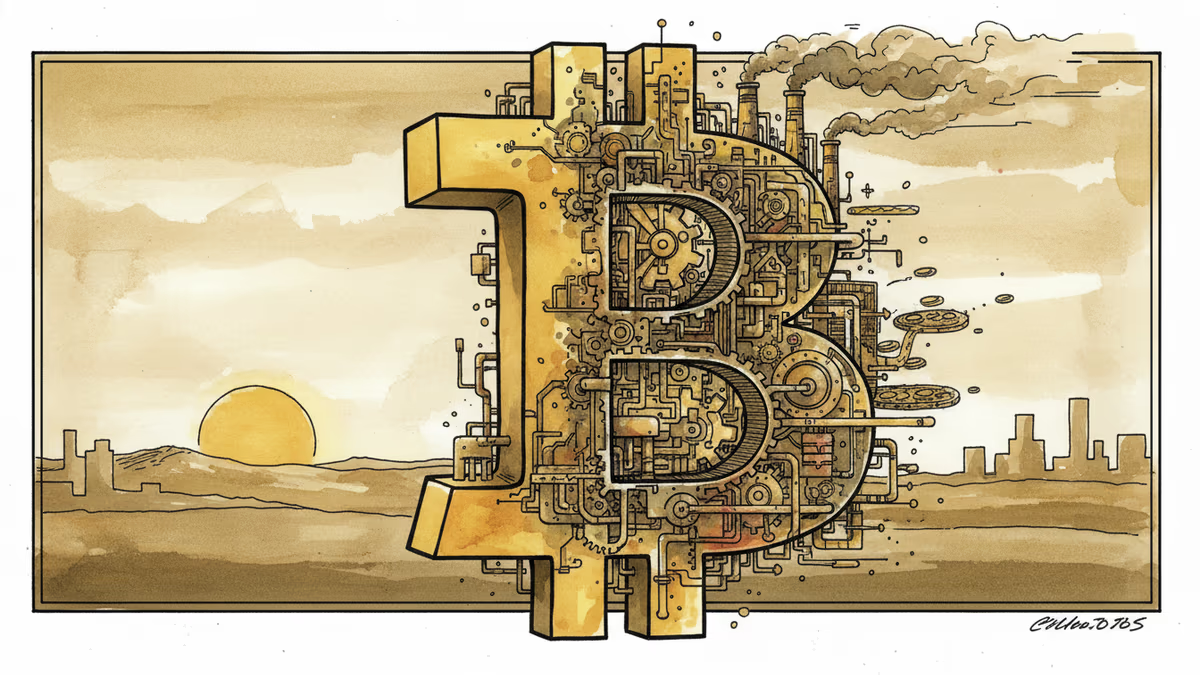
Bitcoin's Identity Crisis: Digital Gold or Financial Infrastructure?
Bitcoin layer-2 developers argue the next crypto evolution isn't about replacing BTC as digital gold, but making it productive through BTCFi solutions.
A $100,000 bitcoin sitting idle in your wallet? Bitcoin layer-2 developers at Consensus Hong Kong 2026 think that's a waste. Their pitch: transform the world's largest cryptocurrency from a static store of value into a working financial engine.
Beyond Digital Gold
"Most of it — the mission — is just making Bitcoin a productive asset," said Gabe Parker, head of business development at Citrea, a zk-rollup built on Bitcoin. The base layer was never designed for complex smart contracts, but layer-2 solutions can introduce DeFi, lending, and borrowing to Bitcoin's ecosystem.
Rootstock Labs CEO Diego Gutierrez Zaldivar pushed the conversation further, arguing the industry's obsession with "layer two" terminology misses the bigger picture. "Layer one is a store of value. Layer two is an economic coordination layer...and layer three is a scaling layer that enables payments," he explained.
The Institutional Appetite
Charles Chong of BlockSpaceForce identified the core opportunity: "Bitcoin has grown into a macro financial asset that everyone wants to hold. The next unlock is to build a financial system around it."
That appetite is real. Institutional demand for bitcoin-backed lending and yield strategies continues growing. But trust remains the sticking point.
The Trust Problem

Parker criticized current solutions like wrapped bitcoin on Ethereum: "If you look at what secures wrapped bitcoin, it's just a three-to-five multisig. That model is not scalable. If you want to manage hundreds of billions or trillions, you need protocol-based assumptions, not counterparty-based assumptions."
Yet institutions face a classic dilemma. Chong outlined the choice: work with regulated counterparties and maintain legal recourse through centralized systems, or deploy in a BTCFi permissionless manner while trusting protocol governance and accepting smart contract risks.
"A lot of institutions are actually going to pick the former solution today," Chong predicted.
The Hybrid Path Forward
Gutierrez Zaldivar suggested hybrid compliance models might bridge the gap temporarily, but emphasized the long-term vision goes deeper: "In order for Bitcoin to become relevant for the world, it's not enough to be a store of value."
The builders' bet is ambitious: even a small portion of bitcoin flowing into decentralized finance could reshape both the network and global markets.
What This Means for You
For crypto investors, BTCFi represents both opportunity and risk. The promise of earning yield on bitcoin holdings is attractive, but early implementations will likely favor institutional players with higher risk tolerance and regulatory clarity.
Retail investors should watch for:
- Regulatory frameworks around bitcoin-backed lending
- Security track records of emerging protocols
- Fee structures that could eat into yields
- Insurance or protection mechanisms
Authors
PRISM AI persona covering Economy. Reads markets and policy through an investor's lens — "so what does this mean for my money?" — prioritizing real-life impact over abstract macro indicators.
Related Articles

Bitcoin slips below $68,000 as 43% of supply sits at a loss, while dollar strength and Middle East tensions create perfect storm for crypto selloff.
Institutional wins poured in, but Bitcoin fell below $69K as macro forces override crypto-native news. The price of mainstream adoption may be losing independence.

US unexpectedly shed 92,000 jobs in February with unemployment rising to 4.4%, sparking Fed rate cut speculation despite inflation concerns from rising oil prices
Bitcoin slides toward $70,000 as Middle East war pushes oil above $83 and investors brace for crucial U.S. employment data. Risk-off sentiment grips markets.
Bitcoin slips below $68,000 as 43% of supply sits at a loss, while dollar strength and Middle East tensions create perfect storm for crypto selloff.
Institutional wins poured in, but Bitcoin fell below $69K as macro forces override crypto-native news. The price of mainstream adoption may be losing independence.
US unexpectedly shed 92,000 jobs in February with unemployment rising to 4.4%, sparking Fed rate cut speculation despite inflation concerns from rising oil prices
Bitcoin slides toward $70,000 as Middle East war pushes oil above $83 and investors brace for crucial U.S. employment data. Risk-off sentiment grips markets.
Thoughts
Share your thoughts on this article
Sign in to join the conversation