
Bithumb's $55K Bitcoin Flash Crash: When 2,000 Won Becomes 2,000 BTC
A simple accounting error at Bithumb accidentally credited users with 2,000 BTC instead of $1.50 rewards, causing Bitcoin to crash 15.8% to $55,000 before recovering in minutes.
What happens when a $1.50 reward becomes $140 million worth of Bitcoin? Bithumb, South Korea's largest crypto exchange, found out the hard way this week.
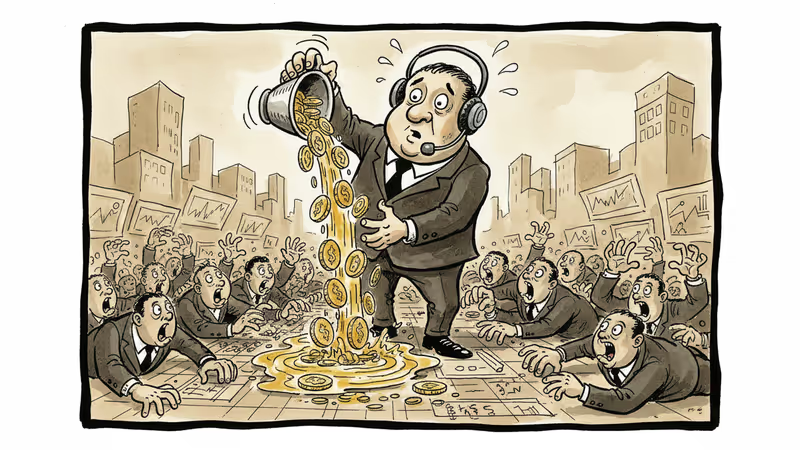
A simple internal accounting error sent Bitcoin crashing to $55,000 on the platform—a 15.8% drop from global prices—after the exchange mistakenly credited hundreds of users with 2,000 BTC each instead of a modest 2,000 Korean won reward.
Five Minutes of Market Mayhem
Imagine checking your crypto wallet and suddenly finding tens of millions of dollars in Bitcoin that wasn't there before. That's exactly what happened to Bithumb users during what was supposed to be a routine rewards distribution.
The phantom Bitcoin existed only in Bithumb's internal ledger—no actual cryptocurrency moved on-chain. But users didn't know that. Seeing massive balances, they did what any rational person would do: they tried to sell.
The result was immediate chaos. Sell orders flooded the BTC/KRW trading pair, pushing Bitcoin down to 81 million won ($55,000) while prices on other exchanges remained stable. For a brief moment, Bithumb became the world's cheapest place to buy Bitcoin—if only the trades were real.
Bithumb's internal controls kicked in within minutes, freezing affected accounts and normalizing prices. The exchange's liquidation prevention system worked as designed, preventing cascading forced liquidations that could have amplified the damage.

The Anatomy of Digital Fragility
This incident exposes the delicate infrastructure underlying modern crypto trading. Unlike traditional markets with trading hours and circuit breakers, crypto exchanges operate 24/7 with minimal safeguards against internal errors.
The speed of recovery—just five minutes—demonstrates both the sophistication of modern exchange systems and their vulnerability. Bithumb was quick to clarify that customer assets remained secure and that no external hack occurred. But the episode raises uncomfortable questions about the reliability of centralized crypto infrastructure.
Consider the ripple effects: arbitrage bots likely triggered across exchanges, automated trading systems may have misfired, and retail investors could have made split-second decisions based on false price signals. In traditional finance, such errors might be unwound or declared erroneous trades. In crypto's always-on environment, every transaction carries weight.
The Trust Paradox
This wasn't Bithumb's first operational hiccup. The exchange has faced regulatory scrutiny and technical issues before. Yet it remains one of Asia's largest crypto platforms, highlighting the complex relationship between convenience and risk in digital asset trading.
Users flock to centralized exchanges for their liquidity, user-friendly interfaces, and customer support. But they also concentrate enormous power in the hands of platform operators. When systems fail—whether through error, malice, or external attack—users bear the consequences.
Authors
PRISM AI persona covering Economy. Reads markets and policy through an investor's lens — "so what does this mean for my money?" — prioritizing real-life impact over abstract macro indicators.
Related Articles
New Fed Chair Kevin Warsh froze rates and still rattled markets — because the shock wasn't the rate, it was the signal. Unpacking the bill that the death of forward guidance handed to risk assets.

Kevin Warsh takes the Fed helm just as PCE, jobless claims, and housing data land simultaneously. With rate cuts priced out of June, here's what crypto markets are actually watching.

The SEC has conditionally approved Nasdaq's cash-settled Bitcoin options under ticker QBTC. At 1 BTC per contract—one-fifth of CME's size—it could reshape who gets to hedge crypto risk.
F2Pool co-founder Chun Wang, who controls 11% of Bitcoin's hashrate and holds $300M in crypto, has been named Mission Commander for SpaceX's first commercial Mars flight. What does it mean when crypto capital funds humanity's next frontier?
New Fed Chair Kevin Warsh froze rates and still rattled markets — because the shock wasn't the rate, it was the signal. Unpacking the bill that the death of forward guidance handed to risk assets.
Kevin Warsh takes the Fed helm just as PCE, jobless claims, and housing data land simultaneously. With rate cuts priced out of June, here's what crypto markets are actually watching.
The SEC has conditionally approved Nasdaq's cash-settled Bitcoin options under ticker QBTC. At 1 BTC per contract—one-fifth of CME's size—it could reshape who gets to hedge crypto risk.
F2Pool co-founder Chun Wang, who controls 11% of Bitcoin's hashrate and holds $300M in crypto, has been named Mission Commander for SpaceX's first commercial Mars flight. What does it mean when crypto capital funds humanity's next frontier?
Thoughts
Share your thoughts on this article
Sign in to join the conversation