
When Your E-Bike Is Actually a Motorcycle
E-bike injuries surged 1,020% as high-powered vehicles masquerade as bicycles. California's new bill aims to clarify what counts as an e-bike—and what doesn't.
The Repair Shop Reality Check
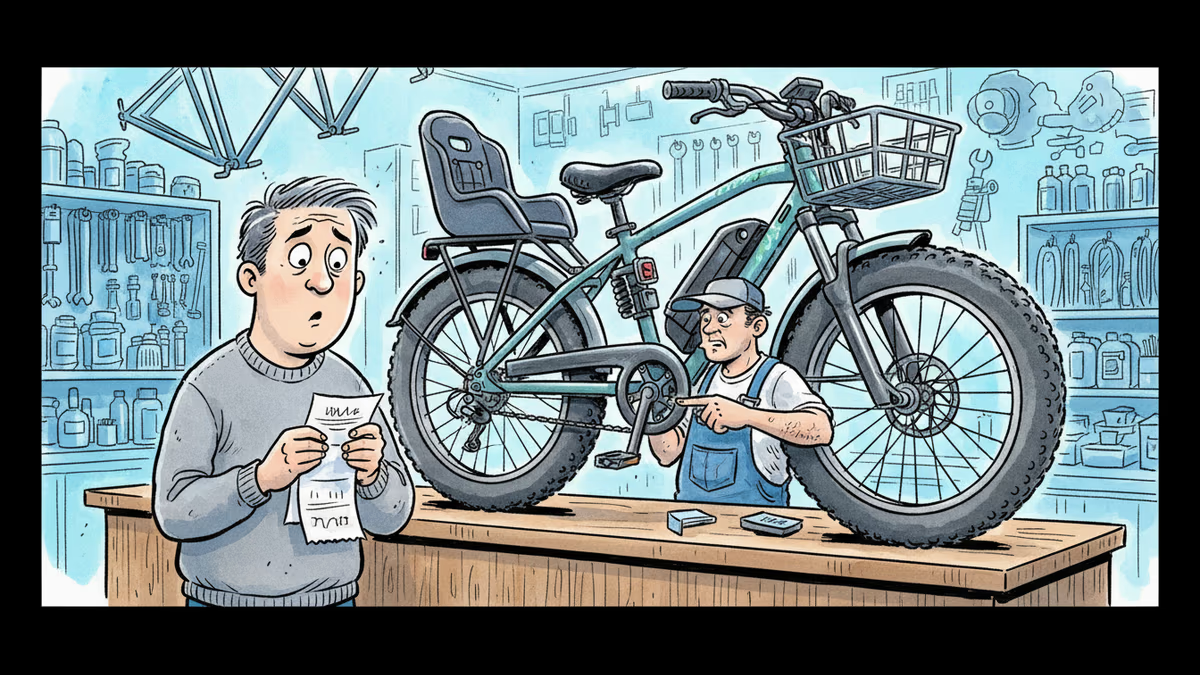
A family walked into Pasadena Cyclery in California, expecting a routine repair on their teenager's e-bike. Store manager Daniel Purnell had to deliver uncomfortable news: "I can't fix that here. That's a motorcycle." The mother was shocked—she had no idea her "e-bike" could hit 55 mph.
"There's definitely an education problem," Purnell says. The numbers back him up: e-bike-related injuries jumped 1,020% nationwide between 2020 and 2024. But here's the catch—even hospitals can't consistently tell real e-bikes from their souped-up cousins.
The Three-Class System Nobody Follows
For years, bike advocates worked to establish clear categories: Class 1 e-bikes use pedal-assist up to 20 mph, Class 2 adds throttles but stays at 20 mph, and Class 3 reaches 28 mph with pedal-assist. All require motors under 750 watts.
But when researchers visited 19 Bay Area schools, they found 88% of parked electric two-wheelers didn't fit any class at all. Vehicles like the Surron Ultra Bee (top speed: 55 mph) and Tuttio ICT (50 mph) are marketed as "electric bikes" despite being closer to motorcycles in performance.
Kids in the Fast Lane
Teenagers love the freedom electric motors provide, but they're paying the price. Kids 17 and under account for 20% of US e-bike injuries—roughly matching their share of the population. The difference? When something goes wrong at higher speeds, the consequences are severe.

California State Senator Catherine Blakespear sponsored Senate Bill 1167 to address this confusion. The legislation would make it illegal for retailers to label high-powered electric vehicles as e-bikes, clarifying that real e-bikes have functional pedals and motors that don't exceed 750 watts.
The Retailer's Dilemma
"We're not against these devices," says Kendra Ramsey of the California Bicycle Coalition. "People think they're e-bikes and they're not really e-bikes." The problem intensifies online, where parents can't easily distinguish between a 20 mph commuter bike and a 55 mph speed demon.
Some retailers are backing away entirely. The National Bicycle Dealers Association warned members last month that e-motos "present both unnecessary business risks for bicycle retailers and unnecessary safety concerns to consumers and the general public."
Federal vs. State: The Regulatory Gap
Technically, high-powered e-motos should fall under federal motor vehicle standards—requiring registration, insurance, and licenses. But as Matt Moore from PeopleForBikes explains, "manufacturers have chosen not to pursue the clearly defined path to sell a motorcycle."
This regulatory limbo creates a perfect storm: devices that perform like motorcycles, sold like bicycles, to people who think they're buying bicycles.
The Innovation vs. Safety Balance
At least 10 state bills this year deal with e-bike regulation, showing how widespread the issue has become. The challenge isn't just technical—it's philosophical. How do we encourage emission-free transportation without compromising safety? How do we give teenagers mobility without putting them at risk?
Purnell captures the dilemma perfectly: "It's good that they're riding instead of playing video games at home. But do they take away mobility for the unlicensed driver in the name of restricting teens from causing mischief? That's what I don't know."
Authors
Related Articles

New Jersey just passed heavy restrictions on e-bike ownership, sparking a national debate about safety, innovation, and who gets to decide how we move around cities.
Beyond speed and range, the e-scooter market is now a battle over repairability and safety. Discover the critical factors that define a smart investment.

Samsung Electronics' union branch revealed that 84% of survey respondents oppose the government's roughly $290 billion (₩400 trillion) semiconductor megaproject in Gwangju. Government, management, the union and shareholders are all reading the same national project in sharply different ways.

Nvidia shipped roughly a billion RISC-V cores in 2024, then announced it would run CUDA on the open standard. We break down how royalty-free instruction sets and open software stacks are trying to route around CUDA's lock-in. Part 2 of the Semiconductor Sovereignty series.
New Jersey just passed heavy restrictions on e-bike ownership, sparking a national debate about safety, innovation, and who gets to decide how we move around cities.
Beyond speed and range, the e-scooter market is now a battle over repairability and safety. Discover the critical factors that define a smart investment.
Samsung Electronics' union branch revealed that 84% of survey respondents oppose the government's roughly $290 billion (₩400 trillion) semiconductor megaproject in Gwangju. Government, management, the union and shareholders are all reading the same national project in sharply different ways.
Nvidia shipped roughly a billion RISC-V cores in 2024, then announced it would run CUDA on the open standard. We break down how royalty-free instruction sets and open software stacks are trying to route around CUDA's lock-in. Part 2 of the Semiconductor Sovereignty series.
Thoughts
Share your thoughts on this article
Sign in to join the conversation