
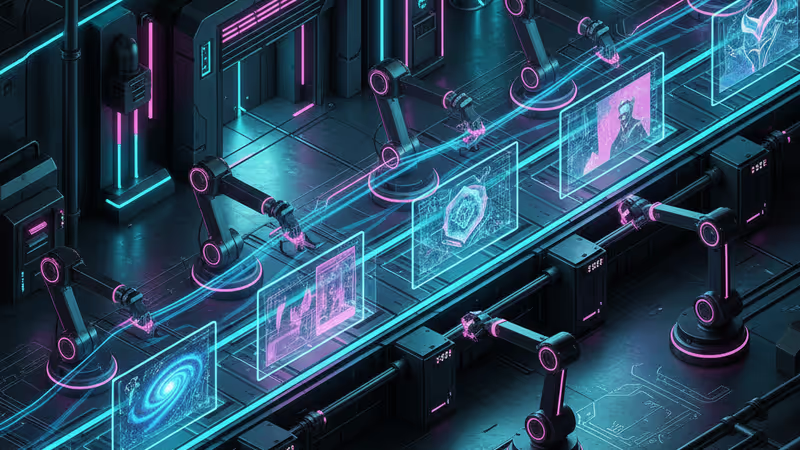
Beyond Pretty Pictures: OpenAI's New Image Model Signals the Industrialization of AI Creativity
OpenAI's new ChatGPT Images model is 4x faster, but the real story is its strategic push to commoditize AI creativity and challenge Adobe and Midjourney. An analysis.
The Lede: Speed Isn't Just a Feature, It's a Strategy
OpenAI's announcement of a faster, more precise image generation model within ChatGPT is far more than a simple version bump. While many will focus on the 4x speed increase, the real story is a calculated strategic maneuver. By prioritizing speed, consistency, and deep API integration, OpenAI is signaling a shift in the generative AI wars: the battle is no longer about creating the most beautiful image, but about becoming the fastest, most reliable visual engine for the global digital economy. This is a direct challenge to the entire creative software and stock photography market, and specialized players like Midjourney and Adobe should be on high alert.
Why It Matters: From Digital Canvas to Digital Factory
This update represents a critical turning point in the maturity of AI image generation. The focus on precision editing and detail consistency moves the technology from a creative novelty to a dependable production tool. For years, a key barrier to professional adoption was the inability to reliably generate consistent characters, objects, or brand styles across multiple images. By tackling this, OpenAI is aiming to replace tedious manual graphic design and illustration workflows.
The second-order effects are profound:
- Commoditization of 'Good Enough' Content: The ability to generate high-quality, consistent images at scale and speed via an API will dramatically lower the cost and effort for marketing materials, social media content, and application UI elements. This will put immense pressure on stock photo services and mid-tier design agencies.
- The Rise of Programmatic Creativity: With API access to GPT-Image-1.5, developers can now build applications that create visual content on the fly, personalized to individual users in real-time. Imagine e-commerce sites generating unique product lifestyle images for every visitor or games creating dynamic assets based on player actions.
- Ecosystem Lock-In: By embedding a best-in-class image model directly within the ubiquitous ChatGPT interface and its API, OpenAI is strengthening its platform's gravitational pull, making it the one-stop-shop for both text and visual generation.
The Analysis: Reshaping the Competitive Landscape
The New Battlefield: Speed and Integration Over Aesthetics
Until now, the AI image generation market has been fragmented. Midjourney has largely won the battle for aesthetic quality and artistic community, producing stunning, hyper-stylized images. Adobe, with Firefly, has focused on the enterprise market, emphasizing copyright safety and deep integration within its Creative Cloud suite. OpenAI is now executing a classic flank maneuver. It may not (yet) consistently beat Midjourney on pure artistic flair, but by offering a solution that is dramatically faster, highly controllable, and easily integrated into any application via API, it's targeting the much larger market of commercial and business use-cases where speed and reliability trump artistry.
Consistency: The Unsung Hero of Professional AI
The mention of "consistent details" is arguably the most important element for business users. Consider a marketing team creating a campaign around a specific mascot, or a startup needing 50 icons in the same visual style. Previously, this required dozens of attempts and significant manual editing. If GPT-Image-1.5 can deliver on its promise of consistency, it unlocks workflows that were previously impractical with generative AI, moving it from a brainstorming tool to a production-ready asset pipeline.
PRISM Insight: The API is the Trojan Horse
Market Impact Analysis: The true disruptive force of this release is not the consumer-facing tool in ChatGPT; it's the availability of GPT-Image-1.5 in the API. OpenAI's strategy mirrors that of Amazon Web Services (AWS): commoditize a complex, expensive capability (in this case, high-end image generation) and sell it as a utility. This allows thousands of other companies to build new products and services on top of OpenAI's infrastructure.
This positions OpenAI not just as a competitor to Adobe or Midjourney, but as a potential foundational layer beneath them. Any application that needs to display a visual—from a presentation slide to a user profile picture—could theoretically use OpenAI's API to generate it instantly. This fundamentally changes the economics of digital content creation and poses an existential threat to any business whose model relies on selling static visual assets or the tools to create them slowly.
PRISM's Take: The End of the AI Art 'Hobbyist' Era
This update marks the end of the beginning for AI image generation. The era of treating these models as fascinating but unpredictable digital toys is over. OpenAI is making a clear and aggressive push to industrialize AI creativity, transforming it into a scalable, predictable, and embeddable utility. The winning platform in the next phase of this race won't necessarily be the one that produces the most beautiful art, but the one that becomes the invisible, indispensable engine powering a million other applications. With this release, OpenAI has just thrown down the gauntlet, betting that in the world of business, speed and utility will always win.
Related Articles
OpenAI's GPT-5.2-Codex moves beyond coding assistance to system-level reasoning. Our analysis covers its impact on technical debt, cybersecurity, and the future of development.
A new documentary deepfakes Sam Altman, revealing critical insights into digital identity, AI's power struggles, and the future of reputational risk.

OpenAI's new App Directory for ChatGPT isn't just a feature. It's a strategic move to build the next dominant computing platform, challenging Apple and Google.
OpenAI's new image editing AI commoditizes photorealistic manipulation, challenging the future of media, trust, and the very concept of photographic proof.