
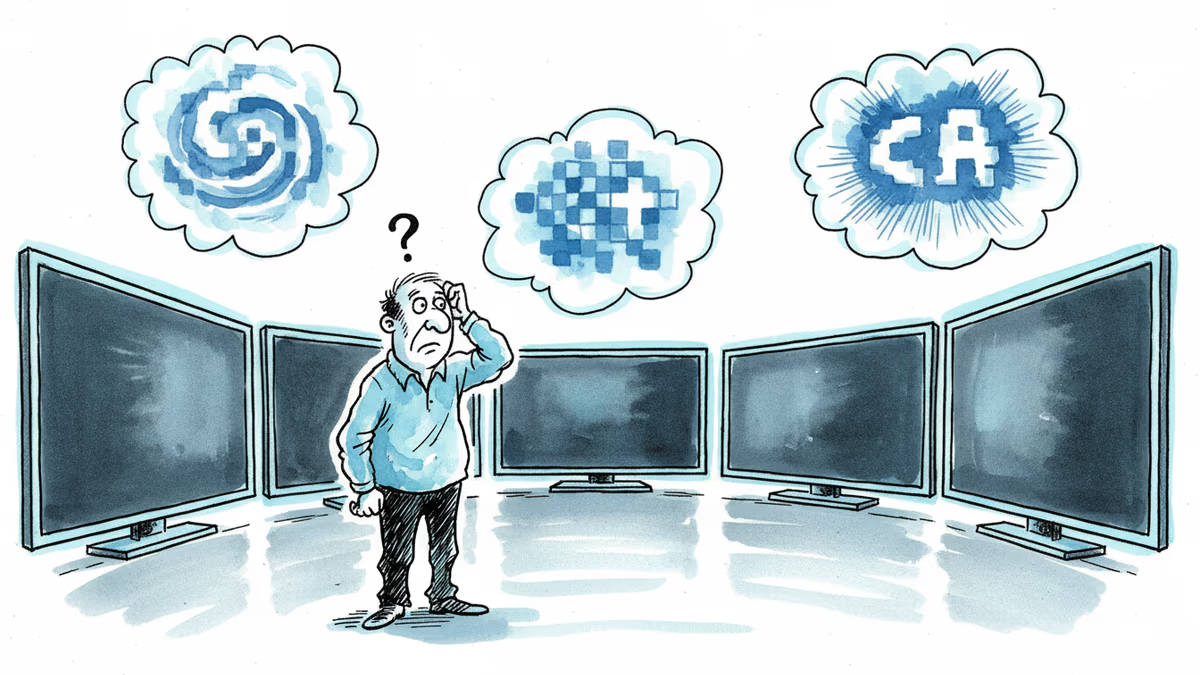
The TV Wars Heat Up: Why Your Next Screen Costs Less But Does More
From OLED to QLED to mini-LED, TV technology advances faster than ever while prices plummet. What does this mean for consumers navigating the crowded market?
The $237 Question: When Did Premium TV Tech Become Budget-Friendly?
Walk into any electronics store today, and you'll face a bewildering wall of acronyms: OLED, QLED, mini-LED, QD-OLED. But here's the kicker—what used to cost $2,000 three years ago now sells for under $300. Vizio's 4K TV with Dolby Vision support rings up at just $237 for a 55-inch model, while premium OLED displays have dropped to $1,177.
The television industry isn't just evolving—it's in free fall toward accessibility. But with dozens of models from LG, Samsung, TCL, Hisense, Sony, and others flooding the market, the abundance of choice has created a new problem: decision paralysis.
The Technology Trickle-Down Effect
Five years ago, HDR (High Dynamic Range) was a premium feature reserved for flagship models. Today, every 4K TV includes it as standard. The same pattern is playing out with technologies that were once exclusive to high-end sets.
TCL's QM6K QLED, now recommended as the best TV for most people at $530, packs mini-LED backlighting, 144Hz refresh rates, and precision dimming technology—features that would have commanded premium prices just two years ago. The company's "Halo Control system" reduces light bloom while maintaining brightness, delivering what was once considered professional-grade picture quality.
Meanwhile, OLED technology—long the gold standard for contrast and black levels—has become more accessible. LG's C4 OLED, priced at $1,177, offers the same core technology found in TVs costing twice as much just 18 months ago.
The Contrast Wars: Why Brightness Isn't Everything
Here's where the TV industry gets interesting: the battle isn't just about who can build the brightest screen anymore. It's about contrast—the difference between the lightest and darkest images on screen.

OLED TVs can turn individual pixels completely off, creating true blacks that make LED-backlit TVs look gray by comparison. But QLED TVs with quantum dots can achieve higher peak brightness, making HDR content pop with intensity that OLEDs struggle to match.
Enter QD-OLED technology, Samsung's attempt to combine the best of both worlds. These displays add quantum dots to traditional OLED panels, promising OLED-level contrast with QLED brightness. The catch? They're still expensive and relatively rare.
The Brand Consolidation Reality
Behind the marketing acronyms lies a sobering truth: the TV industry has consolidated dramatically. Only eight brands—LG, Samsung, Sony, Hisense, TCL, Vizio, Roku, and Panasonic—now dominate the market with reliable, well-supported products.
Cheaper alternatives from brands like Sceptre exist, but they often sacrifice picture quality, build durability, or software support. The message is clear: stick with established players or risk buyer's remorse.
This consolidation has benefits, though. Competition among the major brands has driven rapid innovation and price drops. When TCL launches a feature-packed TV at $530, Samsung and LG must respond with better value propositions.
The Gaming Revolution Nobody Talks About
Perhaps the most overlooked development in TV technology is gaming performance. Modern TVs now support 120Hz refresh rates, Variable Refresh Rate (VRR), and Auto Low Latency Mode (ALLM)—features that were exclusive to expensive gaming monitors just a few years ago.
TCL's QM6K pushes this further with 144Hz support and "Zero-Delay Transient Response." For gamers, this means console-quality performance without needing a separate monitor. Even budget options like Vizio's$237 model support 120fps gaming at 1080p.
The Smart TV Dilemma
Every TV now comes "smart," but that's not necessarily good news. Most built-in interfaces are slow, ad-heavy, or quickly abandoned by manufacturers. The irony? You might need to buy a separate streaming stick to properly use your smart TV.
Google TV, found on many TCL models, offers one of the better experiences with seamless Android and iOS casting. But even premium brands struggle with software that feels responsive and clean compared to dedicated streaming devices.
Authors
Related Articles
At Apple's 50th anniversary, top executives insisted the iPhone will anchor the AI era—and beyond. But is that confidence visionary or a warning sign?
Nine months after a record-breaking launch, Nintendo is cutting Switch 2 production from 6 million to 4 million units per quarter. What went wrong, and what does it signal for the console market?
House of the Dragon Season 3 teaser drops as HBO juggles two Game of Thrones spinoffs. Can the network rebuild trust after the original's controversial finale?
Memory prices have surged up to 6x due to AI demand, causing shortages and price hikes across smartphones, gaming consoles, and laptops. How AI's appetite affects everyday consumers.
At Apple's 50th anniversary, top executives insisted the iPhone will anchor the AI era—and beyond. But is that confidence visionary or a warning sign?
Nine months after a record-breaking launch, Nintendo is cutting Switch 2 production from 6 million to 4 million units per quarter. What went wrong, and what does it signal for the console market?
House of the Dragon Season 3 teaser drops as HBO juggles two Game of Thrones spinoffs. Can the network rebuild trust after the original's controversial finale?
Memory prices have surged up to 6x due to AI demand, causing shortages and price hikes across smartphones, gaming consoles, and laptops. How AI's appetite affects everyday consumers.
Thoughts
Share your thoughts on this article
Sign in to join the conversation