
The Tracker Wars: When Finding Things Becomes About Losing Privacy
From AirTags to Tile, Bluetooth trackers have evolved beyond simple item recovery into a complex web of surveillance, safety, and privacy concerns. Here's what the 2026 landscape reveals.
One billion devices. That's how many Apple products are scattered across the globe, each potentially serving as a relay point for a single lost AirTag. This number isn't just impressive—it's the foundation of why Bluetooth trackers have evolved from simple "find my keys" gadgets into something far more complex and concerning.
The Network Effect Revolution
When Apple launched AirTags in 2021, it didn't just enter the tracker market—it rewrote the rules entirely. While Tile had been content with basic Bluetooth connectivity, Apple brought Ultra Wideband (UWB) precision and the vast Find My network to the table. The result? A tracker that could guide you to within inches of your lost item and work virtually anywhere on Earth where an iPhone might be nearby.
But this technological leap came with an unexpected dark side. By 2022, reports of AirTag stalking and theft tracking were making headlines. Apple scrambled to add safeguards: shorter alert times, louder beeps, and even a separate Android app for detecting unwanted trackers. The company that revolutionized personal privacy was suddenly grappling with how its own technology could violate it.
Google eventually responded with its Find Hub network, but took a notably different approach—prioritizing privacy over precision from the start. The trade-off is clear: Google's system is less accurate but potentially safer.
The Tracker Ecosystem Expands
Today's tracker landscape is far more diverse than the Apple-versus-Tile narrative suggests. Companies like Pebblebee and Chipolo are playing Switzerland, creating devices that work with both Apple's and Google's networks. The $34.99 Pebblebee Card 5, for instance, offers 18-month battery life and wireless charging while supporting both platforms—something neither Apple nor Google's first-party options provide.
Meanwhile, Samsung carved out its own niche with the SmartTag2, complete with UWB tracking for Galaxy users. But here's the catch: these ecosystem plays only work if you're already committed to a particular brand's universe.

Beyond Simple Tracking
The most intriguing development isn't technological—it's social. Tile's "anti-theft mode," introduced in 2023, exemplifies the moral complexity these devices now navigate. The feature makes stolen items invisible to unwanted tracking detection, helping recover genuine theft victims' belongings. But to access it, users must submit government ID, agree to work with law enforcement without a subpoena, and accept a $1 million fine for misuse.
This isn't just a feature—it's a social contract that forces users to choose between recovery capabilities and privacy protection.
The Coming Integration
Looking ahead, the most significant change won't be hardware improvements (though 1.7mm-thick card trackers and 5-year batteries are certainly impressive). Instead, it'll be the rollout of Apple and Google's joint anti-stalking standard, which promises to break down platform barriers while maintaining safety protections.
This standardization could democratize precision tracking, making UWB-level accuracy available across platforms. But it also raises questions about market consolidation. If all trackers work similarly across all networks, what differentiates them beyond price and battery life?
The Privacy Paradox
The tracker market reveals a fundamental tension in modern technology: the same features that make devices incredibly useful also make them potentially dangerous. Apple's Find My network is powerful because it's ubiquitous, but that ubiquity is exactly what makes unwanted tracking possible.
Consumers seem willing to accept this trade-off, with tracker sales continuing to grow despite well-publicized stalking incidents. Perhaps we've collectively decided that the convenience of never losing our keys again outweighs the abstract risk of being tracked.
Authors
Related Articles
Apple's second-gen AirTags hit Costco with 29% discount just one month after launch. At $20 each, what's behind this unusually quick price drop?
Amazon stops selling single AirTags as Apple pushes second-gen. Four-pack still available at $64. Is the original good enough, or should you upgrade?
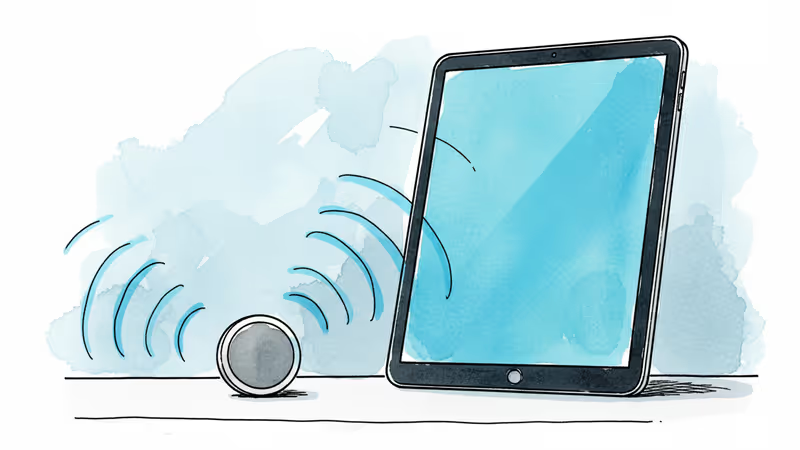
Apple's second-generation AirTag gets 1.5x better range and 50% louder sound. At $29, is this tiny tracker really more useful than an iPad?

Apple's second-generation AirTag extends tracking range by 50%, but the real story lies in what this means for personal security and market competition in 2026.
Apple's second-gen AirTags hit Costco with 29% discount just one month after launch. At $20 each, what's behind this unusually quick price drop?
Amazon stops selling single AirTags as Apple pushes second-gen. Four-pack still available at $64. Is the original good enough, or should you upgrade?
Apple's second-generation AirTag gets 1.5x better range and 50% louder sound. At $29, is this tiny tracker really more useful than an iPad?
Apple's second-generation AirTag extends tracking range by 50%, but the real story lies in what this means for personal security and market competition in 2026.
Thoughts
Share your thoughts on this article
Sign in to join the conversation