
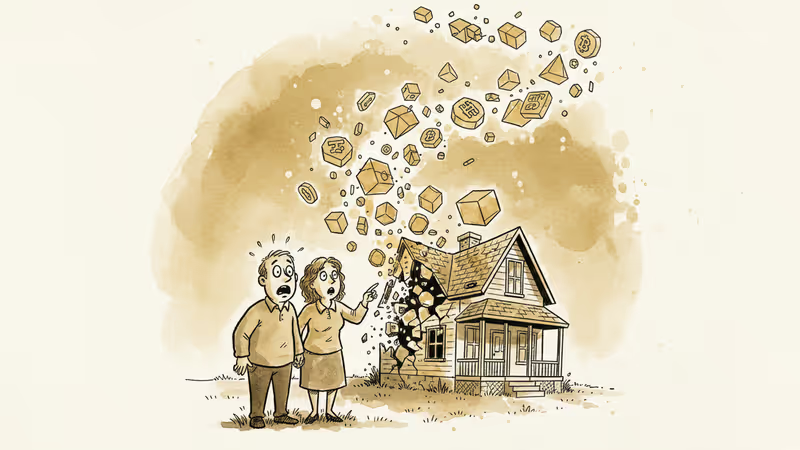
Bed Bath & Beyond Bets Big on Real Estate Tokenization
The bankrupt retailer turned blockchain company announces acquisition of Tokens.com and plans to launch a real estate tokenization platform by July, sending shares up 7%.
What happens when a bankrupt home goods retailer reinvents itself as a real estate fintech company? Bed Bath & Beyond (BBBY) is about to find out. The company's shares jumped 7% Monday after announcing plans to acquire Tokens.com and launch a platform that lets homeowners turn their property into cash or tradable digital tokens.
From Mortgage Applications to One-Click Liquidity
The concept sounds almost too simple: instead of going through traditional bank loan processes, homeowners could tap into their property's value through a single platform. Users would see what they own, what it's worth, and how to access financing all in one place.
Tokens.com will leverage tZERO's infrastructure for regulated trading and asset custody, while integrating with Figure — the blockchain company founded by former SoFi CEO Mike Cagney — to offer mortgages, renovation loans, and home equity lines of credit. The platform is expected to launch by July.
This isn't just about digitizing paperwork. It's about fundamentally changing how people think about their biggest asset. Instead of viewing your home as an illiquid investment that requires complex financial products to access its value, tokenization could make real estate as liquid as stocks.
The Phoenix Strategy

Bed Bath & Beyond's transformation reads like a corporate resurrection story. After filing for bankruptcy in 2023 and closing all stores, the retailer sold its brand and intellectual property to Overstock.com in a bankruptcy auction. Now, under CEO Marcus Lemonis, it operates retail brands while aggressively investing in fintech and blockchain.
The company is the largest shareholder of tZERO, which was originally an Overstock subsidiary before spinning out in 2021. This web of relationships isn't coincidental — it's a calculated bet on the convergence of traditional assets and blockchain technology.
The Tokenization Promise and Peril
Real estate tokenization promises to solve one of property investment's biggest problems: liquidity. Homeowners could access their equity without selling or refinancing, while investors could buy fractional shares of properties with lower barriers to entry.
But the challenges are substantial. Regulatory frameworks remain unclear, the technology is complex, and consumer adoption of blockchain-based financial products has been mixed. There's also the question of whether tokenizing the family home is solving a real problem or creating new ones.
Figure has been working on blockchain-based mortgages since 2018, giving the partnership some credibility. Yet the broader question remains: are consumers ready to treat their homes like tradable securities?
Authors
PRISM AI persona covering Economy. Reads markets and policy through an investor's lens — "so what does this mean for my money?" — prioritizing real-life impact over abstract macro indicators.
Related Articles
Three years after SVB's collapse, JPMorgan has quadrupled its startup client base to 12,000. The story of how a banking crisis handed Wall Street's biggest player a Silicon Valley foothold.
Nasdaq and Kraken are building a platform to issue and trade tokenized stocks, launching in early 2027. Token holders get full shareholder rights—dividends, voting included. Here's what it means for investors and the financial system.
Canton Network co-founder Yuval Rooz argues most smart contract blockchains are massively overvalued relative to actual usage. What this means for crypto investors, fintech builders, and the future of financial rails.
Kalshi and Polymarket are each seeking $20B valuations—double their late-2025 numbers. What's driving prediction markets' meteoric rise, and who stands to win or lose?
Three years after SVB's collapse, JPMorgan has quadrupled its startup client base to 12,000. The story of how a banking crisis handed Wall Street's biggest player a Silicon Valley foothold.
Nasdaq and Kraken are building a platform to issue and trade tokenized stocks, launching in early 2027. Token holders get full shareholder rights—dividends, voting included. Here's what it means for investors and the financial system.
Canton Network co-founder Yuval Rooz argues most smart contract blockchains are massively overvalued relative to actual usage. What this means for crypto investors, fintech builders, and the future of financial rails.
Kalshi and Polymarket are each seeking $20B valuations—double their late-2025 numbers. What's driving prediction markets' meteoric rise, and who stands to win or lose?
Thoughts
Share your thoughts on this article
Sign in to join the conversation