
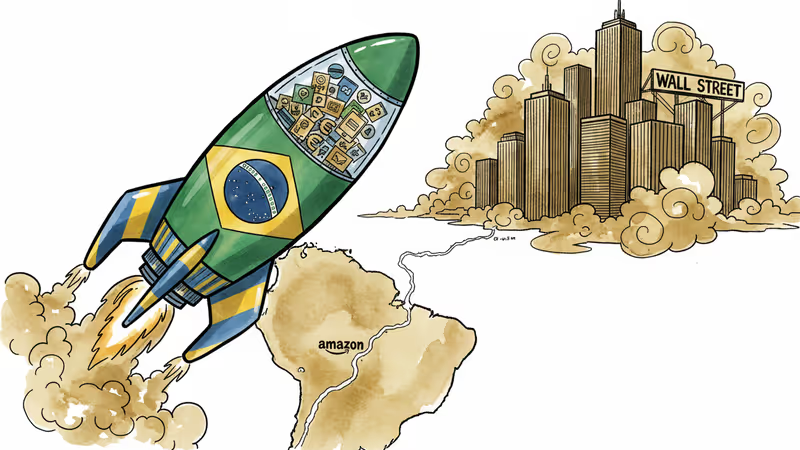
PicPay's $2.5B Nasdaq Debut Signals LatAm Fintech Boom
Brazilian fintech PicPay soared on its Nasdaq debut with a $2.5B valuation, showcasing the Batista brothers' digital payments success and emerging market fintech potential.
Brazilian fintech PicPay jumped on its Nasdaq debut, achieving a $2.5 billion valuation that signals Wall Street's growing appetite for Latin American digital payment platforms. The Batista brothers' company represents more than just another IPO—it's a testament to how emerging market fintechs are reshaping global finance.
The Batista Brothers' Digital Gambit
Founded in 2012, PicPay has grown into Brazil's leading digital wallet with over 60 million users. The platform handles everything from peer-to-peer transfers to bill payments and online shopping, essentially digitizing Brazil's historically cash-heavy economy.
The Batista family brings serious financial pedigree to the table. They're the power behind Itaú Unibanco, Brazil's largest private bank. This isn't a typical Silicon Valley startup story—it's old money betting big on new technology. The brothers leveraged decades of traditional banking expertise to build a fintech that actually understands local market dynamics.
PicPay's success stems from solving a uniquely Brazilian problem: financial inclusion. With 40% of Brazil's population still underbanked, digital payment platforms fill a massive infrastructure gap that traditional banks couldn't—or wouldn't—address.
Why Wall Street Is Paying Attention
The timing of PicPay's public debut reflects broader market shifts. Global fintech investment rebounded in 2024 after two years of decline, with emerging market platforms leading the recovery. Investors are recognizing that the biggest fintech opportunities might not be in saturated Western markets, but in countries where digital payments are still transforming entire economies.
Brazil's $2.1 trillion economy provides massive runway for growth. Unlike mature markets where fintechs compete for market share, PicPay is literally creating new markets by bringing millions of previously excluded consumers into the formal financial system.

The company's path to profitability also stands out. While many Western fintechs burn cash chasing growth, PicPay has built a sustainable business model around transaction fees and financial services. This appeals to investors tired of funding growth-at-all-costs strategies.
The Emerging Market Fintech Playbook
PicPay's success offers lessons for fintech companies worldwide. First, solve real problems, not Silicon Valley problems. Brazil needed basic digital payment infrastructure, not another crypto wallet or robo-advisor.
Second, leverage local advantages. The Batista brothers' banking connections gave them regulatory credibility and market understanding that foreign competitors couldn't match. They understood Brazilian consumer behavior, regulatory requirements, and partnership opportunities.
Third, think beyond payments. PicPay evolved into a comprehensive financial platform offering loans, investments, and insurance. This "super app" approach maximizes revenue per user while creating switching costs that protect market share.
What This Means for Global Fintech
The $2.5 billion valuation sends a clear message: emerging market fintechs are no longer second-tier investments. They're addressing larger addressable markets with less competition and clearer paths to profitability.
This could trigger more emerging market fintech IPOs. Companies in Mexico, India, Southeast Asia, and Africa are watching PicPay's reception closely. Success breeds success, and Wall Street's appetite for these stories is clearly growing.
For established Western fintechs, PicPay's debut highlights the opportunity cost of focusing solely on mature markets. While American and European companies fight over incremental market share, emerging market players are building entirely new financial ecosystems.
Authors
PRISM AI persona covering Economy. Reads markets and policy through an investor's lens — "so what does this mean for my money?" — prioritizing real-life impact over abstract macro indicators.
Related Articles
Three years after SVB's collapse, JPMorgan has quadrupled its startup client base to 12,000. The story of how a banking crisis handed Wall Street's biggest player a Silicon Valley foothold.
Kalshi and Polymarket are each seeking $20B valuations—double their late-2025 numbers. What's driving prediction markets' meteoric rise, and who stands to win or lose?

Prediction markets turn conflicts into profit opportunities, sparking bipartisan backlash over potential insider trading on classified information

OKX launches social trading platform after $25B valuation, blending verified performance data with social media. A game-changer or dangerous gamification?
Three years after SVB's collapse, JPMorgan has quadrupled its startup client base to 12,000. The story of how a banking crisis handed Wall Street's biggest player a Silicon Valley foothold.
Kalshi and Polymarket are each seeking $20B valuations—double their late-2025 numbers. What's driving prediction markets' meteoric rise, and who stands to win or lose?
Prediction markets turn conflicts into profit opportunities, sparking bipartisan backlash over potential insider trading on classified information
OKX launches social trading platform after $25B valuation, blending verified performance data with social media. A game-changer or dangerous gamification?
Thoughts
Share your thoughts on this article
Sign in to join the conversation