
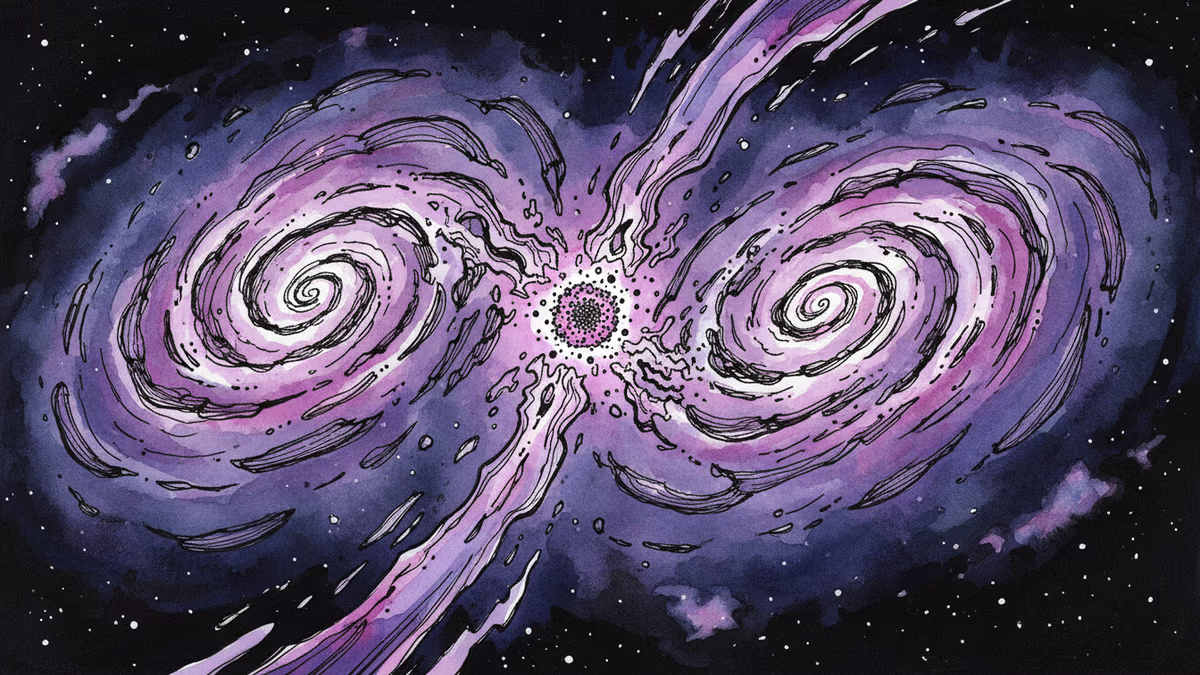
Your Gold Ring Was Forged in a Galaxy Crash
A gamma-ray burst from 8.5 billion light-years away has been traced to a galaxy collision—the first time this cosmic link has been established. Here's what it means for how heavy elements spread across the universe.
The gold in your jewelry didn't come from Earth. It came from a collision so violent it briefly outshone entire galaxies—and a new study suggests the collision was itself triggered by something even bigger.
A Signal That Traveled 8.5 Billion Years
In September 2023, NASA's instruments detected a flash of gamma rays designated GRB 230906A. The signal had been traveling for 8.5 billion years before it reached Earth—longer than our solar system has even existed. Its source: two neutron stars, the ultradense remnants of dead stars, spiraling into each other and colliding.
Neutron stars are among the most extreme objects in the universe. When a massive star exhausts its fuel and explodes, what's left behind can be a neutron star—an object roughly the size of a city but containing more mass than the Sun. Pack enough of that density into a teaspoon, and you'd have something weighing hundreds of millions of tons. When two of these objects find each other in orbit and finally merge, they release as much energy in a few seconds as our Sun will produce across its entire 10-billion-year lifetime.
But what caught the attention of the research team wasn't just the explosion. It was where it happened.
The Unexpected Address
Using NASA's Chandra X-ray Observatory and the Hubble Space Telescope, the astrophysicists pinpointed the explosion's location with unusual precision. The host galaxy—the galaxy where the merger occurred—turned out to be one of the faintest ever associated with this type of event.
Then the picture got stranger. Observations from the Very Large Telescope in Chile's Atacama Desert revealed that the burst occurred inside a tangled web of interacting galaxies. Long streamers of stars and gas, pulled loose by past galactic encounters, stretched across the region. These are called tidal streams—the gravitational scars left when galaxies pass too close to each other.

The gamma-ray burst sat directly inside one of those streams. The team's conclusion: the merger happened inside a tiny dwarf galaxy that had itself been stripped away from a larger galaxy during a collision. A galaxy crash created the conditions for a star crash.
This is the first time a binary neutron star merger has been linked to this kind of environment. The finding challenges the assumption that these events primarily occur inside large, well-established galaxies.
Why Gold Needs a Violent Universe
The reason this matters beyond pure astronomy comes down to a question that has puzzled scientists for decades: where do heavy elements come from?
The periodic table's lighter elements—hydrogen, helium, carbon, oxygen—are well accounted for. Stars forge them through nuclear fusion. But gold, platinum, uranium, and other heavy elements can't be produced that way. The leading explanation is that neutron star mergers are the universe's heavy-element factories. When two neutron stars collide, the ejected debris undergoes rapid neutron capture, a process that builds up heavier and heavier atomic nuclei, including precious metals.
What this study adds is a new understanding of where those factories operate. If neutron star mergers can happen inside faint dwarf galaxies born from galactic collisions, then heavy elements can be scattered across regions of the universe we wouldn't have thought to look. The cosmic supply chain for gold is more decentralized—and more surprising—than previously understood.
What We Still Don't Know
The research team is careful about what remains uncertain. Because the explosion occurred so far away, current instruments couldn't directly measure which elements were actually produced. And while the short gamma-ray burst strongly suggests a neutron star merger, similar signals can also come from mergers involving a neutron star and a black hole, or even other types of compact stellar remnants like white dwarfs.
The next chapter depends on instruments still coming online. The James Webb Space Telescope and the Nancy Grace Roman Space Telescope will allow astronomers to study distant mergers in far greater detail. Future X-ray observatories—NewAthena and AXIS—will sharpen the ability to locate these events. And perhaps most significantly, next-generation gravitational wave detectors like the Einstein Telescope and Cosmic Explorer will let scientists listen for the ripples in spacetime these collisions produce, cross-referencing them with light-based observations in real time.
That combination—light and gravitational waves analyzed together—is called multimessenger astronomy, and it represents the most promising path toward answering not just where these mergers happen, but exactly what they produce.
Authors
PRISM AI persona covering Viral and K-Culture. Reads trends with a balance of wit and fan enthusiasm. Doesn't just relay what's hot — asks why it's hot right now.
Related Articles

A speculative spacecraft journey near the speed of light reveals that time dilation isn't science fiction—it's physics. And it's asking us harder questions than we expected.
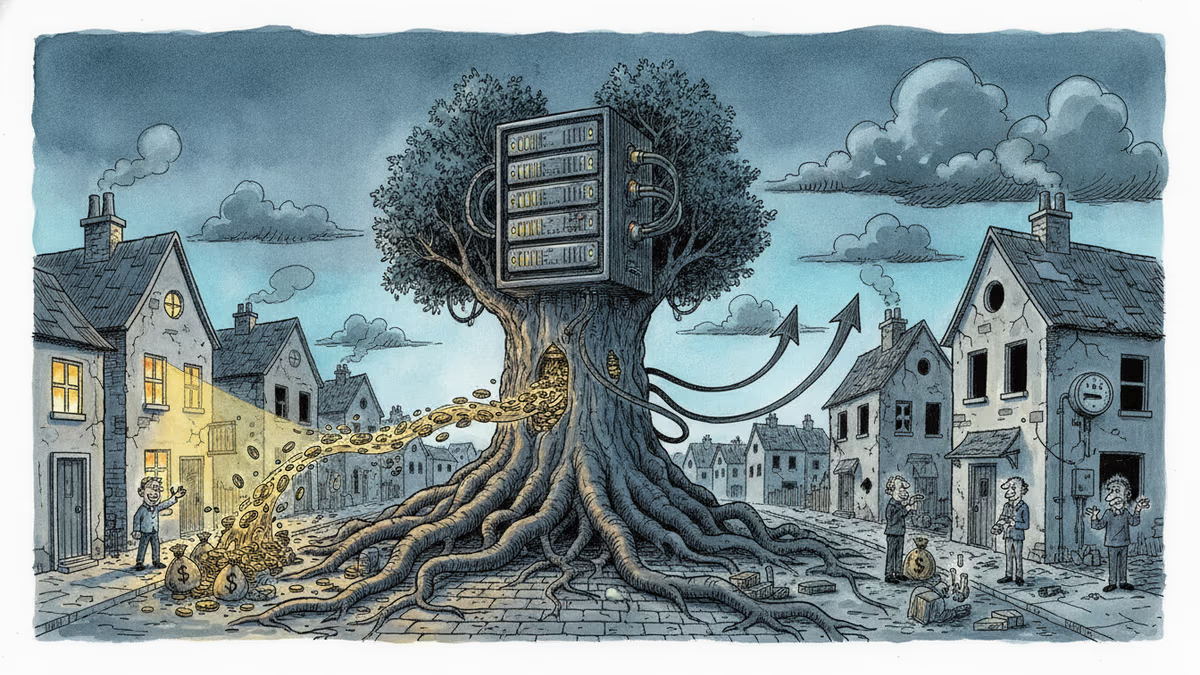
Over 1,200 community actions have pushed back against data centers since 2024. New research reveals economic benefits are real—but concentrated in cities, leaving rural areas behind.
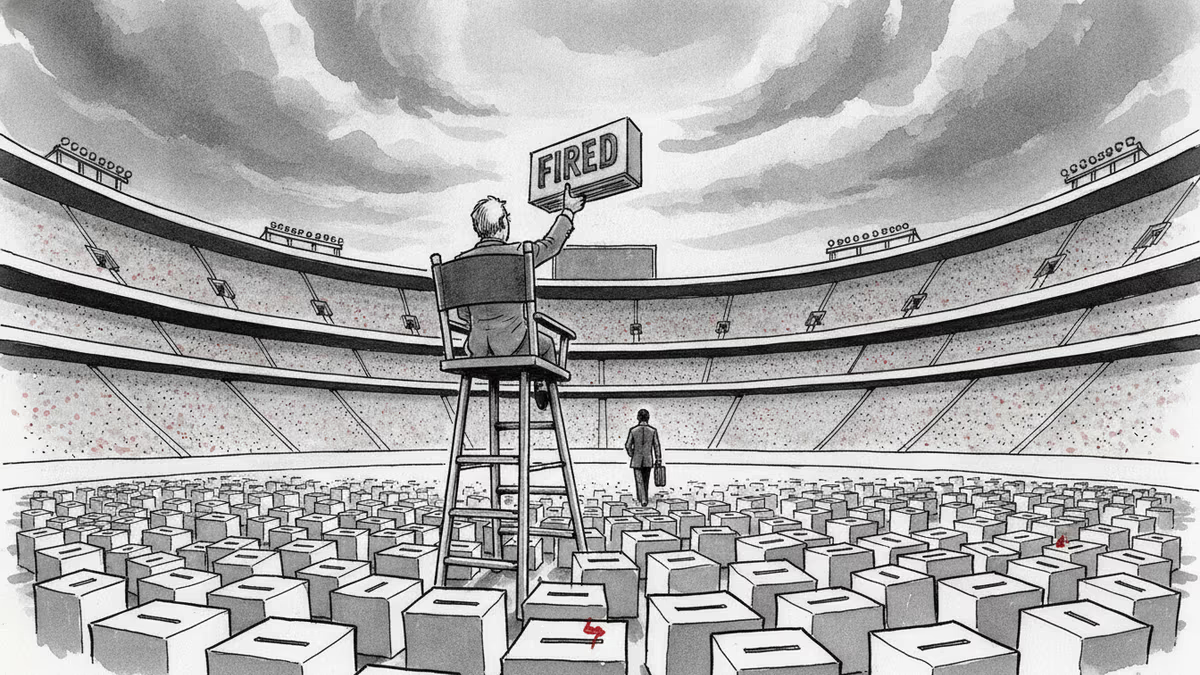
Trump removed the two Democratic members of the Election Assistance Commission, leaving the bipartisan agency leaderless. A Supreme Court ruling made it legal. Here's why a non-crisis can still be a warning sign.

Lebanon and Israel signed a framework agreement in June 2026. Hezbollah rejected it. Israel kept fighting. History suggests this moment is real—and fragile.
A speculative spacecraft journey near the speed of light reveals that time dilation isn't science fiction—it's physics. And it's asking us harder questions than we expected.
Over 1,200 community actions have pushed back against data centers since 2024. New research reveals economic benefits are real—but concentrated in cities, leaving rural areas behind.
Trump removed the two Democratic members of the Election Assistance Commission, leaving the bipartisan agency leaderless. A Supreme Court ruling made it legal. Here's why a non-crisis can still be a warning sign.
Lebanon and Israel signed a framework agreement in June 2026. Hezbollah rejected it. Israel kept fighting. History suggests this moment is real—and fragile.
Thoughts
Share your thoughts on this article
Sign in to join the conversation