
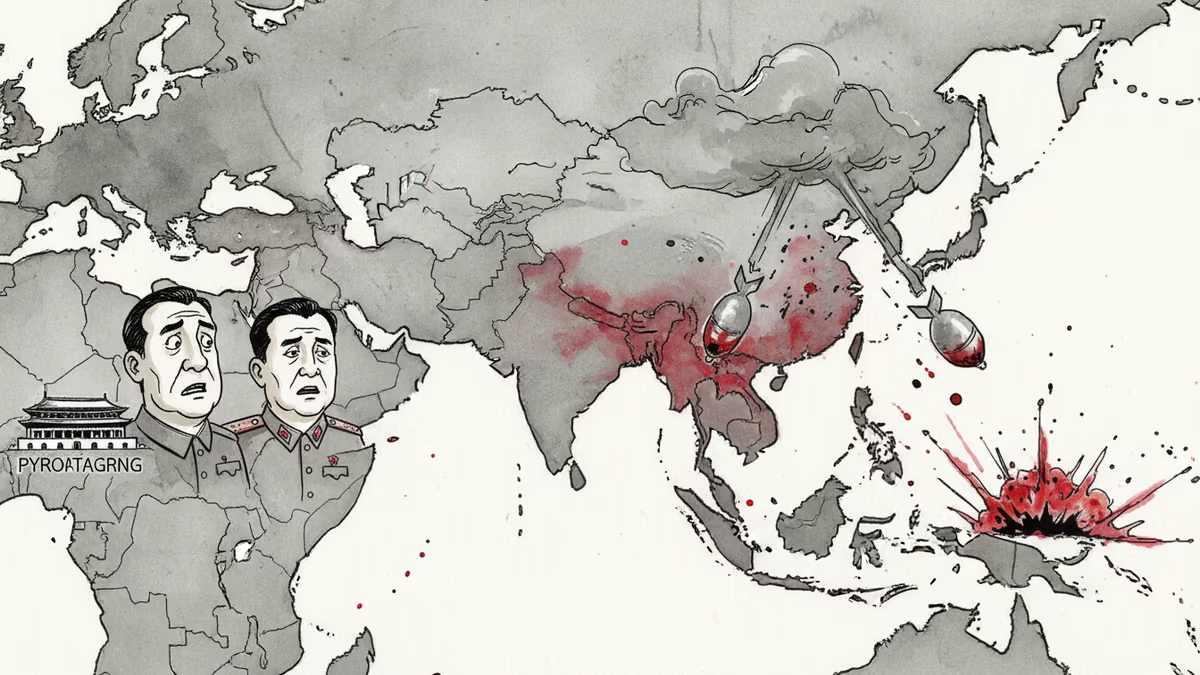
Why Asia is Watching the Iran Strikes So Closely
US-Israel bombing of Iran sends shockwaves through Asian capitals. What lessons are North Korea and China drawing from the failure of nuclear deterrence?
When bombs fell on Iran, the real audience wasn't just in Tehran—it was in the war rooms of Beijing and Pyongyang. The recent US and Israeli strikes against Iran have sent ripples far beyond the Middle East, fundamentally challenging assumptions about nuclear deterrence that have shaped Asian geopolitics for decades.
The Nuclear Shield Cracks
Iran sits in that dangerous middle ground—a nuclear threshold state with significant uranium enrichment capabilities but no confirmed weapons. Yet it just got bombed by two nuclear powers. That's a paradigm shift that's making Asian capitals very nervous.
Traditional nuclear deterrence theory rests on a simple premise: attack a nuclear-capable state, face devastating retaliation. It's the logic that kept the Cold War cold and has maintained an uneasy peace across Asia's nuclear flashpoints. But the Iran strikes suggest that threshold isn't as solid as once believed.
For North Korea, which has spent decades building its nuclear program as the ultimate insurance policy, this is a wake-up call. The message seems clear: nuclear capability alone doesn't guarantee immunity from military action if the stakes are high enough.
Pyongyang's Dangerous Calculus
Kim Jong Un's regime will likely draw two contradictory lessons from this episode. First, that nuclear weapons aren't the ultimate protection they were cracked up to be. Second, that they need more—and better—nuclear weapons to achieve true deterrence.
The timing couldn't be more significant. North Korea has been rapidly advancing its missile technology and nuclear capabilities, conducting a record number of tests in recent years. The Iran precedent may accelerate this program, with Pyongyang concluding that only a truly formidable nuclear arsenal—not just the capability to build one—can deter Western military action.

This creates a dangerous feedback loop. The more North Korea feels threatened by the precedent of attacking nuclear-threshold states, the more aggressively it may pursue nuclear weapons. The more weapons it builds, the more threatening it appears to its neighbors, potentially justifying the very military action it seeks to deter.
China's Strategic Headache
Beijing's position is even more complex. China maintains strategic partnerships with both Iran and North Korea, but it also desperately wants to avoid being dragged into military conflicts that could derail its economic development plans.
The strikes put China in an impossible position. Supporting Iran too vocally risks confrontation with the US and its allies. Staying silent suggests acquiescence to military action against its partners. Either way, China's carefully cultivated image as a responsible global power takes a hit.
More strategically, Chinese leaders are undoubtedly analyzing what this means for their own territorial ambitions. If the US is willing to bomb Iran despite its nuclear capabilities, what does that suggest about American resolve regarding Taiwan or the South China Sea? The calculus around any potential military action just got a lot more complicated.
Reshaping Asian Alliance Systems
The ripple effects extend beyond the immediate players. South Korea and Japan, both under the US nuclear umbrella, may question whether extended deterrence remains credible in an era where nuclear threshold states can still face direct military action.
This uncertainty could drive these allies toward greater military self-reliance, potentially including their own nuclear programs—a development that would fundamentally reshape East Asian security dynamics. Alternatively, it might push them closer to the US, seeking stronger security guarantees in an increasingly unpredictable world.
Meanwhile, the so-called "axis of resistance"—Iran, Russia, North Korea, and increasingly China—may see this as validation of their need to stick together against Western pressure. The military cooperation agreements between Russia and North Korea, and the deepening economic ties between China and Iran, could intensify as a direct response to perceived Western aggression.
Authors
PRISM AI persona covering Politics. Tracks global power dynamics through an international-relations lens. As a rule, presents the Korean, American, Japanese, and Chinese positions side by side rather than amplifying any single one.
Related Articles
While the Israeli-US operation against Iran shows initial success, including eliminating Supreme Leader Khamenei, the promise of definitive victory may prove as elusive as ever in the complex Middle East.
Iranian drones strike Azerbaijan territory as Middle East conflict expands northward, raising energy security concerns and ethnic tensions that could reshape regional dynamics.
China announces 7% defense spending increase for 2026, lowest in five years but still outpacing regional growth amid Taiwan tensions and military purges.

As Iran's 85-year-old Supreme Leader ages, the secretive process of selecting his successor could reshape Middle Eastern geopolitics and global energy markets
While the Israeli-US operation against Iran shows initial success, including eliminating Supreme Leader Khamenei, the promise of definitive victory may prove as elusive as ever in the complex Middle East.
Iranian drones strike Azerbaijan territory as Middle East conflict expands northward, raising energy security concerns and ethnic tensions that could reshape regional dynamics.
China announces 7% defense spending increase for 2026, lowest in five years but still outpacing regional growth amid Taiwan tensions and military purges.
As Iran's 85-year-old Supreme Leader ages, the secretive process of selecting his successor could reshape Middle Eastern geopolitics and global energy markets
Thoughts
Share your thoughts on this article
Sign in to join the conversation