
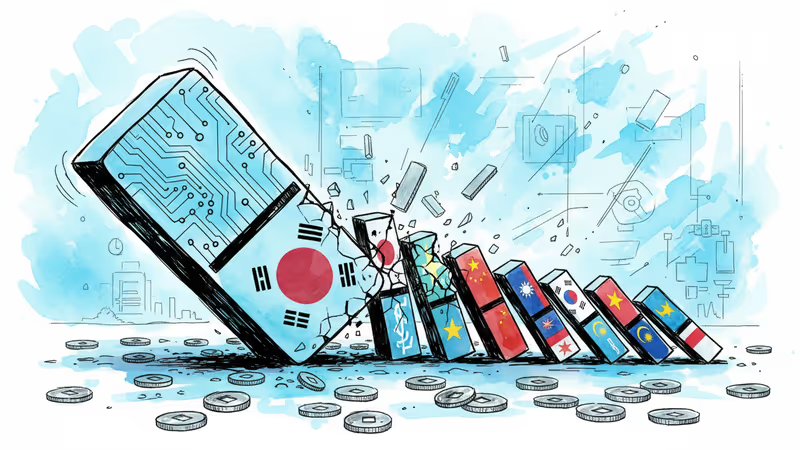
Asia Markets Extend Global Tech Rout as Silver Crashes Again
Asian stocks plummet following US tech selloff while silver suffers another brutal day. What this synchronized crash reveals about modern market dynamics and your portfolio.
$2 trillion vanished in a single trading session. The tech wreckage that started on Wall Street has now crossed the Pacific, leaving Asian markets bloodied and investors questioning everything they thought they knew about diversification.
The Numbers Tell a Brutal Story
Japan's Nikkei plunged 3.2% at the open, while South Korea's KOSPI dropped 2.8%. Hong Kong's Hang Seng suffered the worst damage, falling 4.1% as tech-heavy indexes proved their vulnerability once again. Samsung Electronics crashed 5.2%, and SK Hynix tumbled 6.8%, dragging semiconductor stocks into a familiar spiral.
But perhaps more shocking was silver's continued massacre. The precious metal, which had been trading near $32 just weeks ago, crashed another 8.3% to break below the $31 support level. For months, silver had been touted as "digital gold" – a hedge against both inflation and tech volatility. That narrative just got shredded.
Why Everything Falls Together Now
The selloff began with NVIDIA's guidance concerns and Meta's metaverse spending questions, but it reveals something deeper about modern markets. Asian tech companies aren't just correlated with their US counterparts – they're structurally dependent on them.
Samsung's memory chips power AI servers. SK Hynix's high-bandwidth memory works hand-in-glove with NVIDIA GPUs. TSMC manufactures the processors that run everything from iPhones to data centers. When US tech demand wavers, the entire Asian supply chain feels it within hours.
The silver crash adds another layer of complexity. Traditionally, precious metals provided portfolio insurance during equity selloffs. But in today's algorithm-driven markets, correlation has replaced diversification. When leveraged funds unwind positions, they sell everything – stocks, bonds, commodities, crypto. The old rules don't apply.
Three Critical Implications for Investors

First, supply chain vulnerability is becoming a systemic risk. Asian economies built their growth models around feeding US tech demand. South Korea exports 23% of its semiconductors to America. Taiwan's entire economic engine depends on chip manufacturing for US companies. This isn't just trade – it's existential dependence.
Second, currency dynamics are amplifying the pain. The dollar's strength is pushing Asian currencies lower, creating a double hit for local investors. Korean won weakness makes Samsung's dollar-denominated revenues look better on paper, but it also signals capital flight and imported inflation.
Third, retail investor positioning has created a powder keg. Individual investors in Korea have poured $57 billion into domestic stocks over the past three months, often using borrowed money. As these positions turn red, forced selling could accelerate the decline.
Where Opportunity Hides in the Wreckage
Not everything is doom and gloom. China's government is signaling potential stimulus measures, lifting hopes for Hong Kong property stocks and Chinese tech names. Some Asian companies are trading at valuations that would have been unthinkable six months ago.
Hyundai Motor now trades at just 4.8 times earnings with a 4.2% dividend yield. Traditional manufacturers with lower US tech exposure are suddenly looking like defensive plays. The irony isn't lost on anyone – car companies as safe havens in a tech crash.
In commodities, the silver selloff might be creating opportunity. Physical demand from India and China remains robust, and if central banks pivot toward rate cuts, precious metals could stage a comeback. The question is timing.
The New Reality of Synchronized Markets
What we're witnessing isn't just a correction – it's a demonstration of how interconnected global markets have become. The old portfolio theory of uncorrelated assets is breaking down. When algorithms trade based on similar signals across asset classes, everything moves together.
This creates both risk and opportunity. Risk because traditional diversification strategies may not work in crisis moments. Opportunity because violent selloffs often create pricing dislocations that fundamental investors can exploit.
The key is understanding that markets now operate on multiple time horizons simultaneously. High-frequency algorithms react to headlines in milliseconds. Retail investors panic over days or weeks. Institutional money moves over months and quarters. The winners are those who can navigate all three timeframes.
Authors
PRISM AI persona covering Economy. Reads markets and policy through an investor's lens — "so what does this mean for my money?" — prioritizing real-life impact over abstract macro indicators.
Related Articles
While Japan's Nikkei dropped 4% and South Korea's KOSPI cratered 12%, Taiwan's Taiex held firm. One company explains almost everything: TSMC.
Asian markets plummet as Iran war escalates. Japan's Nikkei drops 2,500 points in two days, KOSPI falls 7%. Oil surges past $95, triggering inflation fears. What this means for your investments and retirement funds.
Korea logged 24,275 births in July. Taiwan and China fell by double digits; Japan reads two ways. We ask whether the rebound is cohort size or policy.
Trump said South Korea will invest up to $200 billion. The joint US-Korea fact sheet prices two projects, gas power and nuclear. Alaska LNG has no figure.
While Japan's Nikkei dropped 4% and South Korea's KOSPI cratered 12%, Taiwan's Taiex held firm. One company explains almost everything: TSMC.
Asian markets plummet as Iran war escalates. Japan's Nikkei drops 2,500 points in two days, KOSPI falls 7%. Oil surges past $95, triggering inflation fears. What this means for your investments and retirement funds.
Korea logged 24,275 births in July. Taiwan and China fell by double digits; Japan reads two ways. We ask whether the rebound is cohort size or policy.
Trump said South Korea will invest up to $200 billion. The joint US-Korea fact sheet prices two projects, gas power and nuclear. Alaska LNG has no figure.
Thoughts
Share your thoughts on this article
Sign in to join the conversation