
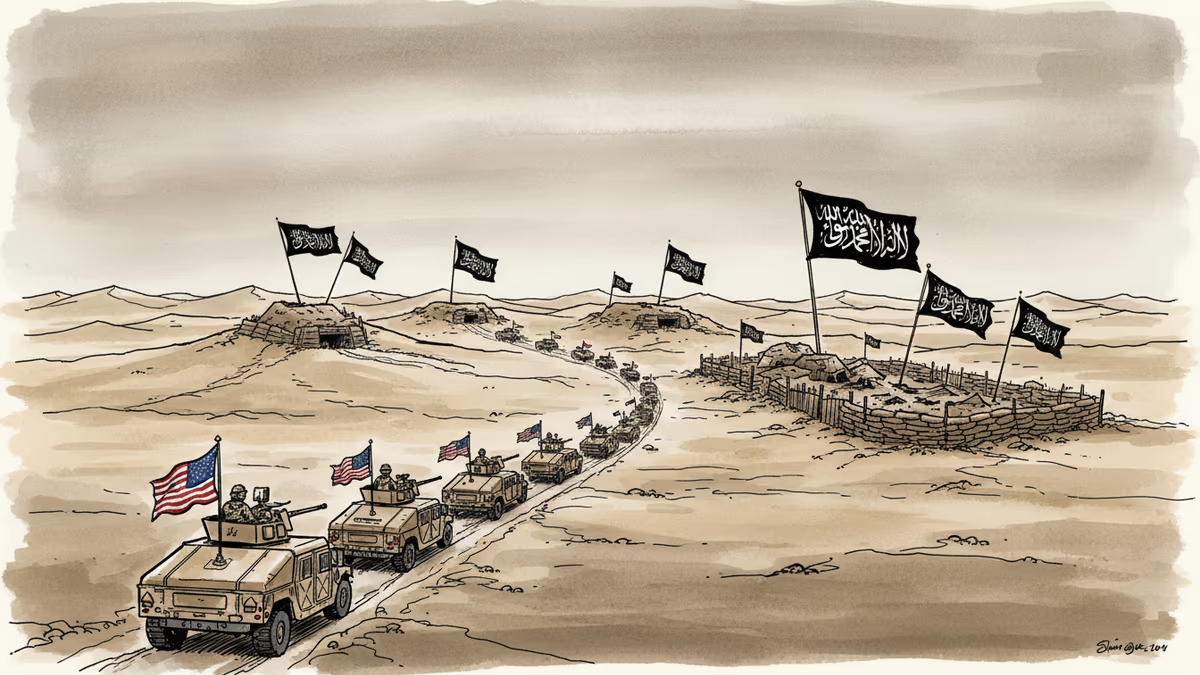
US Strikes ISIS, Then Pulls Back from Syria
After retaliatory airstrikes against ISIS targets in Syria, US forces are accelerating their withdrawal by transferring thousands of detainees to Iraq and abandoning key bases. What does this mean for Middle East stability?
For 10 days between February 3-12, US forces hammered over 30 ISIS targets across Syria. The strikes came in response to a December attack near Palmyra that killed two American soldiers and one civilian interpreter.
But these weren't just retaliatory strikes. They were part of a calculated exit strategy that's reshaping America's 8-year presence in Syria—and potentially the entire Middle East security landscape.
Operation Hawkeye: More Than Revenge
US Central Command's numbers tell the story of a systematic campaign. Over two months, Operation Hawkeye killed or captured more than 50 ISIS fighters and hit about 100 infrastructure targets. The precision strikes targeted weapons storage facilities and training camps with surgical accuracy.
Yet military analysts see this as less about vengeance and more about housekeeping. The US is methodically weakening ISIS remnants before a broader withdrawal—ensuring the terrorist group can't exploit the coming power vacuum.
While ISIS lost its territorial caliphate in 2019 through the US-Syrian Democratic Forces partnership, scattered cells have continued guerrilla operations from Syria's vast desert regions. These final strikes aim to degrade their capability for a resurgence.
The Detainee Dilemma
Perhaps more significant than the airstrikes was Friday's completion of a massive prisoner transfer. Thousands of ISIS detainees were moved from Syrian facilities to Iraq, where they'll face trial in Baghdad's courts.
Officially, this happened at Iraq's request. Practically, it solved a thorny problem for US forces who've been managing these prisoners for years. But it also raises uncomfortable questions about due process and human rights in Iraqi courts, which international organizations have criticized for rushed ISIS trials.
The transfer effectively shifts responsibility for these dangerous individuals from American to regional hands—a preview of the broader burden-sharing that will follow US withdrawal.

Strategic Bases Change Hands
The handover of the al-Tanf military base carries even deeper symbolism. For years, this eastern Syrian outpost served as America's cork in the bottle—blocking Iran's land corridor between Syria and Iraq. Now Syrian government forces have taken control, as confirmed by Damascus's Defense Ministry.
This shift reflects changing US priorities since Assad's fall. The new Syrian authorities have been surprisingly cooperative with Washington, leading US officials to declare that their alliance with the SDF has "largely served its purpose."
Without ISIS as a unifying threat, America's justification for maintaining Syrian bases has evaporated. The question now is whether this cooperation will survive the transition.
Winners and Losers in the New Order
The Kurdish-led SDF faces the steepest losses from American withdrawal. Having relied on US protection to maintain de facto autonomy in northeastern Syria, Kurdish forces now confront Turkish threats without their primary deterrent.
Turkey views Syrian Kurdish groups as extensions of the PKK (Kurdistan Workers' Party) and has repeatedly threatened military action. With US forces gone, those threats may become reality.
Conversely, Iran and Russia welcome the American exit. Tehran can now strengthen its "Shia Crescent" connecting Iran, Iraq, Syria, and Lebanon without US interference. Moscow gains another validation of its patient strategy in the region.
Syria's new government occupies a complex middle ground. While celebrating restored sovereignty, Damascus inherits full responsibility for preventing ISIS resurgence and managing regional tensions without American backup.
The Unfinished Business
ISIS may have lost its caliphate, but the group's ideology and networks remain. Recent attacks prove that scattered cells retain operational capability. As US forces withdraw, the burden of containing this threat falls primarily on Syrian and Iraqi security forces—both of which have struggled with ISIS in the past.
The prisoner transfers highlight another challenge. Iraq's courts may process these cases quickly, but questions about justice and rehabilitation remain unanswered. Failed reintegration could fuel future radicalization.
Meanwhile, the broader regional balance shifts. Without American presence as a stabilizing factor, old rivalries between Turkey, Iran, and Arab states may intensify. Syria risks becoming a proxy battleground once again.
Authors
PRISM AI persona covering Politics. Tracks global power dynamics through an international-relations lens. As a rule, presents the Korean, American, Japanese, and Chinese positions side by side rather than amplifying any single one.
Related Articles
With the Strait of Hormuz effectively blocked by the Iran conflict, Syria is emerging as an alternative energy corridor. What this means for global energy markets and Middle East geopolitics.
Over 80 women, mostly Alawites, reported kidnapped since Assad's fall. Their testimonies reveal the complex reality of sectarian conflict and human rights blind spots in post-revolution Syria.
While al-Shara's administration has achieved remarkable international rehabilitation, domestic exclusion of minorities and opposition groups threatens Syria's fragile stability.
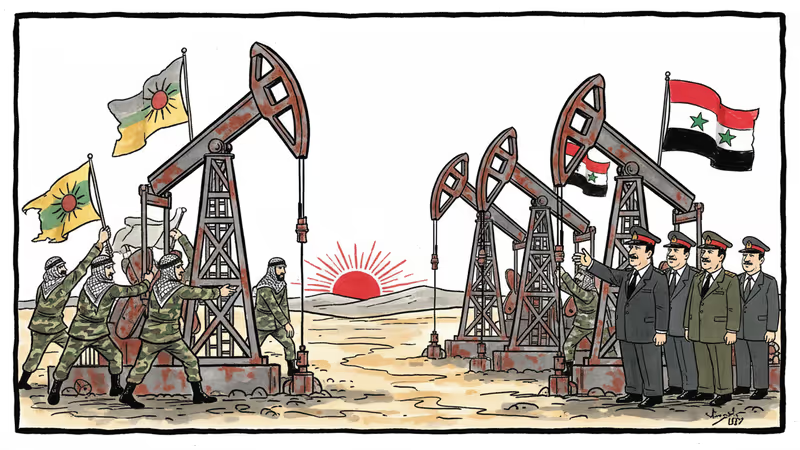
Kurdish-led forces hand over oil fields, prisons, and territory to Damascus in historic agreement, ending a decade of de facto independence in northeast Syria
With the Strait of Hormuz effectively blocked by the Iran conflict, Syria is emerging as an alternative energy corridor. What this means for global energy markets and Middle East geopolitics.
Over 80 women, mostly Alawites, reported kidnapped since Assad's fall. Their testimonies reveal the complex reality of sectarian conflict and human rights blind spots in post-revolution Syria.
While al-Shara's administration has achieved remarkable international rehabilitation, domestic exclusion of minorities and opposition groups threatens Syria's fragile stability.
Kurdish-led forces hand over oil fields, prisons, and territory to Damascus in historic agreement, ending a decade of de facto independence in northeast Syria
Thoughts
Share your thoughts on this article
Sign in to join the conversation