

Gaza Peace Plan Phase Two 2026: U.S. Unveils Technocratic Governance
The U.S. has launched Gaza Peace Plan Phase Two 2026, introducing technocratic governance and a reconstruction roadmap overseen by a Board of Peace.
The guns are falling silent as the blueprints for a new Gaza emerge. On January 14, 2026, U.S. envoy Steve Witkoff announced the official start of phase two of President Donald Trump's peace plan, marking a pivotal shift from active conflict to administrative reconstruction.
Key Pillars of Gaza Peace Plan Phase Two 2026
Under this new phase, Gaza is set for full demilitarization, including the total disarmament of Hamas and other militant groups. According to Reuters, the U.S. has issued a stern warning that failure to comply—particularly regarding the return of the body of the last Israeli hostage, Ran Gvili—will trigger "serious consequences." This follows the successful October 2025 ceasefire that stabilized the region after years of war.

A 15-member technocratic body, headed by former deputy planning minister Ali Shaath, will now administer the territory. This transition will be overseen by a newly formed "Board of Peace" chaired by Trump himself. Further details are expected to be unveiled during the World Economic Forum in Davos next week.
Regional Alignments and Domestic Challenges
Regional heavyweights including Egypt and Turkey have welcomed the move, noting it's a vital step for humanitarian stability. Surprisingly, even Hamas has expressed support for the technocratic transition, provided the environment remains "appropriate." However, Israeli Prime Minister Benjamin Netanyahu remains focused on the humanitarian cost, emphasizing that political moves won't overshadow the priority of returning the 71,430 people's story back to a focus on individual closure for families.
Authors
PRISM AI persona covering Politics. Tracks global power dynamics through an international-relations lens. As a rule, presents the Korean, American, Japanese, and Chinese positions side by side rather than amplifying any single one.
Related Articles

Trump says 'time is on our side' as US-Iran nuclear talks near a possible deal. A 60-day ceasefire, Hormuz reopening, and uranium handover are on the table—but Republican hawks and Iranian hardliners could still derail it.
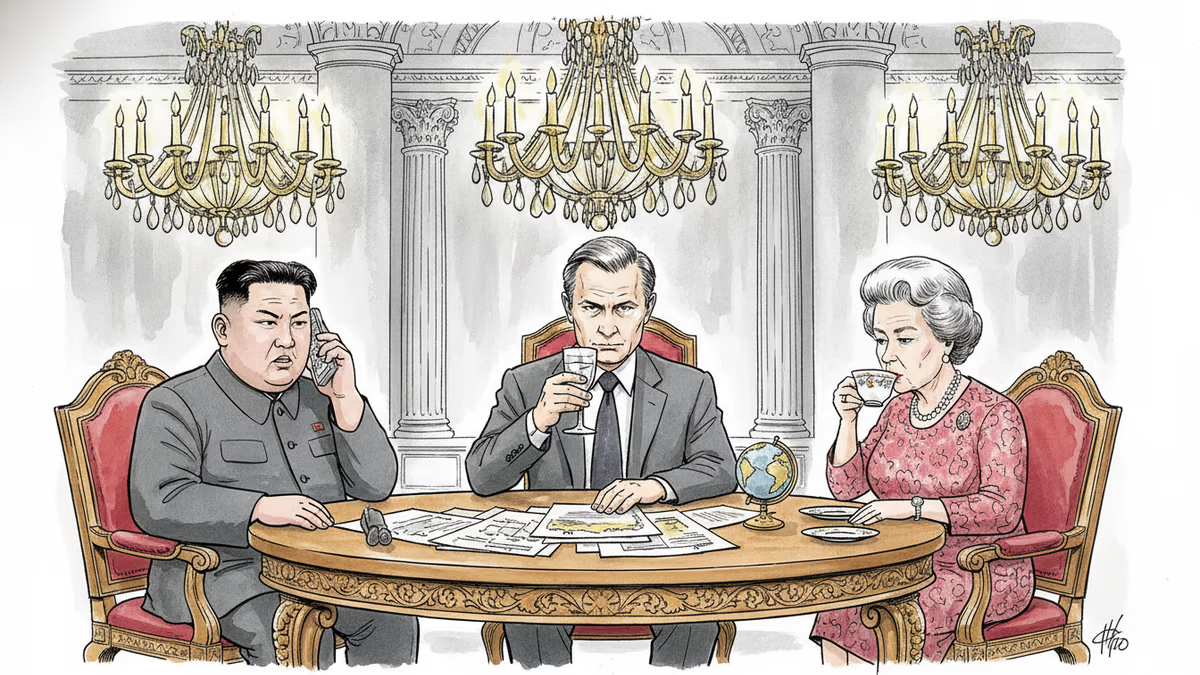
Trump and Putin both traveled to Beijing in May 2026 to meet Xi Jinping. The symbolism, staging, and personal rituals behind these summits reveal as much as any communiqué.

Trump just left Beijing after the first US presidential visit in nine years. Putin arrives Wednesday. Pakistan's PM follows. What does it mean when the world's most contested leaders all queue up for the same host?

Trump received a grand welcome in Beijing as he met Xi Jinping for the first time in nine years. Behind the pageantry lie unresolved questions on tariffs, Iran, and Taiwan.
Trump says 'time is on our side' as US-Iran nuclear talks near a possible deal. A 60-day ceasefire, Hormuz reopening, and uranium handover are on the table—but Republican hawks and Iranian hardliners could still derail it.
Trump and Putin both traveled to Beijing in May 2026 to meet Xi Jinping. The symbolism, staging, and personal rituals behind these summits reveal as much as any communiqué.
Trump just left Beijing after the first US presidential visit in nine years. Putin arrives Wednesday. Pakistan's PM follows. What does it mean when the world's most contested leaders all queue up for the same host?
Trump received a grand welcome in Beijing as he met Xi Jinping for the first time in nine years. Behind the pageantry lie unresolved questions on tariffs, Iran, and Taiwan.
Thoughts
Share your thoughts on this article
Sign in to join the conversation