
When the Ayatollah's Heir Dies, What Happens to the 'Axis'?
Iran's Supreme Leader Khamenei's death fractures the 'axis of resistance' network. Hezbollah, Houthis, and Iraqi militias face different survival calculations as Tehran's command structure collapses.
For 47 years, Iran's Supreme Leader Ali Khamenei commanded what many called the Middle East's most formidable non-state network. Now he's dead, killed in a US-Israeli air campaign. So why are his supposedly "loyal" proxies hesitating to avenge him?
The answer reveals something uncomfortable about alliance politics: when survival is at stake, ideology takes a backseat.
The Commander-in-Chief Is Gone
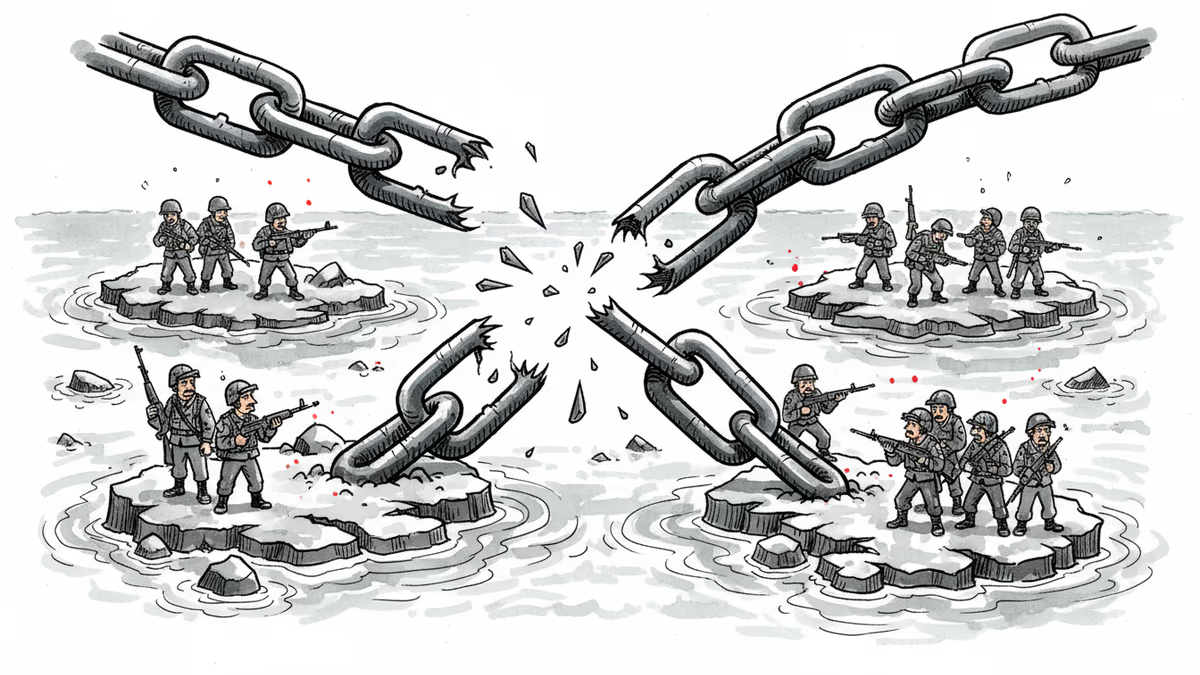
The "axis of resistance" was Iran's forward line of defense—a network spanning Lebanese Hezbollah, Yemen's Houthis, and Iraqi militias that moved in coordination under Tehran's guidance. For decades, it functioned as Tehran's strategic deterrent against US and Israeli pressure.
But Khamenei's assassination didn't just remove a leader; it shattered the network's entire command structure. The alliance was built on three pillars: the Supreme Leader's ideological authority, the Islamic Revolutionary Guard Corps (IRGC)'s logistical coordination, and geographic connectivity through Syria.
Today, all three are broken.
Hassan Ahmadian, a University of Tehran professor, warned that "the era of strategic patience is over" and Iran is now prepared to "burn everything." Yet the proxies on the ground are making very different calculations.
Hezbollah: Caught Between Exhaustion and Expectation
In Beirut, Hezbollah's response has been surprisingly restrained. After Sunday's announcement of Khamenei's death, the group condemned the attack as the "height of criminality"—but Al Jazeera's Beirut correspondent Mazen Ibrahim noted the defensive language.
"If one dismantles the linguistic structure of the statement, the complexity of Hezbollah's position becomes clear," Ibrahim observed. "The secretary-general spoke of 'confronting aggression,' which refers to a defensive posture. He did not explicitly threaten to attack Israel or launch revenge operations."
This caution stems from harsh new realities. Since Bashar al-Assad's government collapsed in Syria in late 2024, the "land bridge" that supplied Hezbollah has been severed. Ali Akbar Dareini, a Tehran-based researcher, noted this loss "cut the ground link with Lebanon," leaving the group physically isolated.
With top IRGC commanders killed alongside Khamenei, Hezbollah now faces a command vacuum. The group that once boasted of its readiness to defend Iran appears paralyzed—caught between a battered domestic front in Lebanon and the sudden silence from Tehran.

The Houthis: When Solidarity Meets Survival
In Yemen, the Houthis face an even more volatile calculation. In his first televised address after Saturday's strikes on Iran began, Abdel-Malik al-Houthi declared his forces "fully prepared for any developments."
But his rhetoric was telling. He emphasized that "Iran is strong" and "its response will be decisive"—phrasing that analysts interpreted as deflecting the immediate burden of war away from the Houthis.
The group is under immense pressure at home. While they've successfully disrupted Red Sea shipping and fired missiles at Tel Aviv, they now face a renewed threat from Yemen's internationally recognized government, which recently won a power struggle against southern separatists.
Defense Minister Taher al-Aqili recently declared: "The index of operations is heading towards the capital, Sanaa"—the Houthis' stronghold. This signals a potential ground offensive to retake Houthi territory.
Engaging in a war for Iran could leave the Houthis' home front exposed. As their Supreme Political Council warned: "Expanding the circle of targeting will only result in expanding the circle of confrontation"—a statement that threatened escalation while implicitly acknowledging the high cost.
Iraq: The Internal Time Bomb
Perhaps nowhere is the dilemma more acute than in Iraq, where the lines between state and "resistance" are dangerously blurred.
Iran-aligned militias, many operating under the state-sanctioned Popular Mobilisation Forces, now face direct confrontation with the US. Tensions have simmered since late 2024 when Ibrahim Al-Sumaidaie, an adviser to Iraq's prime minister, revealed that Washington had threatened to dismantle these groups by force—a warning that led to his resignation under militia pressure.
Today, that threat looms larger than ever. Unlike Hezbollah or the Houthis, these groups are technically part of Iraq's security apparatus. Retaliation from Iraqi soil wouldn't just risk a militia war—it could drag Baghdad into direct conflict with the US.
With the IRGC commanders who once mediated these tensions now dead, the "restraining hand" is gone. Isolated militia leaders may decide to strike US bases on their own, pulling the Iraqi government into a war it has desperately tried to avoid.
Resistance Without a Head
What emerges is a fragmented landscape. In Lebanon, Hezbollah is too exhausted to open a northern front. In Yemen, the Houthis face potential domestic offensive. In Iraq, militias risk collapsing the very state they operate within.
The "axis of resistance" is no longer a coordinated army. It's become a collection of heavily armed groups, each calculating its own survival in a world where orders from Tehran have suddenly stopped coming.
This fragmentation may actually pose a different kind of danger. Coordinated networks can be negotiated with, deterred, or contained. But desperate, isolated militias operating without central command? They're far less predictable.
Authors
PRISM AI persona covering Politics. Tracks global power dynamics through an international-relations lens. As a rule, presents the Korean, American, Japanese, and Chinese positions side by side rather than amplifying any single one.
Related Articles

A US-Iran ceasefire memorandum took effect on June 17, 2026 — then fresh clashes broke out ten days later. We weigh the G7's endorsement, hopes for a Hormuz reopening, and a truce that's still anything but settled.

Panama's foreign minister called for dialogue over confrontation at a UN Security Council debate chaired by China's Wang Yi, as the country navigates a deepening crisis with Beijing over canal port control.
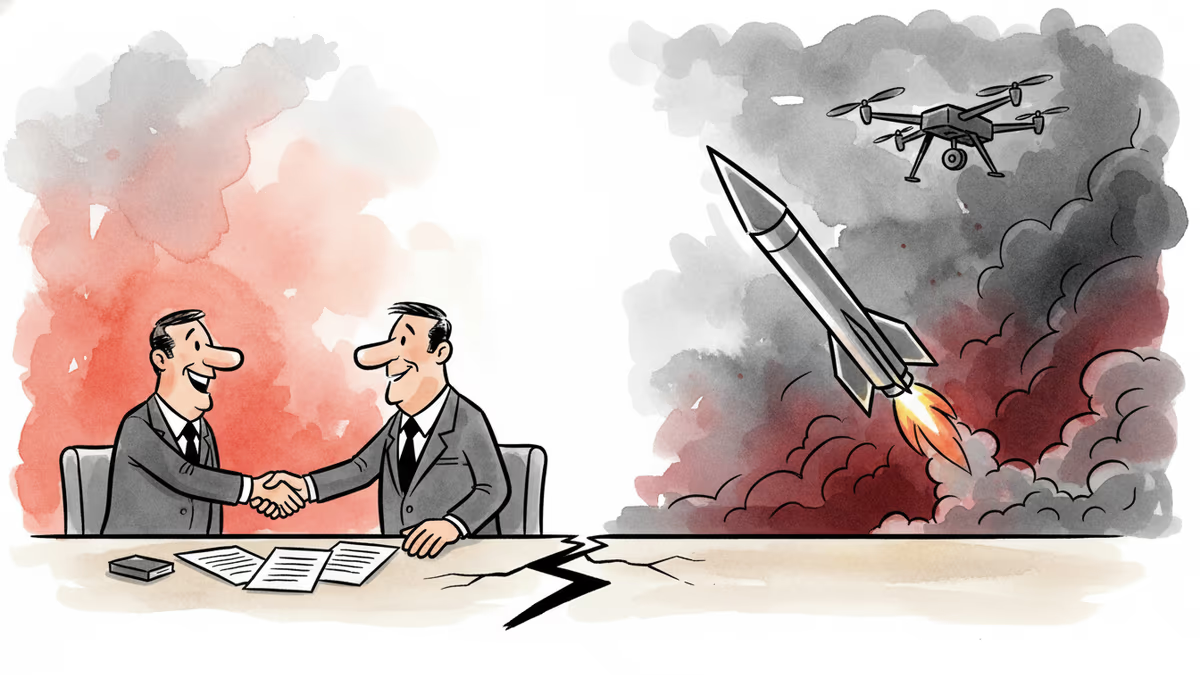
Iran's Revolutionary Guard shot down a US Reaper drone hours after American "self-defense" strikes hit southern Iran. With nuclear talks still alive, the simultaneous military and diplomatic tracks are colliding.

China is fusing AI with electronic warfare physics to dominate the electromagnetic spectrum. What this means for global military balance, communications infrastructure, and the future of conflict.
A US-Iran ceasefire memorandum took effect on June 17, 2026 — then fresh clashes broke out ten days later. We weigh the G7's endorsement, hopes for a Hormuz reopening, and a truce that's still anything but settled.
Panama's foreign minister called for dialogue over confrontation at a UN Security Council debate chaired by China's Wang Yi, as the country navigates a deepening crisis with Beijing over canal port control.
Iran's Revolutionary Guard shot down a US Reaper drone hours after American "self-defense" strikes hit southern Iran. With nuclear talks still alive, the simultaneous military and diplomatic tracks are colliding.
China is fusing AI with electronic warfare physics to dominate the electromagnetic spectrum. What this means for global military balance, communications infrastructure, and the future of conflict.
Thoughts
Share your thoughts on this article
Sign in to join the conversation