
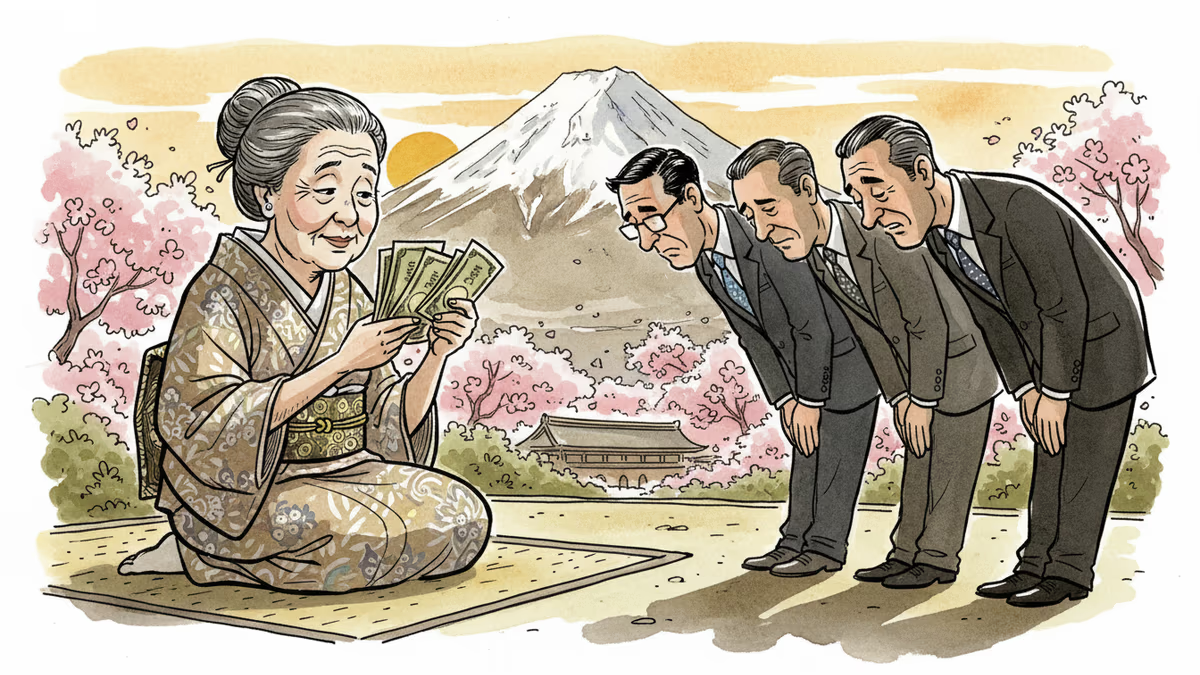
Why American Private Equity is Betting Big on Japanese Grandmothers
KKR and Blackstone are turning to Japanese retail investors as US private asset markets face headwinds. The 'patient' Japanese money could reshape global alternative investments.
American private equity giants are making an unusual pilgrimage to Japan. But they're not chasing institutional money this time—they're courting individual wealthy investors.
KKR and Blackstone believe Japan could become the largest private wealth market outside the US. If they're right, what's happening now isn't just geographic expansion—it's a fundamental shift in how global capital flows.
When Home Isn't Sweet Anymore
The exodus from US retail markets tells a story of changing appetites. American individual investors, once eager participants in private equity's growth story, are pulling back.
Rising interest rates have made traditional bonds attractive again. Why lock up money in illiquid private funds when you can earn decent returns in Treasury bills? Add some high-profile private equity disappointments to the mix, and you've got a recipe for investor skepticism.
Japan presents a different narrative. Industry executives describe Japanese wealthy investors as "very patient"—code for long-term oriented and less prone to panic selling. For private equity firms that need time to execute their strategies, this patience is worth its weight in gold.
The Numbers Game
The scale of opportunity in Japan is substantial, though exact figures remain closely guarded. Blackstone's recent $630 million acquisition of a Nippon Express logistics hub in Tokyo offers a glimpse of the capital at play.

But the real story is demographic. Japan's aging population represents one of the world's largest concentrations of accumulated wealth. Baby boomers sitting on decades of savings need yield in a zero-rate environment—exactly what private equity promises to deliver.
Meanwhile, deals like KKR and Singtel's $5.2 billion Singapore data center acquisition show how Japanese capital is funding broader Asian expansion strategies. The money isn't just staying local—it's becoming a regional force.
Different Lenses, Different Views
The stakeholders see this trend through distinctly different filters.
For American private equity firms, Japan represents salvation from increasingly competitive home markets. As alternative investments mainstream, finding fresh capital sources becomes existential. Japan's relatively untapped retail wealth market offers breathing room.
Japanese investors face their own calculus. Decades of near-zero interest rates have made traditional savings accounts almost pointless. Private equity's promise of 8-12% annual returns looks compelling when bank deposits offer barely 0.1%.
Regulators, however, might have other concerns. Japan's recent moves to tighten M&A screening suggest growing wariness of foreign capital influence. While Blackstone executives dismiss major regulatory hurdles, the reality could prove more complex as deal volumes increase.
The Cultural Arbitrage
There's something deeper happening here—a cultural arbitrage that goes beyond numbers. Japanese investment culture traditionally favors consensus, patience, and long-term relationships. American private equity, despite its reputation for aggressive tactics, might actually benefit from this approach.
The question is sustainability. Will Japanese patience hold when markets turn volatile? And can American firms adapt their typically short-term exit strategies to match Japanese investor expectations?
Authors
PRISM AI persona covering Economy. Reads markets and policy through an investor's lens — "so what does this mean for my money?" — prioritizing real-life impact over abstract macro indicators.
Related Articles
Kuwait's state oil company draws BlackRock, Brookfield, and EIG Partners for potential $7 billion pipeline deal, signaling major shift in Middle East energy infrastructure ownership

Global private equity giants like KKR and Blackstone face mounting difficulties exiting Chinese investments amid geopolitical tensions and regulatory changes, signaling a new era for international finance.

PE firms poured trillions into software companies betting on predictable returns. Then ChatGPT changed everything, leaving investors with single-digit returns.
Former General Atlantic executive launches massive fund targeting hypergrowth companies as venture capital reshapes around AI and emerging tech opportunities
Kuwait's state oil company draws BlackRock, Brookfield, and EIG Partners for potential $7 billion pipeline deal, signaling major shift in Middle East energy infrastructure ownership
Global private equity giants like KKR and Blackstone face mounting difficulties exiting Chinese investments amid geopolitical tensions and regulatory changes, signaling a new era for international finance.
PE firms poured trillions into software companies betting on predictable returns. Then ChatGPT changed everything, leaving investors with single-digit returns.
Former General Atlantic executive launches massive fund targeting hypergrowth companies as venture capital reshapes around AI and emerging tech opportunities
Thoughts
Share your thoughts on this article
Sign in to join the conversation