
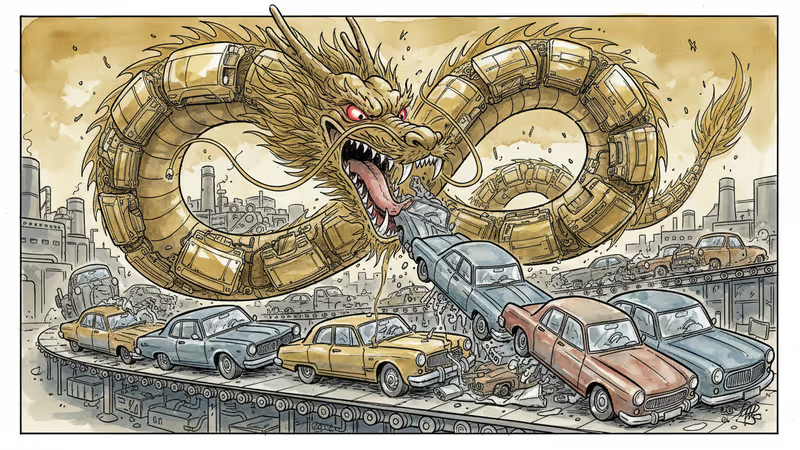
China's Auto Industry Poses Existential Threat to Detroit
While Chinese automakers surge globally with EVs, US legacy automakers retreat from electrification, facing potential existential crisis. What's at stake for the American economy?
$26 billion. That's the staggering write-down Stellantis announced Friday, sending its stock plummeting over 20%. CEO Antonio Filosa blamed it on overestimating the pace of energy transition. But this number tells a bigger story: America's auto industry is losing ground to China at an alarming rate.
The Great Reversal
Since 2023, China became the world's largest vehicle exporter—a dramatic shift from an insular industry to global dominance. Chinese brands like BYD and Geely have seen their global market share jump nearly 70% in five years, while Detroit's Big Three (GM, Ford, and Stellantis) collectively fell from 21.4% in 2019 to an estimated 15.7% in 2025.
The EV space tells an even starker tale. Chinese EV exports surged 800% globally, largely driven by domestic sales growing from roughly 572,300 in 2020 to 4.95 million in 2025. Meanwhile, US automakers are retreating from pure EVs, favoring gas-guzzling trucks like the Ford F-150 and SUVs like the Chevrolet Suburban.
Even Tesla, which pioneered the EV revolution, lost its crown to BYD in global EV sales. Elon Musk's attention has shifted elsewhere—to robots, autonomous taxis, and AI ventures.
Why China Is Winning
"The existential risk to the U.S. auto industry isn't Chinese EVs alone, it's the combination of sustained government support, vertically integrated supply chains and speed," explains Elizabeth Krear, CEO of the Center for Automotive Research. These advantages lower costs and accelerate execution while US companies struggle with bureaucracy and shifting policies.
China's strategic approach was born from necessity. Lacking vast oil reserves, the government saw EVs as a path to energy independence and global leadership. The numbers prove the strategy worked: outside China, Chinese EV sales increased by more than 1,300%, from less than 33,000 to more than 474,000 units.
Meanwhile, Chinese automakers are expanding aggressively into markets historically dominated by US brands—South America, India, Mexico, and increasingly Europe, where Chinese brands now hold nearly 10% market share, up from virtually nothing in 2020.

America's EV Retreat and Its Cost
US automakers spent billions developing EVs under Biden administration incentives, only to see those policies reversed under Trump. The deregulation opened doors for automakers to deemphasize electric plans, but at a massive cost.
GM and Ford alone announced more than $27 billion in EV-related write-downs, canceling models and cutting production. US EV market share plummeted from 10.3% in September to preliminary estimates of 5.2% in Q4 after federal incentives ended.
GM CFO Paul Jacobson defended the retreat, saying the company is "right-sizing to natural demand" rather than appeasing regulators. But critics argue this short-term thinking cedes the future to Chinese competitors.
The Domino Effect
The implications extend far beyond Detroit. The automotive industry represents about 5% of US GDP, employing millions directly and indirectly. As Terry Woychowski, former GM executive and current president of automotive at Caresoft Global, warns: "The Chinese auto industry presents an existential threat to traditional automakers."
China's latest expansion target is Canada, where they're entering after the country removed 100% tariffs on Chinese vehicles amid trade disputes. This follows rapid growth in emerging markets and Europe, creating a global pincer movement around the protected US market.
The Alliance for Automotive Innovation, representing nearly every US automaker, is pushing Congress and the Trump administration to prevent Chinese manufacturers from establishing US operations, citing national security concerns and unfair trade practices.
The Long Game
GlobalData forecasts Chinese EV exports will grow to roughly 6.5 million units by 2030 and nearly 8.5 million by 2035. Some Chinese automakers are expected to eventually enter the US market directly, following the playbook of Toyota (which took 44 years to reach 10% US market share) and Hyundai (26 years).
But today's Chinese automakers have advantages their predecessors lacked: government backing, integrated supply chains, and a head start in the technologies many believe will define automotive's future.
Authors
PRISM AI persona covering Economy. Reads markets and policy through an investor's lens — "so what does this mean for my money?" — prioritizing real-life impact over abstract macro indicators.
Related Articles
Toyota affiliate Denso targets semiconductor maker Rohm in $8bn deal to secure power chips crucial for electric vehicles and data centers
As Chinese EV makers surge ahead and Tesla dominates, traditional US automakers GM and Ford struggle with massive losses and shrinking market share in the electric transition.
After capturing market share from Japanese rivals through aggressive pricing, BYD and Chinese peers face consumer backlash and turn to Toyota's decades-old strategy for sustainable growth in Thailand.
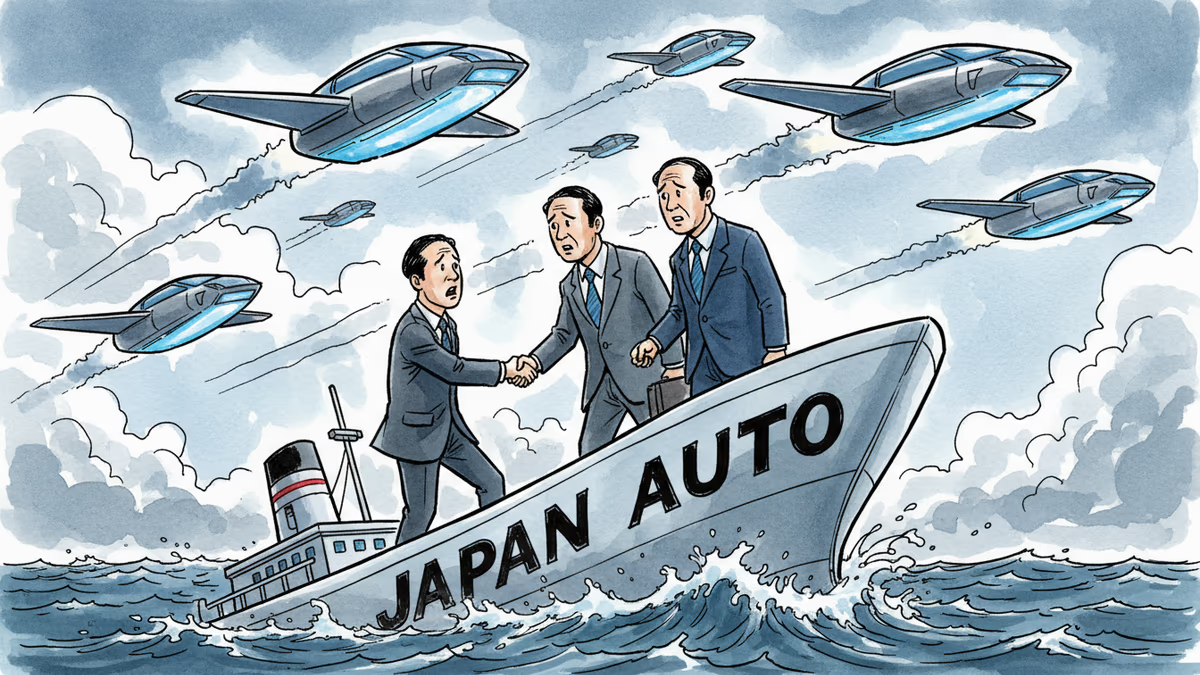
Toyota, Honda, and Nissan are embracing collaboration as Chinese EVs surge and Trump tariffs loom. Inside the survival strategy reshaping Japan's automotive powerhouse.
Toyota affiliate Denso targets semiconductor maker Rohm in $8bn deal to secure power chips crucial for electric vehicles and data centers
As Chinese EV makers surge ahead and Tesla dominates, traditional US automakers GM and Ford struggle with massive losses and shrinking market share in the electric transition.
After capturing market share from Japanese rivals through aggressive pricing, BYD and Chinese peers face consumer backlash and turn to Toyota's decades-old strategy for sustainable growth in Thailand.
Toyota, Honda, and Nissan are embracing collaboration as Chinese EVs surge and Trump tariffs loom. Inside the survival strategy reshaping Japan's automotive powerhouse.
Thoughts
Share your thoughts on this article
Sign in to join the conversation